
Anti-Vibration Mounts for Industrial Machinery: Design, Material and Manufacturing Considerations
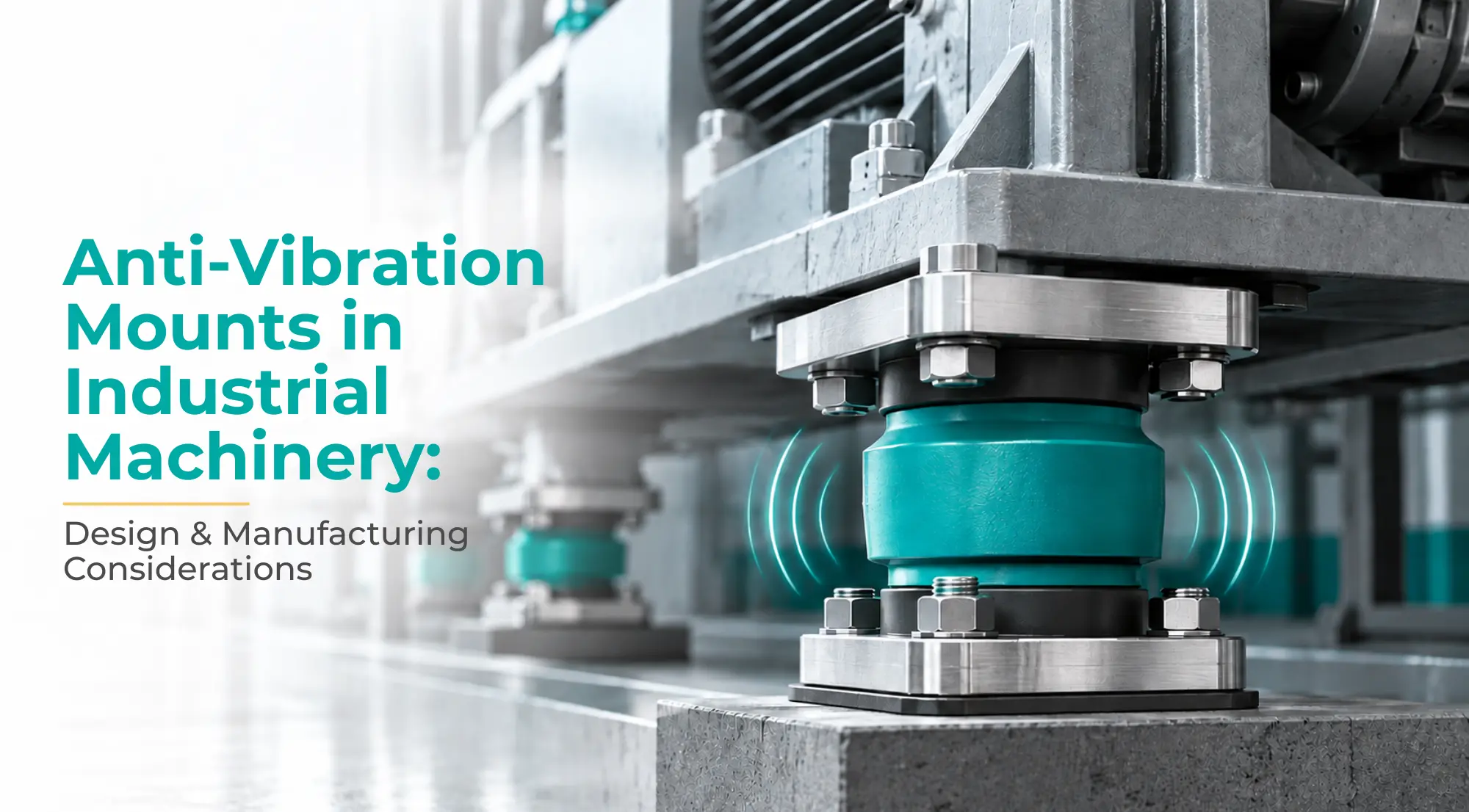


Industrial machinery rarely operates without generating vibration. Motors, pumps, compressors, fans, generators and other rotating equipment produce dynamic forces that can travel through mounting points into machine frames, foundations and connected equipment. If these forces are not managed properly, they can contribute to noise, fastener loosening, fatigue, premature component wear and reduced equipment reliability.
Anti-vibration mounts provide a controlled interface between the machine and its supporting structure, helping reduce the transmission of vibration and shock. However, selecting an effective mount is not simply a matter of choosing a rubber mount with sufficient load capacity. Load distribution, operating frequency, static deflection, stiffness, mount geometry, rubber compound, environmental conditions and manufacturing consistency all influence performance.
For industrial applications, the mount needs to be considered as part of the complete machine-support system. This article explains the key design and manufacturing considerations for anti-vibration mounts, from load and frequency requirements to material selection, inspection and production quality.
What Are Anti-Vibration Mounts and How Do They Work?
An anti-vibration mount is a mechanical component positioned between equipment and its supporting structure to reduce the transmission of vibration and dynamic forces. Rubber and other elastomeric materials are commonly used because they can deform under load while providing resilience and damping.
A typical rubber vibration mount combines an elastomeric element with metal components such as plates, bushes, studs or inserts. The elastomer provides the resilient and damping element, while the metal components provide the mounting interface and transfer loads through the assembly.
A mounted machine can be considered as a mass-spring-damper system. The equipment provides the mass, the mount supplies stiffness and the elastomer contributes damping. The resulting natural frequency and transmissibility determine how much vibration is passed to the supporting structure.
The effectiveness of a vibration isolation mount depends on how the mount’s stiffness and natural frequency relate to the vibration produced by the machine. If the mounting system is designed appropriately, the mount can reduce the amount of vibratory energy transmitted to the supporting structure.
Natural Frequency and Excitation Frequency
One of the basic parameters in vibration isolation is the relationship between the machine’s excitation frequency and the natural frequency of the mounted system.
For rotating machinery, the basic excitation frequency can be estimated from operating speed:
Excitation frequency (Hz) = RPM ÷ 60
For example, a machine operating at 1,500 RPM has a fundamental rotational frequency of approximately 25 Hz. The mount and supported equipment have their own dynamic characteristics, so the relationship between these frequencies needs to be considered when selecting or designing an anti-vibration mount for industrial machinery.
If the machine’s excitation frequency is close to the mounting system’s natural frequency, vibration may be amplified rather than reduced. The design must therefore consider start-up, shutdown and variable-speed operation not only the normal running speed.
Simply increasing rubber hardness does not automatically improve vibration isolation. The mount needs to provide the appropriate stiffness, deflection and damping characteristics for the operating conditions.
Understanding the Key Design Parameters of Anti-Vibration Mounts
The performance of an industrial vibration mount depends on several interconnected design parameters. Evaluating these factors together helps prevent problems such as excessive movement, insufficient isolation or premature mount failure.
1. Load Per Mount
The total machine weight is only the starting point for selecting a mount. The actual load carried by each mounting point also needs to be considered.
Load distribution can be affected by:
- Total equipment weight
- Number of mounting points
- Centre of gravity
- Mounting-point location
- Uneven equipment geometry
- Dynamic operating loads
For example, four mounts supporting a machine do not necessarily experience exactly one-quarter of the machine weight each. A machine with an offset centre of gravity can place significantly different static loads on individual mounting points. Therefore, load per mount should be established before specifying the required mount capacity.
2. Operating Speed and Excitation Frequency
Machine operating speed directly influences the frequency of the forces generated by rotating components. Pumps, motors, compressors and fans can also produce additional excitation frequencies depending on their operating characteristics.
The mount selection should therefore consider:
- Normal operating RPM
- Start-up and shutdown conditions
- Variable-speed operation
- Dominant excitation frequencies
- Potential resonance conditions
A mount that performs adequately at one operating speed may behave differently when the machine operates across a wider speed range.
3. Static Deflection
Static deflection describes how much the mount deforms under the supported load before considering additional dynamic movement.
It is closely related to mount stiffness and the natural frequency of the supported system. A mount with very high stiffness may provide strong support but transmit more vibration, while a softer mount may provide greater isolation but allow excessive movement.
The required static deflection therefore needs to be considered together with the machine’s operating conditions rather than treated as an isolated specification.
For a simple vertical isolation system, a commonly used approximation is:
fₙ ≈ 15.8 / √δ
where:
- fₙ is the natural frequency in Hz.
- δ is the static deflection in millimetres.
This relationship is an approximation for an idealised system rather than a universal mount-selection formula. It helps illustrate why a softer mount with greater static deflection can provide a lower natural frequency, while also allowing greater movement.
4. Mount Stiffness
A vibration mount does not necessarily have the same stiffness in every direction. Depending on its geometry and construction, a mount can behave differently under:
- Compression
- Shear
- Radial loading
- Axial loading
- Torsional movement
This directional behaviour becomes particularly important for machinery that generates both vertical and lateral forces. For example, a mount designed primarily for vertical compression may not provide the same level of control when subjected to significant horizontal or shear loads.
5. Damping and Resonance Control
Damping influences how strongly the system responds near resonance and how quickly movement decays after a disturbance. Higher damping can reduce resonance amplification, but excessive damping may reduce isolation at some operating frequencies.
The appropriate balance depends on whether the priority is vibration isolation, movement control, shock absorption or resonance suppression. Damping should therefore be considered alongside stiffness and natural frequency rather than treated as an independent material property.
6. Shock and Dynamic Loads
Industrial equipment can experience more than continuous vibration. Start-stop cycles, sudden changes in operating conditions, impact and transient loads can place additional demands on the mounting system.
The design should therefore distinguish between:
- Continuous vibration
- Cyclic loading
- Start-up loads
- Shutdown loads
- Shock or impact loading
A mount designed only around the machine’s static weight may not be adequate when substantial dynamic or shock loads are present.
7. Mount Geometry and Load Direction
The geometry of an anti-vibration rubber mount influences how the elastomer deforms and how loads are transferred through the component.
Factors such as:
- Rubber thickness
- Mount diameter
- Insert position
- Bonded area
- Load direction
- Available installation space
can affect the mount’s stiffness, deflection and stability.
This is why the physical geometry of the mount should be developed around the actual application rather than selecting a component based only on its nominal load rating.
How Does Material Selection Affect Mount Performance?
Elastomer selection should be based on the complete mechanical and environmental duty cycle. The same nominal hardness can produce different performance characteristics depending on the compound, temperature and loading conditions.
Material selection should also consider operating temperature, oil and fuel exposure, ozone and UV exposure, water and humidity, chemical exposure, compression set, fatigue resistance, dynamic stiffness, hardness change over time and compatibility with cleaning agents.
Hardness should not be treated as a direct substitute for dynamic stiffness. The dynamic response of an elastomer can also vary with compound formulation, frequency, temperature and loading conditions.
- Natural Rubber: Natural rubber can provide good resilience and dynamic performance, making it useful where repeated deformation and vibration isolation are important.
- Nitrile Rubber: It can be considered for applications where exposure to oils or petroleum-based fluids is an important operating condition.
- EPDM: It is commonly considered where resistance to weathering, ozone and moisture is important.
- Neoprene: It provides a balance of mechanical and environmental properties and can be considered for various industrial applications.
The correct compound should be selected based on both mechanical requirements and environmental exposure. Rubber hardness alone should not be used as the only criterion for material selection because different compounds and formulations can have different performance characteristics.
How Are Anti-Vibration Mounts Manufactured?
Design specifications alone do not guarantee consistent mount performance. Manufacturing processes need to maintain the specified geometry, stiffness and bonding characteristics of an anti-vibration mount.
1. Precision Metal Insert Manufacturing: Metal inserts need to meet specified dimensional and positional requirements because they form the mounting interface between the component and the machine. Dimensional variation can affect mounting alignment, load transfer and assembly.
2. Rubber Geometry and Moulding: The mould determines critical features such as rubber thickness, profile, insert location and overall dimensions. Consistent moulding conditions help maintain repeatability between production batches.
3. Bonding Consistency: Where rubber is bonded to metal, surface preparation, bonding-agent application and controlled processing are important for consistent bond integrity.
4. Cure Control: The curing process affects the final properties of the elastomer. Variations in curing conditions can contribute to differences in hardness, resilience and overall component behaviour.
5. Dimensional Inspection:
Depending on the design, inspection may include:
- Overall dimensions
- Insert position
- Concentricity
- Mounting-hole or thread dimensions
- Rubber thickness
- Critical tolerances
For OEM production, controlling these characteristics helps maintain consistency across repeated production runs.
6. Functional Validation and Testing:
Depending on the application, validation may include:
- Shore hardness testing
- Load-deflection testing
- Static stiffness measurement
- Dynamic stiffness measurement
- Bond integrity testing
- Fatigue or cyclic loading
- Environmental ageing
- Visual inspection
- Cure verification
What Should Be Considered During Mount Installation?
Even a correctly designed anti-vibration mount can perform poorly if it is installed incorrectly. The mounting arrangement should maintain the intended load path and allow the mount to deform as designed without introducing unintended constraints.
Key installation considerations include:
- Correct orientation
- Proper tightening torque
- Flat and clean mounting surfaces
- Avoidance of pre-compression or unintended side loading
- Adequate clearance for movement
- Alignment of mounting holes and inserts
- Restraints where excessive movement is possible
- Correct support height across all mounts
- Avoidance of short-circuiting the isolation path through rigid brackets, pipes or cables
Connected piping, cables or rigid brackets can create an alternative vibration path and transmit vibration directly to the supporting structure, reducing the effectiveness of the isolation system.
How Do You Select the Right Anti-Vibration Mount?
Selecting an industrial anti-vibration mount requires more than matching the equipment weight with a catalogue load rating. The mounting system should be evaluated according to the machine’s operating conditions and the environment in which the mount will work.
| Application Condition | Key Factors to Evaluate |
|---|---|
| Heavy machinery | Load per mount, centre of gravity, static deflection and stability |
| High-speed rotating equipment | Operating speed, harmonics, natural frequency and damping |
| Variable-speed equipment | Start-up, shutdown and resonance-crossing behaviour |
| Significant lateral movement | Shear stiffness, radial stiffness and movement limits |
| Shock or impact loading | Peak load, energy absorption and fatigue resistance |
| Oil or fuel exposure | Elastomer compatibility and swelling resistance |
| Outdoor equipment | Ozone, UV, moisture and weather resistance |
| High-temperature operation | Temperature capability and stiffness change |
| Precision equipment | Stability, low drift, repeatability and dimensional control |
The correct vibration isolation mount is therefore the one whose mechanical and material characteristics match the complete application.
Anti-Vibration Mount Manufacturing at Schilthorn Precision
With 15+ years of engineering experience, Schilthorn Precision manufactures rubber-to-metal bonded components for vibration isolation, cushioning, sealing and secure load transfer. Our capabilities include precision metal insert manufacturing, application-specific rubber compound selection, moulding, rubber-to-metal bonding and inspection.
For custom anti-vibration mounts, the design process can be developed around the required load, mounting geometry, directional stiffness, operating environment and production requirements. The focus is on dimensional consistency, reliable rubber-to-metal integration and repeatable OEM production.
Looking for custom anti-vibration mounts for your application? Contact Schilthorn Precision to discuss your requirements.
Frequently Asked Questions
1. Can anti-vibration mounts be used for machines with uneven load distribution?
Yes, but the individual load carried by each mounting point needs to be considered. The centre of gravity and mounting-point locations can create different loads across the mounts.
2. Why does a machine still vibrate after anti-vibration mounts are installed?
Mounts reduce transmitted vibration; they do not necessarily eliminate vibration generated by the machine itself. Incorrect mount selection, resonance, uneven loading, poor installation or excessive dynamic forces can also affect isolation performance.
3. Can anti-vibration mounts be installed horizontally?
Some mount designs can accommodate horizontal, shear or combined loading, but suitability depends on the mount geometry and its directional stiffness. The expected load direction should be considered during selection.
4. How often should anti-vibration mounts be inspected?
Inspection frequency depends on the equipment, operating environment, loading and service conditions. Mounts exposed to high cyclic loads, oil, chemicals, temperature extremes or outdoor conditions may require more frequent inspection.
5. What causes an anti-vibration mount to crack or separate from its metal insert?
Possible contributing factors include overload, excessive deformation, fatigue, unsuitable elastomer selection, environmental exposure and problems with the rubber-to-metal bonding process.
6. Can anti-vibration mounts be customized for a specific machine?
Yes. Mount geometry, metal insert configuration, elastomer selection, stiffness and mounting dimensions can be developed around application requirements, subject to the manufacturer’s design and manufacturing capabilities.
7. What happens if an anti-vibration mount is underloaded?
An underloaded mount may not operate within its intended deflection and stiffness range. This can affect the dynamic behaviour of the mounting system, so the actual load per mount should be considered during selection.
8. How do I know whether rubber or spring isolation is suitable for my machine?
The decision depends on factors such as load, operating frequency, required isolation, static deflection, damping, available space and environmental conditions. These parameters should be evaluated together rather than selecting an isolation system based on load alone.