
Threaded Inserts Guide: Types, Uses & Installation Tips
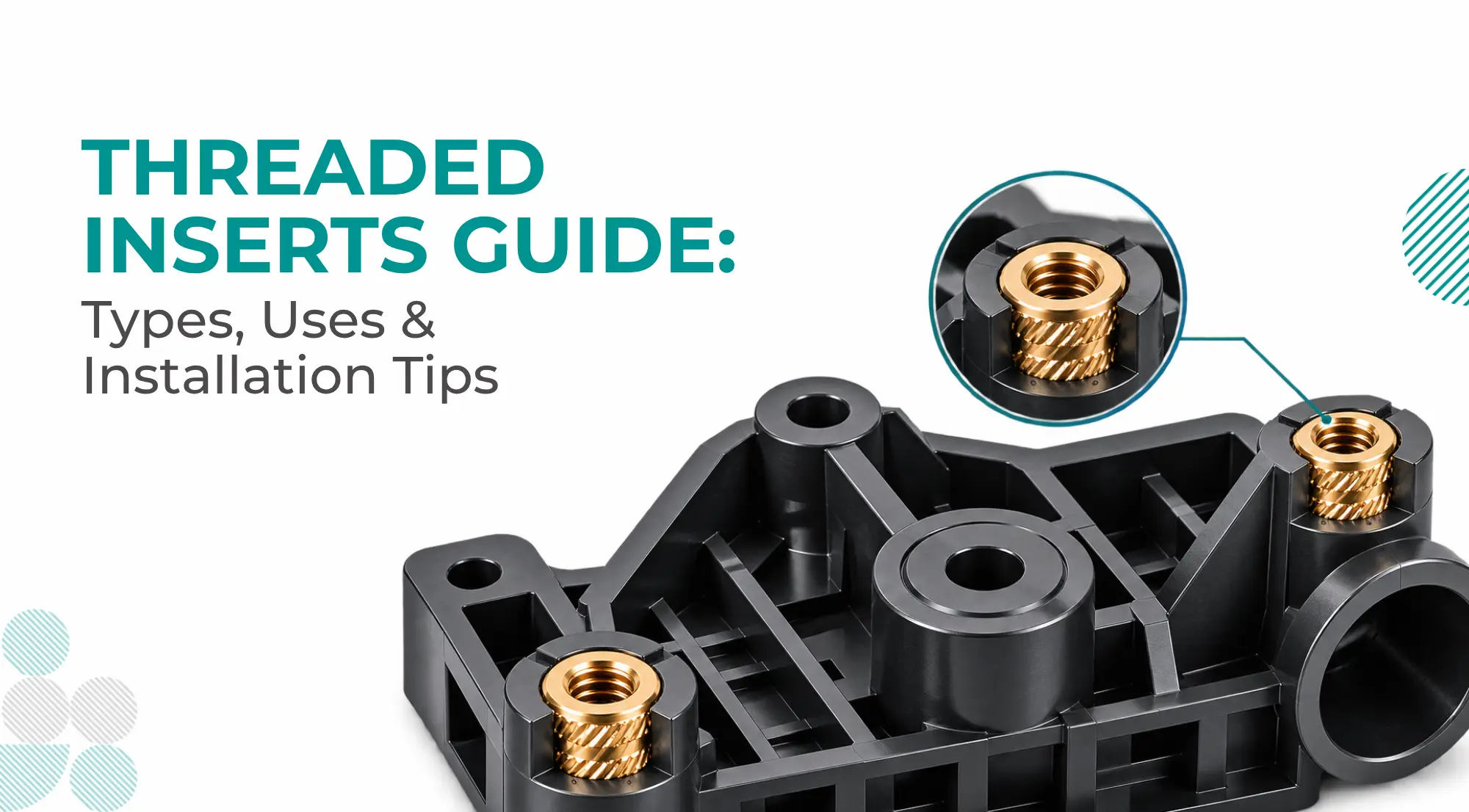


When a component is made from plastic, thin-wall metal, CPVC or another material with limited thread strength, creating a durable threaded connection can be challenging. A directly tapped thread may not provide the required durability for repeated fastening, particularly where screws or bolts need to be removed and reinstalled during servicing or assembly.
A threaded insert provides an alternative by creating a dedicated threaded interface within the parent material. The insert takes the fastening load while its external features help retain it within the component.
However, selecting the right threaded insert involves more than matching the fastener thread. Parent material, thread specification, insert geometry, retention method, installation process, wall thickness, load requirements and production volume all need to be considered together. The right combination helps ensure that the insert remains secure and the finished connection performs as intended.
What Is a Threaded Insert?
A threaded insert is a component installed into a parent material to provide or reinforce a threaded fastening point. It typically has an internal thread that accepts a screw, bolt or other fastener, while its external geometry is designed to retain the insert within the surrounding material.
The internal thread provides the fastener interface, while features such as knurling, external threads, grooves or other profiles provide mechanical retention within the parent material.
This makes threaded inserts useful when the parent material is too soft, thin or susceptible to thread wear to reliably support the required fastening connection on its own.
Why Are Threaded Inserts Used?
Threaded inserts are used when a directly machined or moulded thread cannot provide the required thread performance, serviceability or fastening reliability for the application.
- Improve Thread Strength and Durability: Plastic and other softer materials may not provide sufficient resistance to thread wear, particularly when fasteners are tightened and loosened repeatedly. A threaded insert provides a dedicated internal thread that is better suited to the fastening requirement.
- Support Repeated Assembly and Disassembly: Components that require servicing or replacement may be assembled and disassembled several times during their service life. Using an insert helps maintain a consistent threaded interface instead of repeatedly engaging the fastener with the parent material.
- Create Threads in Thin-Wall Components: Thin sections may not provide enough material for adequate thread engagement when a thread is formed directly into the component. A suitably designed insert can provide the required threaded interface within the available space.
- Reduce Damage to Plastic or Soft Materials: Direct fastening into soft materials can result in thread deformation or wear when the connection is repeatedly loaded. An insert separates the fastening thread from the parent material, reducing dependence on the surrounding material for thread integrity.
- Provide a Controlled Fastening Point: Threaded inserts can be incorporated into moulded components, housings, fittings and other parts where a defined fastening location is required. This allows the thread specification and fastening interface to be controlled independently of the surrounding component material.
- Support Thread Repair: Helical thread inserts can restore damaged or stripped threaded holes by creating a new internal thread within a prepared hole. This can provide an alternative to replacing the entire component when the surrounding material remains suitable for repair.
Types of Threaded Inserts
Threaded inserts are available in several designs, each intended for a particular parent material, loading condition and installation requirement. Although all of them provide a threaded connection, their external geometry, retention mechanism and installation process can differ significantly. Selecting the right insert therefore depends on whether the application requires thread reinforcement, thread repair, high pull-out resistance, anti-rotation performance or a reusable fastening point.
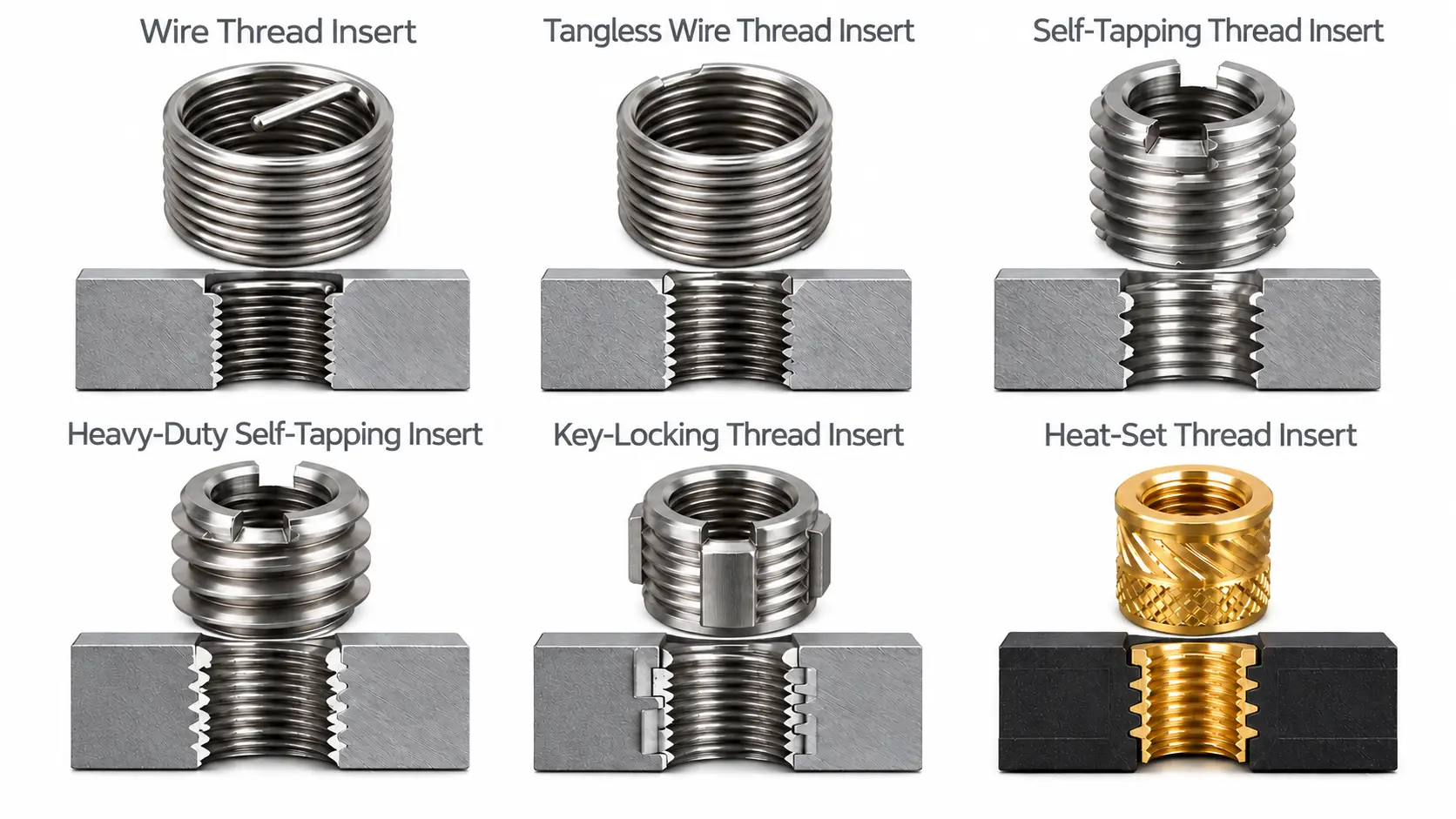
1. Wire Thread Inserts
Wire thread inserts, also called helical thread inserts, are made from precision-formed wire wound into a helical shape. Once installed, the insert provides a new internal thread within the parent material and allows the original fastener size to be retained.
A wire thread insert is installed into a specially prepared hole rather than directly into a standard tapped hole. The receiving hole is first drilled or prepared to the required diameter and then tapped using the appropriate STI (Screw Thread Insert) tap. The STI thread provides the external thread profile required to accommodate the insert, while the insert’s internal thread matches the final fastener specification.
For example, when an application requires an M6 × 1.0 fastener, the receiving hole is prepared according to the specified STI dimensions rather than simply tapping a standard M6 × 1.0 thread. After installation, the wire insert provides the required M6 × 1.0 internal thread for the mating screw.
This distinction is important during manufacturing and repair because incorrect hole preparation or tapping can prevent the insert from seating correctly and can affect the final thread quality.
Wire thread inserts are commonly used when a threaded connection needs reinforcement in materials such as aluminium and other relatively soft metals. They can also be used to restore stripped or damaged threads without replacing the complete component.
Typical applications include:
- Aluminium housings and mounting plates
- Motor and actuator housings
- Sensor brackets
- Fixture and tooling plates
- Lightweight machine components
- Frequently serviced threaded joints
- Thread repair in damaged metal components
Because the insert creates a durable internal thread while retaining the original fastener size, it is particularly useful where a component will undergo repeated assembly and disassembly.
2. Tangless Wire Thread Inserts
Tangless wire thread inserts use the same basic helical principle as conventional wire inserts but eliminate the installation tang. In a conventional tang-type insert, the tang is used to drive the insert into the prepared hole and is then removed after installation. A tangless design eliminates this additional removal operation.
This can be beneficial in applications where access is restricted, where the finished assembly must remain free from loose metal fragments, or where the extra step of tang removal is undesirable.
Tangless inserts can be considered for blind holes, compact housings, precision mechanical assemblies and equipment where maintenance access is limited. Their suitability still depends on the hole geometry, installation tooling and required thread performance.
3. Self-Tapping Thread Inserts
Self-tapping thread inserts are solid inserts designed with external cutting or forming features that engage with the parent material during installation. Unlike inserts that require a separately tapped external thread, a self-tapping design can create its own engagement within a suitably prepared hole.
They are used in materials where the surrounding material may not provide sufficient thread strength for direct fastening. Applications can include aluminium, softer metals, engineering plastics and components requiring thread repair or reinforcement.
The pilot-hole diameter is particularly important. If the hole is too small, installation torque can increase excessively and may damage the component or insert. If the hole is too large, the insert may not develop sufficient engagement with the surrounding material.
Depending on the insert design, external cutting features may take the form of slots, cutting edges or other geometries intended to penetrate or form the parent material.
Typical applications include:
- Aluminium components
- Cast metal parts
- Plastic housings
- Fixture and tooling plates
- Thread repair applications
- Prototype machine components
- General mechanical assemblies
Installation should be carried out with appropriate alignment and controlled torque to achieve consistent seating and retention.
4. Heavy-Duty Self-Tapping Inserts
Heavy-duty self-tapping inserts are designed for applications where a standard self-tapping insert may not provide the required level of mechanical engagement. Their external geometry and larger engagement area are intended to provide higher resistance to loads acting on the installed insert.
These inserts can be used in machine components, fixture plates, actuator supports, brackets and other assemblies where the threaded connection is exposed to higher fastening loads or repeated service.
However, the performance of a heavy-duty insert is not determined by the insert alone. The strength, thickness and condition of the parent material also influence pull-out resistance and torque-out performance. An appropriately selected insert must therefore be matched with a suitable hole diameter and sufficient surrounding material.
5. Key-Locking Thread Inserts
Key-locking thread inserts are solid threaded inserts that incorporate external locking keys. After the insert is positioned in the prepared hole, the keys are driven into the surrounding material to mechanically lock the insert against rotation.
This locking mechanism is particularly useful where repeated tightening, loosening or vibration could otherwise cause the insert to rotate within the parent material.
Key-locking inserts are commonly considered for thread repair and reinforcement in metal components, especially aluminium and cast materials. They can be used for machine bases, fixture plates, equipment housings, maintenance components and other fastening points where anti-rotation performance is important.
Installation generally requires accurate hole preparation followed by insertion and setting of the locking keys. The hole dimensions, insert size and installation procedure need to follow the manufacturer’s specifications to ensure that the locking features engage correctly.
6. Heat-Set Threaded Inserts
Heat-set threaded inserts are primarily used in thermoplastic components, including injection-moulded and 3D-printed parts. Unlike mechanical inserts that rely mainly on interference or cutting features, heat-set inserts use controlled heat to soften the surrounding plastic during installation.
The heated insert is positioned over a prepared hole and pressed into the component. As the insert enters the softened thermoplastic, the material flows around its external features. Once the heat is removed and the plastic cools, the material solidifies around the insert and provides mechanical retention.
The installation temperature needs to be appropriate for the insert material and the thermoplastic being used. Excessive heat can deform the surrounding component, while insufficient heat may prevent proper seating and material flow around the insert.
Heat-set threaded inserts are commonly used in:
- 3D-printed components
- Electronic housings
- Sensor and control enclosures
- Plastic brackets
- Robot and automation prototypes
- Actuator covers
- Cable-management components
- Plastic test fixtures
They are particularly useful when a plastic component requires a reusable metal thread for repeated fastening. Instead of relying on the plastic itself to withstand repeated screw engagement, the insert provides a dedicated threaded interface that can improve assembly durability.
Threaded Insert Installation Methods
The installation method used for a threaded insert depends on the insert design, parent material, component geometry and required retention. Some inserts are pressed into a prepared hole, while others are installed by cutting, heating, vibration or deformation of the surrounding material. Proper hole preparation and process control are important in each method to achieve consistent positioning and reliable thread performance.
1. Press-Fit Installation
Press-fit installation uses controlled axial force to install a threaded insert into a prepared hole. The insert is retained by interference between its external diameter or retention features and the surrounding material. Depending on the insert design, external knurling, ribs or other surface features may increase mechanical engagement with the parent material.
The hole diameter and tolerance are critical to the process. An oversized hole can reduce the interference required for reliable retention, while an undersized hole can increase insertion force and potentially deform or crack the surrounding material.
Press-fit installation is commonly used for rigid plastic components, metal parts and other assemblies where the parent material can withstand the required insertion force. For applications involving repeated fastening, both resistance to pull-out and resistance to rotation should be considered during insert and hole design.
2. Self-Tapping Installation
Self-tapping installation is used with threaded inserts that have an external cutting or forming profile. The insert is rotated into a correctly prepared pilot hole, allowing its external features to cut or form engagement with the surrounding material.
The pilot-hole diameter must be selected according to the insert design and parent material. If the hole is too small, installation torque may become excessive and damage the component or insert. If it is too large, the insert may not achieve sufficient engagement with the surrounding material.
During production, controlled alignment and installation torque help ensure consistent seating and reduce the risk of thread damage, insert misalignment or variation in final retention.
3. Heat-Set Installation
Heat-set installation uses controlled heat and pressure to embed the insert into a prepared hole. The heated insert softens the surrounding thermoplastic as it enters the component, allowing the material to flow around the external retention features.
After the insert reaches the specified depth, the material cools and solidifies around it. Temperature, insertion depth, pressure and alignment need to be controlled to achieve consistent retention.
Excessive heat or force can deform the component, while insufficient heat may prevent adequate material flow. The boss diameter and surrounding wall thickness should therefore be considered alongside the installation parameters.
4. Ultrasonic Installation
Ultrasonic installation uses high-frequency mechanical vibration to generate localized heat at the interface between the threaded insert and the surrounding thermoplastic. The resulting heat softens the plastic around the insert’s external retention features.
As the softened material flows around the insert, it forms a mechanical lock when the vibration stops and the plastic cools. Because the heat is generated primarily at the insert-plastic interface, the process can provide relatively fast installation while limiting the thermal exposure of the rest of the component.
Ultrasonic insertion is particularly useful for high-volume thermoplastic production where repeatable positioning and short cycle times are important. The ultrasonic energy, insertion force, cycle time and other process parameters need to be matched to the insert geometry, thermoplastic material and component design.
5. Moulded-In Installation
Moulded-in installation incorporates the threaded insert into the component during the injection moulding process. Instead of installing the insert after the plastic component has been produced, the insert is positioned in the mould before the plastic is injected.
As the molten plastic fills the mould cavity, it flows around the insert and retains it within the finished component. This approach can provide consistent insert positioning and eliminates a separate post-moulding insertion operation.
Moulded-in installation is particularly relevant to high-volume injection-moulded components where the insert position must remain consistent across production batches. The insert location, orientation, surrounding wall thickness, retention features and interaction with other mould features need to be considered during mould and component design.
6. Helical Insert Installation
Helical inserts require a specific installation process because they are installed into a specially prepared and tapped hole. They are commonly used for thread repair or reinforcement where an existing threaded hole has been damaged or where additional thread durability is required.
The hole is first prepared to the dimensions specified for the insert and tapped using the appropriate tap. The helical insert is then installed using a suitable installation tool and driven into the hole to the required depth.
Correct hole preparation, insert size, installation depth and alignment are important for achieving the intended internal thread. When used for thread repair, the process can restore a functional threaded connection without requiring replacement of the entire component, provided the surrounding material remains suitable for the repair.
7. Rivet Nut Installation
Rivet nuts, also known as blind threaded inserts, are installed from one side of the component. They are particularly useful for sheet-metal parts, hollow sections and fabricated assemblies where the rear side of the component is inaccessible.
During installation, the rivet nut is positioned in a prepared hole and an installation tool pulls or compresses the insert so that its body deforms on the blind side of the material. This creates a mechanical clamping section that secures the insert while leaving an internal thread available for the fastener.
Rivet nuts are commonly used in sheet-metal enclosures, automotive components, HVAC equipment, cabinets and other fabricated assemblies. The hole diameter, material thickness, grip range and installation tooling must be matched to the insert specification to achieve reliable retention without deforming the surrounding component.
Where Threaded Inserts Are Used
Threaded inserts are used in components where the design requires a reliable threaded connection within plastic, CPVC, thin-wall metal or other suitable materials. The insert type and material vary according to the component and service conditions.
1. Threaded Inserts for HVAC Components
Threaded inserts can be used in moulded HVAC components, housings and fittings where components need defined threaded mounting or fastening points.
Brass inserts are commonly used for applications where the insert needs to interface with a fastener while remaining integrated with a plastic or moulded component. The insert specification can vary according to the component material, available space and fastening requirements.
For HVAC assemblies, the surrounding component design may also need to accommodate factors such as temperature, vibration and service access.
2. Threaded Inserts for Automotive Parts
Automotive components often use lightweight plastic parts with integrated fastening points. Threaded inserts can provide defined mounting points for interior components, housings and other moulded assemblies.
They are particularly useful where the component may need to be assembled or removed during production or service. The insert design should be matched to the fastener, component geometry and expected loading conditions.
Schilthorn Precision manufactures moulding inserts for automotive applications, including inserts designed for plastic components where a reusable threaded connection is required.
3. Threaded Inserts for CPVC Fittings
Threaded inserts for CPVC fittings provide a metal threaded interface within plastic or CPVC components. Brass inserts can be used where a fitting requires a defined threaded connection while retaining the surrounding plastic construction.
These inserts are relevant to plumbing, irrigation and fluid-handling components, where the insert, fitting material and connection need to work together under the specified service conditions.
For CPVC applications, factors such as material grade, thread specification, dimensional requirements and pressure conditions should be considered during selection. Schilthorn Precision manufactures brass CPVC fitting inserts for application-specific requirements, with its CPVC product range including materials and standards such as BS-218, IS-319 and C3606, along with pressure testing up to 600 PSI where specified.
4. Threaded Inserts for Injection Moulded Components
Injection-moulded components can incorporate threaded inserts to create defined fastening points without forming the complete fastening thread directly in the plastic.
Applications include:
- Plastic housings
- Electronic and electrical enclosures
- Mounting components
- Automotive moulded parts
- Industrial plastic components
Depending on the production process, inserts may be positioned in the mould before injection or installed after moulding using methods such as heat-setting, ultrasonic insertion or press-fitting. For production components, the insert location and surrounding mould features should be designed together to maintain consistent positioning during assembly.
Threaded Inserts vs. Tapped Holes
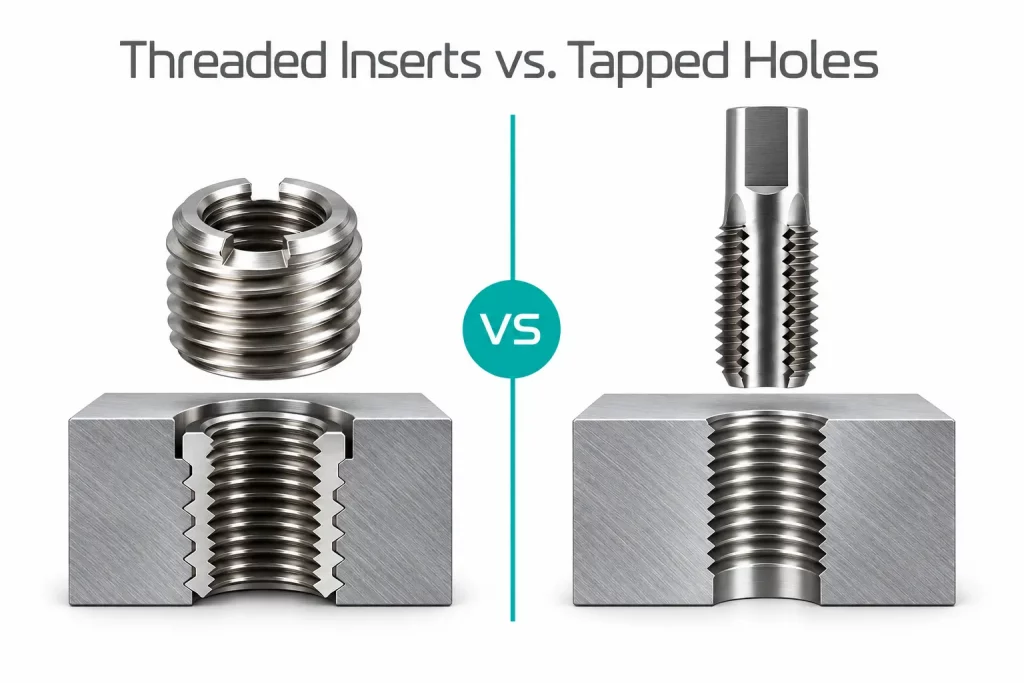
A tapped hole can be sufficient when the parent material provides adequate thread strength and engagement. Threaded inserts become more useful when the component requires additional thread durability, repeated assembly, thread repair or a reliable fastening point in softer or thinner materials.
| Consideration | Tapped Hole | Threaded Insert |
|---|---|---|
| Parent material | Suitable for materials that can provide adequate thread strength, such as many metal components | Useful in plastics, softer metals and other materials where direct threads may have limited durability |
| Material thickness | Requires sufficient material thickness for the required thread engagement | Can provide a dedicated threaded interface where direct thread engagement is limited |
| Thread durability | Depends on the strength and wear resistance of the parent material | The insert provides a separate threaded interface that can improve resistance to thread wear |
| Repeated assembly | Suitable when the fastening point is not frequently disassembled | Useful for components that require repeated assembly and disassembly |
| Thread repair | A damaged tapped hole may require re-tapping, oversizing or another repair method | Can be used to restore a damaged or stripped threaded connection |
| Vibration / cyclic loading | Performance depends on the complete tapped joint and parent material | Insert selection can provide additional thread retention, but the complete fastening system still needs to be designed for the service conditions |
| Installation | Requires drilling and tapping the parent material | Requires an additional insert installation process such as press-fitting, heat-setting, self-tapping or another suitable method |
| Production considerations | Simple and economical when the component can be directly tapped | Adds an additional component and installation step but can provide advantages where direct tapping is unsuitable |
| Typical use | Strong, sufficiently thick metal components with adequate thread engagement | Plastic housings, thin sections, softer materials, repair applications and frequently serviced fastening points |
Common Threaded Insert Installation Mistakes
Even the right threaded insert can fail when installation parameters are not properly controlled. Common issues include incorrect hole preparation, misalignment, excessive force and insufficient material support.
- Incorrect Hole Size: The hole must match the insert manufacturer’s specified dimensions. An oversized hole can reduce retention, while an undersized hole can increase installation force and damage the insert or component.
- Misaligned Installation: An insert installed at an angle can leave the internal thread misaligned, making fastener installation difficult and affecting the fit of mating components. Proper alignment should be maintained throughout installation.
- Insufficient Surrounding Material: Thin walls or undersized bosses may crack, deform or allow the insert to pull out under load. Boss diameter, wall thickness and edge distance should be considered during component design.
- Incorrect Installation Temperature: For heat-set inserts, excessive heat can deform the thermoplastic, while insufficient heat may prevent proper material flow around the insert. Temperature and insertion force should be controlled according to the insert and parent material.
- Excessive Installation Torque: Excessive torque can damage the insert or surrounding material, particularly with self-tapping inserts. Controlled tooling helps achieve consistent installation without overloading the component.
- Over-Tightening the Fastener: The insert does not make the entire joint immune to excessive tightening torque. Fastener torque should be specified based on the insert, parent material, fastener and component geometry.
- Ignoring Vibration: In vibration-prone assemblies, the insert alone may not prevent fastener loosening. Appropriate preload, locking features or other anti-loosening measures may be required depending on the application.
How to Choose the Right Threaded Insert
Choosing a threaded insert depends on the parent material, fastener, loading conditions, component geometry and installation process. Consider these factors before specifying an insert:
- Parent material: Plastic, aluminium, steel, CPVC or another material.
- Fastener: Required thread size, pitch and fastener type.
- Loading: Pull-out, torque, shear, vibration or combined loads.
- Wall thickness: Available material around the insert and boss dimensions.
- Hole geometry: Blind or through-hole and available installation space.
- Installation method: Press-fit, self-tapping, heat-set, ultrasonic, moulded-in or other suitable process.
- Service conditions: Temperature, moisture, chemicals and corrosion exposure.
- Production requirements: Prototype, low-volume, high-volume or automated assembly.
Practical Threaded Insert Selection
| Application Requirement | Suitable Insert Options |
|---|---|
| Thread repair in metal | Wire thread or key-locking insert |
| Soft metal reinforcement | Wire thread or self-tapping insert |
| Plastic housings | Heat-set, press-fit or self-tapping insert |
| 3D-printed thermoplastics | Heat-set threaded insert |
| High-load applications | Key-locking or heavy-duty insert |
| Frequently serviced joints | Wire thread or self-tapping insert |
| Thin sheet-metal components | Rivet nut / blind threaded insert |
| High-volume moulded parts | Moulded-in, heat-set or ultrasonic insert |
There is no universal threaded insert for every application. The final selection should match the insert design, parent material, fastener, hole geometry, installation method and expected service conditions.
Threaded Insert Manufacturing at Schilthorn Precision
Schilthorn Precision manufactures brass and metal moulding inserts for applications across HVAC, automotive, aerospace and plastic-case assemblies. The inserts are available with straight, helical and diamond knurl patterns, with materials and dimensions selected according to the application.
For automotive applications, Schilthorn manufactures inserts designed to provide strong, reusable threaded connections while helping reduce the risk of cracking caused by bolt loading. The company also manufactures brass inserts for CPVC fittings used in plumbing, irrigation, electronics and other applications. For CPVC fitting inserts, Schilthorn uses brass conforming to BS-218, IS-319 and C3606, with pressure testing up to 600 PSI, as specified for the application.
Looking for moulding inserts for your application? Contact Schilthorn Precision to discuss your requirements.
Frequently Asked Questions About Threaded Inserts
1. Do threaded inserts make a plastic component stronger?
A threaded insert can improve the durability of the threaded fastening point, but it does not automatically make the entire plastic component stronger. Performance depends on the insert design, parent material, boss geometry, insert length, installation method and applied load. For critical applications, pull-out and torque-out resistance should be evaluated under representative conditions.
2. What is the difference between pull-out strength and torque-out resistance?
Pull-out strength refers to the axial force required to pull an insert out of the parent material. Torque-out resistance refers to the rotational force required to make the insert rotate within the material. Both can be important when the insert must withstand fastening loads without moving or rotating.
3. Can threaded inserts be used in glass-filled plastics?
Yes, threaded inserts can be used in glass-filled plastics, but the insert type and installation process should be selected according to the specific material grade. Factors such as the plastic’s behaviour during installation, boss design, hole dimensions and required retention should be considered together.
4. Does the material of the threaded insert matter?
Yes. Insert materials such as brass, steel and stainless steel can offer different levels of strength, corrosion resistance, temperature resistance and compatibility with the surrounding material and fastener. Material selection should therefore be based on the application and service conditions.
5. Can a threaded insert be removed and replaced?
It depends on the insert type and installation method. Some post-installed inserts can be removed and replaced, while moulded-in inserts become part of the component during the moulding process. If the surrounding material has been damaged, its condition should also be checked before installing a replacement.
6. How do I specify a threaded insert to a manufacturer?
A threaded insert specification should include details such as thread size and pitch, insert length, outside diameter, material, retention or knurl pattern, installation method and parent material. A component drawing or sample can also help the manufacturer understand the required dimensions and application.
7. Can threaded inserts be used for high-temperature applications?
Yes, provided that the insert material, parent material and installation method are suitable for the operating temperature. In plastic components, the temperature capability of the surrounding material should also be considered because it may determine the overall performance of the connection.
8. Can the same threaded insert be used for different plastic materials?
Not necessarily. Different plastics can behave differently during installation and under load. The insert geometry, hole dimensions and installation parameters should therefore be evaluated for the specific parent material rather than assuming that the same configuration will perform identically across different plastics.
9. What information should I provide when requesting custom threaded inserts?
For a custom requirement, provide the component drawing, thread specification, insert dimensions, material requirement, knurl or external retention pattern, installation method, parent material, expected load and production quantity. This gives the manufacturer the information needed to evaluate the insert design.
10. Are threaded inserts suitable for automated assembly?
Yes. Threaded inserts can be incorporated into automated production using controlled pressing, thermal, ultrasonic or moulding processes, depending on the insert and component design. For high-volume production, the installation process should provide consistent positioning, force or process parameters and repeatable retention.