
Aerospace Components Manufacturer India: Meeting AS9100 Standards
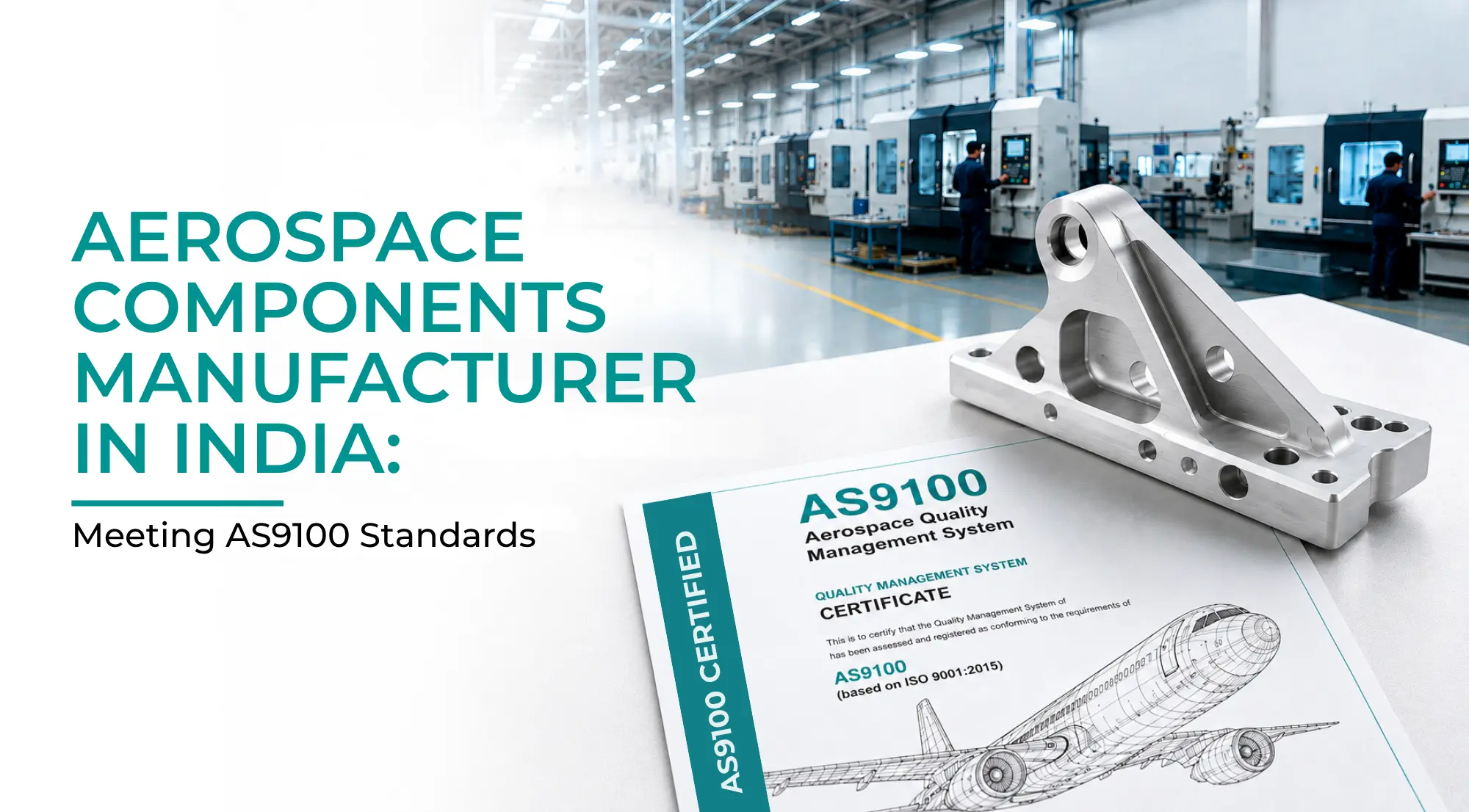


Aerospace components require much more than dimensional accuracy. A part may have complex geometry, tight tolerances, thin sections or specialised materials, but its acceptance can also depend on how consistently it is manufactured, inspected and documented.
For an aerospace components manufacturer in India, this means the manufacturing process needs to connect engineering requirements with material control, CNC machining, inspection and production records. Drawing revisions, GD&T, material specifications and customer requirements all need to be understood before production begins.
AS9100 provides a recognised quality-management framework for the aerospace, aviation and defence supply chain. Understanding these requirements is essential when selecting an aerospace manufacturing partner.
What Makes Aerospace Component Manufacturing Different?
Aerospace manufacturing is not simply about producing a component within a specified dimension. The manufacturer must maintain control over the material, drawing requirements, machining process, inspection method and production records throughout the manufacturing cycle. This becomes especially important when components have tight tolerances, complex geometries or features that are difficult to machine and inspect.
-
Precision Is More Than Holding a Tight Tolerance
Aerospace components often contain several critical characteristics that must work together rather than simply meet individual dimensional values. GD&T, positional accuracy, concentricity, surface finish and feature-to-feature relationships can all affect how the component performs in the final assembly.
For example, a component may have several holes produced from different machining setups. Each hole could individually fall within its dimensional tolerance, but incorrect datum control or positioning can still make the complete component unsuitable for assembly.
This is why an aerospace parts manufacturer needs a controlled machining strategy that considers datums, workholding, machining sequence and inspection from the beginning.
-
Material and Drawing Control
Material selection is another critical part of aerospace manufacturing. Components may require specific aluminium alloys, titanium, stainless steels, alloy steels or other engineering materials based on the application and customer specification.
The manufacturer must also work to the correct drawing revision. A part manufactured accurately to an outdated drawing is still a nonconforming component.
Before machining begins, the manufacturing team should therefore establish the applicable material, drawing revision, tolerances, GD&T, surface-finish requirements and any customer-specific requirements.
-
Repeatability Matters in Aerospace Production
Producing one accurate prototype does not necessarily demonstrate production capability. When the same component is manufactured repeatedly, factors such as tool wear, machine condition, temperature, workholding and machining sequence can influence dimensional consistency.
This is particularly important for aerospace parts manufacturing companies supplying components in batches or through repeat orders. A reliable manufacturing process should be capable of maintaining critical characteristics from the first component through subsequent production without depending entirely on additional manual correction.
The objective is not simply to manufacture an accurate part once, but to establish a repeatable process that consistently produces components to the required specification.
AS9100 in Aerospace Manufacturing: What Does It Actually Control?
AS9100 is a quality-management standard developed specifically for organisations operating across the aviation, space and defence supply chain. It builds on the principles of ISO 9001 but introduces additional controls that address the higher quality, safety and reliability expectations of aerospace manufacturing.
For an aerospace component manufacturer, AS9100 is not simply a certification displayed for customers. It provides a structured approach to controlling the activities that can influence product quality from planning and supplier management to production, inspection, nonconformance and continual improvement.
-
What AS9100 Covers in Aerospace Manufacturing
A quality system based on AS9100 can address areas such as:
- Configuration management – controlling drawings, specifications and product changes
- Risk management – identifying and controlling risks that could affect product conformity
- Product safety – considering safety-related characteristics and potential hazards
- Supplier control – ensuring externally sourced products and processes meet defined requirements
- Production control – maintaining controlled and repeatable manufacturing processes
- Nonconformance management – identifying, segregating and appropriately addressing components that do not meet requirements
- Traceability – maintaining identification and records where required
- Change management – controlling changes that could affect the product or manufacturing process
These controls help create consistency across the organisation. Instead of relying only on final inspection to identify problems, the quality system establishes controls throughout the process to reduce the possibility of nonconforming components reaching the customer.
ISO 9001 vs AS9100 for Aerospace Manufacturing
| ISO 9001 | AS9100 |
|---|---|
| General quality-management standard | Aerospace, space and defence quality-management standard |
| Applicable across industries | Developed specifically for the aviation, space and defence supply chain |
| Establishes general QMS controls | Adds sector-specific quality and operational controls |
| Supports consistent processes | Addresses additional aerospace supply-chain expectations |
For organisations searching for ISO 9001-certified aerospace component manufacturer in India, it is important to understand what the customer actually requires. ISO 9001 certification demonstrates an established quality-management system, while AS9100 provides a framework more specifically aligned with aerospace manufacturing.
However, certification should never be considered in isolation. A capable supplier also needs the machining expertise, inspection capability, material controls and engineering processes required to manufacture the particular component consistently.
From Aerospace Drawing to Finished Component: The Manufacturing Process
For an aerospace component manufacturer, precision starts before the component reaches the CNC machine. The drawing, material, machining strategy and inspection requirements need to be considered together so that the finished part meets both dimensional and functional requirements.
Step 1: Drawing and Requirement Review
The manufacturing process begins with a detailed review of the approved drawing and technical requirements. The team needs to identify:
- Critical dimensions and tolerances
- GD&T requirements
- Material grade
- Surface-finish requirements
- Thread specifications
- Special processes
- Inspection requirements
- Drawing revision
- Customer-specific requirements
This review helps determine the most suitable manufacturing route and prevents avoidable issues caused by using an incorrect revision or overlooking a critical characteristic.
Step 2: Material Verification
The selected material must match the applicable component specification. Depending on the application, aerospace components may be manufactured from aluminium, titanium, stainless steel, alloy steels and other engineering materials.
Material identification should be maintained through the manufacturing process wherever traceability is required. This creates a connection between the material received and the component eventually produced.
Step 3: Process Planning and Workholding
Once the requirements are understood, the manufacturing team determines how the component will be produced. This includes selecting the appropriate machine, establishing datums, deciding the machining sequence and designing suitable workholding. For complex components, reducing unnecessary setups can help maintain the positional relationship between features.
The machining strategy also needs to account for factors such as tool access, material behaviour, thin sections and the tolerances specified on the drawing.
Step 4: CNC Turning, CNC Milling and Multi-Axis Machining
Different aerospace components require different machining approaches. CNC turning is well suited to rotational components such as shafts, sleeves, bushes, stepped diameters and threaded features. CNC milling is used for components involving profiles, pockets, slots, holes, complex surfaces and non-rotational geometries.
For more complex components, multi-axis machining can provide access to multiple surfaces while reducing the number of separate setups. This can help maintain positional accuracy between related features.
Step 5: In-Process Inspection
Inspection can be incorporated at important stages of production rather than waiting until the component is completely machined.
This is particularly useful for components involving:
- Tight-tolerance features
- Multiple machining setups
- Thin-wall sections
- Complex geometries
- Difficult-to-machine materials
Checking critical characteristics during production helps identify dimensional variation early and reduces the risk of carrying an error into subsequent operations.
Step 6: Final Verification
Once machining is complete, the component undergoes final verification against the applicable drawing and specifications. The inspection approach is determined by the characteristics that need to be controlled and may involve dimensional measurement, GD&T verification, CMM measurement, surface-finish checks or other applicable methods.
The purpose is to confirm that the finished component conforms to the defined technical requirements before it proceeds to the next stage or customer release.
Quality Controls That Matter in Aerospace Parts Manufacturing
Aerospace quality control extends beyond checking the finished component. Manufacturers also need objective evidence of conformity and control over the component’s manufacturing history. First Article Inspection, traceability, nonconformance control and quality records support this process.
-
First Article Inspection (FAI)
First Article Inspection (FAI) provides a structured record showing that the first manufactured component has been evaluated against the applicable drawing and specifications.
Depending on the component and customer requirements, FAI can cover:
- Dimensional characteristics
- GD&T requirements
- Material identification
- Special processes
- Functional characteristics
- Supporting inspection records
FAI is particularly useful when a component enters production for the first time or when changes to the product or manufacturing process require re-verification. It provides a documented connection between the approved design requirements and the manufactured component.
-
Material and Production Traceability
Traceability allows the manufacturing history of a component to be established when required. This can connect the finished part with information such as:
Material batch? Manufacturing process? Inspection records? Final component
For aerospace parts manufacturing companies, this becomes valuable when customers require evidence of material conformity or when a quality issue needs to be investigated after production.
A controlled traceability system can help identify which material was used, which drawing revision was followed, what inspections were performed and whether any relevant deviation was recorded.
-
Nonconformance and Corrective Action
Not every manufacturing variation can be prevented. What matters is how the manufacturer identifies and controls it. When a component does not meet an applicable requirement, it should be identified and segregated so that it is not unintentionally released. The issue can then be reviewed according to the applicable quality process to determine the appropriate disposition.
Where a recurring or significant problem is identified, corrective action can be used to investigate its underlying cause and prevent the same issue from occurring again. This creates an important distinction between simply rejecting a defective part and improving the manufacturing process that produced it.
-
Documentation and Record Control
Aerospace manufacturing requires controlled records that provide evidence of conformity and support traceability throughout production.
Depending on project requirements, these may include:
- Material certificates
- FAI documentation
- Process records
- Drawing and revision information
- Special-process records
- Nonconformance records
- Final release documentation
These records help establish the manufacturing history of the component and provide the customer with the required evidence that applicable requirements have been addressed.
How to Choose an Aerospace Parts Manufacturer in India
Choosing an aerospace parts manufacturer in India should go beyond comparing prices or machine lists. The supplier needs to demonstrate that it can meet the component’s technical, quality and production requirements consistently.
-
Quality System
Check whether the manufacturer has relevant certifications such as AS9100 and how it manages drawing revisions, nonconformities, process changes and quality records.
-
Machining and Engineering Capability
Evaluate whether the supplier has the right capabilities for your component, such as:
- CNC turning and CNC milling
- Multi-axis machining
- Tight-tolerance machining
- Thin-wall machining
- Engineering and DFM support
The key question is not simply what machines are available, but whether the manufacturer can reliably produce your component’s critical features.
-
Inspection and Traceability
The supplier should have inspection capabilities appropriate to the drawing, such as CMM, GD&T verification, in-process inspection, FAI and other required testing.
Also check how material and production records are maintained and whether the finished component can be traced back to the required documentation.
-
Production Capability
Finally, consider whether the manufacturer can support your requirement beyond the initial prototype. The ability to maintain consistent machining, inspection and documentation across repeat production is essential when selecting a long-term aerospace manufacturing partner.
Why Choose Schilthorn as Your Aerospace Component Manufacturer?
Schilthorn Precision Engineering brings 15+ years of precision manufacturing experience to aerospace and other demanding engineering applications. The company operates with AS9100 and ISO 9001-certified quality systems and specialises in high-precision components with complex geometries.
Its aerospace manufacturing capabilities include:
- CNC milling and turning
- 3-axis, 4-axis and multi-axis machining
- Tolerances up to 10 microns for applicable machining requirements
- Full material traceability
- First Article Inspection
- NDT and laboratory testing
- Surface treatments
- Prototype through production quantities
Schilthorn also manufactures components across materials including aluminium, titanium, stainless steel, alloy steels and other engineering materials, with capabilities suited to complex and precision-critical parts.
Looking for an aerospace components manufacturer in India for precision-critical parts?
Share your drawings or technical requirements with us to discuss your manufacturing requirements.
Frequently Asked Questions
1. What does an aerospace components manufacturer in India do?
An aerospace components manufacturer produces precision-machined parts for aviation, aerospace, defence and space applications. Depending on the project, its work can include CNC machining, inspection, material traceability, FAI and customer-specific quality documentation.
2. What is AS9100 in aerospace manufacturing?
AS9100 is a quality-management standard developed for organisations in the aviation, space and defence supply chain. It builds on ISO 9001 and adds requirements relevant to these industries.
3. What CNC capabilities are useful for aerospace parts?
Depending on the component, aerospace manufacturing may require CNC milling, CNC turning, multi-axis machining, precision workholding and suitable dimensional inspection.
4. Why is First Article Inspection important?
FAI provides documented evidence that a manufactured component has been inspected against its applicable requirements. It can be required for new or specific production jobs depending on customer requirements.
5. Why is material traceability important in aerospace manufacturing?
Material traceability helps connect the material used in a component with its production and inspection records, making the manufacturing history easier to establish when required.
6. Can Schilthorn support prototype and production requirements?
Yes. Schilthorn’s supplied manufacturing information covers requirements from prototype through production quantities, depending on the component and project.
7. What machining accuracy does Schilthorn offer?
Schilthorn’s supplied CNC milling information specifies ±10-micron dimensional tolerance for applicable requirements, with actual achievable results depending on the component, material, geometry and GD&T.