
How Cross Flow Fan Blades Are Manufactured for Mass Production HVAC
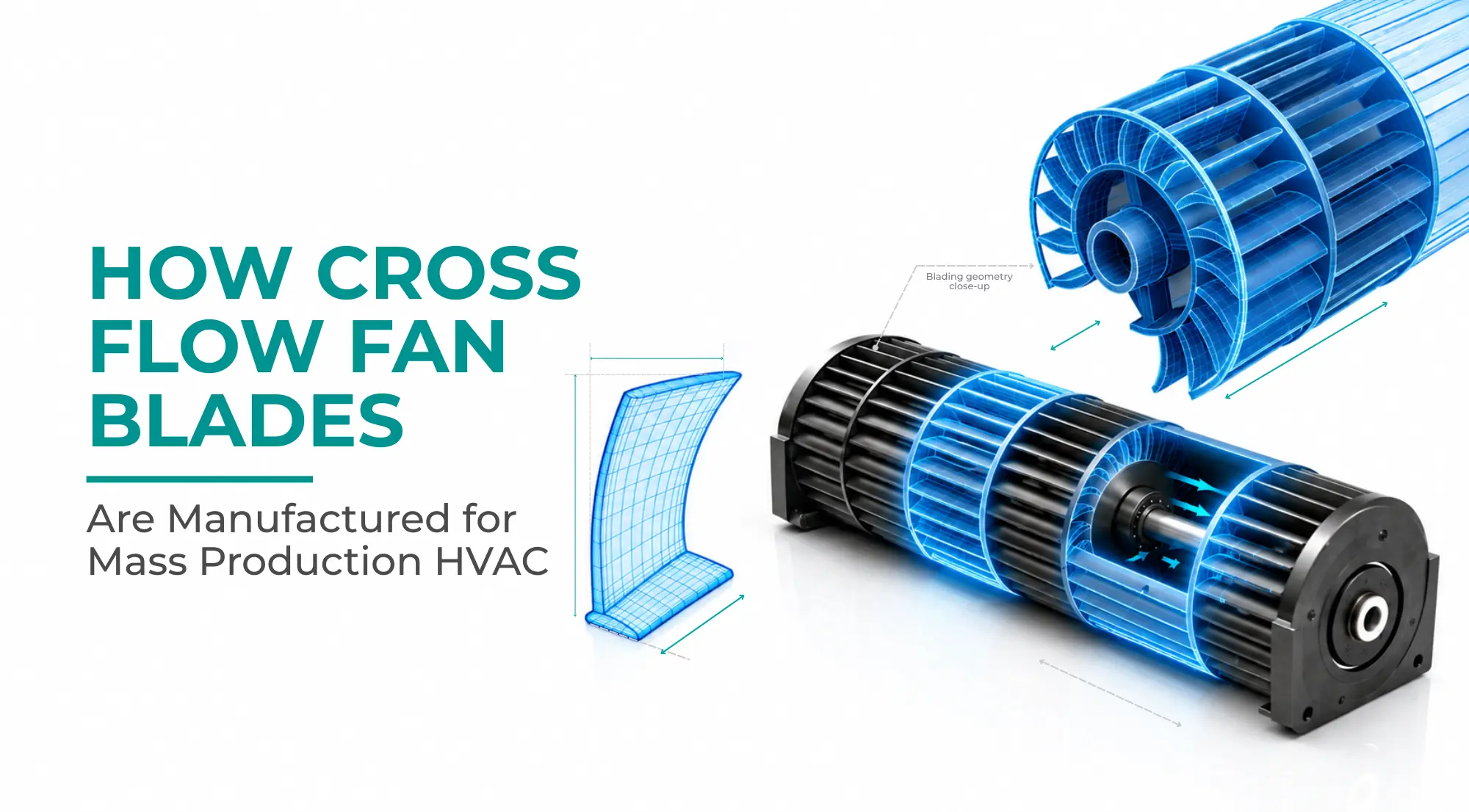


A cross-flow fan may appear to be a relatively simple cylindrical component, but manufacturing its blades consistently at mass-production volumes requires much more than forming the basic blade shape. Blade geometry, material behaviour, dimensional stability, assembly, balance and production tooling all influence the performance of the finished fan assembly.
For HVAC equipment manufacturers, these factors become even more important when thousands of components need to be produced with consistent dimensions and repeatable performance. The manufacturing method must therefore be selected around the blade design, material, production volume and required operating characteristics.
Cross flow fans also known as tangential fans are widely used where a long, relatively narrow airflow pattern is required. Their performance depends heavily on the geometry and consistency of the blades arranged around the cylindrical rotor.
So, how are cross flow fan blades manufactured for mass-production HVAC applications?
The answer involves several interconnected stages, from design and material selection to tooling, blade production, assembly and quality inspection.
What Is a Cross Flow Fan Blade?
A cross-flow fan uses a cylindrical impeller made up of multiple blades arranged around a central rotor. Unlike a conventional axial fan, where air generally moves parallel to the shaft, a cross-flow fan draws air into the rotor and discharges it across the fan assembly.
These fans are also commonly called tangential fans or tangential blowers and are frequently used in HVAC equipment such as split air-conditioning indoor units, air curtains and other air-distribution systems.
The blade profile, curvature, spacing and orientation influence how efficiently the rotor moves air and how much noise or vibration it generates.
If you want to understand the operating principle and differences between cross flow and axial fans in greater detail, see our guide to cross flow fans and axial fans.
For mass production, however, understanding how the fan works is only the starting point. The greater manufacturing challenge is maintaining the same blade geometry and assembly accuracy across a large production run.
What Makes Cross Flow Fan Blades Challenging to Manufacture at Scale?
Producing one prototype blade and producing thousands of consistent blades are two very different manufacturing challenges.
At mass-production volumes, even small variations in blade geometry or assembly can affect the behaviour of the finished rotor.
Key manufacturing considerations include:
- Blade geometry and profile
- Material selection and dimensional stability
- Blade length and curvature
- Consistent blade spacing
- Mould or tooling accuracy
- Shrinkage and deformation control
- Assembly alignment
- Rotor balance and runout
- Vibration and noise
- Repeatable production processes
This is why cross flow fan blade manufacturing needs to be considered as a complete production system rather than simply a process for forming individual blades.
Step-by-Step: How Cross Flow Fan Blades Are Manufactured
The exact manufacturing route depends on the blade design, material and fan configuration. For mass-produced HVAC components, the process commonly involves the following stages.
-
Define the Blade Design and Performance Requirements
Manufacturing begins with the component design and technical requirements. The blade geometry needs to be developed around the intended airflow, rotational speed, available installation space and overall fan configuration.
Important design parameters may include:
- Blade profile
- Blade curvature
- Blade angle or pitch
- Blade length
- Rotor diameter
- Blade spacing
- Mounting features
- Operating speed
- Required airflow
- Noise and vibration expectations
The design also needs to account for how the blades will be manufactured and assembled. A geometry that performs well aerodynamically may still require modification if it creates unnecessary tooling complexity, difficult ejection or inconsistent production.
For OEM applications, this design-for-manufacturing review is particularly important because tooling decisions made at the beginning can influence production cost and repeatability for the entire product life cycle.
-
Select the Appropriate Material
Material selection is closely connected to the manufacturing process and the operating environment of the fan. Cross flow fan blades are commonly manufactured from polymers and thermoplastics selected according to requirements such as:
- Strength
- Dimensional stability
- Temperature resistance
- Weight
- Impact resistance
- Processability
- Long-term operating conditions
Materials such as ABS, AS-based materials and reinforced thermoplastics may be considered for suitable applications, but there is no single material that is appropriate for every cross-flow fan design.
The selected material needs to maintain the required blade geometry during production and service. Material shrinkage, thermal behaviour and stiffness can influence dimensional accuracy and ultimately affect rotor performance.
For this reason, material selection should be evaluated together with blade design, moulding process and expected production conditions rather than treated as a separate decision.
-
Develop the Mould and Production Tooling
For injection-moulded cross flow fan blades, tooling is one of the most important investments in the production process. The mould must reproduce the required blade geometry consistently while also allowing efficient material flow, cooling and part ejection.
Depending on the design, tooling considerations can include:
- Cavity geometry
- Parting-line location
- Gate design
- Cooling arrangement
- Ejection system
- Tool material
- Tool life
- Dimensional repeatability
- Production cycle requirements
For mass production, the tooling needs to remain stable over repeated cycles. Variations in cooling, mould temperature or tool condition can contribute to dimensional changes or deformation. Where the design and production volume justify it, tooling may also be configured to increase output per machine cycle.
This is one reason manufacturers need strong tooling development and precision machining capabilities alongside the moulding process itself.
-
Manufacture the Fan Blades
Once the material and tooling are established, the blade production process can begin. For an injection-moulded blade, the basic sequence is:
Material preparation → Plasticisation → Injection → Packing/holding → Cooling → Ejection
The material is heated to the required processing condition and injected into the mould cavity under controlled pressure. After the cavity is filled, the part is held and cooled before being ejected.
The process parameters need to remain consistent from cycle to cycle. Changes in temperature, injection pressure, cooling conditions or cycle time can influence the final dimensions and shape of the blade.
Not every cross-flow fan uses exactly the same manufacturing route. Some designs use separately produced blade sections that are subsequently cut, positioned and assembled with end plates or support components.
Therefore, the blade design and production method need to be considered together.
-
Trim, Finish and Inspect the Blades
After moulding or forming, the blades may require trimming or finishing depending on the manufacturing method. The first inspection stage typically focuses on whether the individual blade meets the required drawing and process specifications.
Manufacturers may check:
- Overall blade dimensions
- Blade length
- Profile and curvature
- Mounting features
- Surface condition
- Flash
- Warpage or deformation
- Critical dimensional relationships
For high-volume HVAC production, inspection should not depend only on checking a finished batch. Appropriate in-process quality checks help identify process drift before large quantities of non-conforming components are produced.
-
Assemble the Cross Flow Fan Rotor
Producing accurate individual blades is only part of the manufacturing process. The blades must then be positioned and integrated into the rotor assembly with the required spacing, alignment and orientation.
Depending on the design, a cross-flow fan assembly may include:
- Multiple fan blades
- End plates
- Support discs
- Shaft or shaft-interface components
- Mounting features
The joining or assembly method depends on the construction of the particular fan. Even small variations in blade positioning can affect the finished rotor’s balance and airflow characteristics. This makes assembly accuracy especially important for mass-produced HVAC fans.
-
Check Balance, Runout and Vibration
A cross-flow fan rotor can have correctly manufactured individual blades and still produce unwanted vibration if the completed assembly is not properly balanced. This makes balance and runout inspection an important part of production quality control.
Depending on the application, manufacturers may evaluate:
- Static balance: Checks whether the rotor has uneven mass distribution that causes it to favour a particular rotational position.
- Dynamic balance: Evaluates the rotor while rotating and helps identify imbalance that can produce vibration during operation.
- Runout: Checks whether the rotating assembly moves outside the specified rotational alignment.
- Vibration and noise: The assembled rotor may also need to be evaluated for excessive vibration or acoustic issues under operating conditions.
These checks are particularly important in HVAC applications because unwanted vibration and noise can affect equipment reliability as well as user comfort.
How Manufacturers Maintain Consistency in Mass Production
Producing one acceptable fan blade is different from producing thousands of blades with the same characteristics.
At high production volumes, manufacturers need a defined system for controlling variation across materials, tooling, processing, inspection and assembly. The objective is not simply to find defective parts at the end, but to keep the process stable enough to prevent avoidable variation in the first place.
-
Establish Process Capability and a Control Plan
Before full-scale production, the manufacturing process should demonstrate that it can repeatedly produce components within the specified requirements.
This involves reviewing critical dimensions, process variation, machine and tooling capability, material behaviour and production stability. A defined control plan can then establish what needs to be controlled, how it will be checked and when the checks will take place.
For cross flow fan components, this may cover material identification, critical blade dimensions, moulding parameters, blade profile, assembly positioning, runout and balance requirements. This gives production teams a defined baseline for maintaining consistency throughout serial production.
-
Approve First-Off Parts and Define Inspection Frequency
First-piece or first-off inspection provides a baseline before a production run moves into full-scale output. The initial components can be checked against the approved drawing, specifications and agreed acceptance criteria. Once approved, subsequent production can follow a defined inspection and sampling frequency based on characteristic criticality, process stability and customer requirements.
This helps identify setup or tooling issues before large quantities of components are produced.
-
Monitor Manufacturing Parameters
Production parameters need to remain within the defined process window throughout the manufacturing run.
For injection-moulded components, this can include:
- Material temperature
- Injection pressure and speed
- Holding or packing conditions
- Mould temperature
- Cooling time
- Cycle time
Monitoring these variables helps identify process drift before it results in significant dimensional or visual variation.
-
Maintain Tooling, Machines and Inspection Equipment
Tooling condition can gradually affect production consistency over a long manufacturing run. Regular maintenance and inspection can help identify tool wear, cooling-system issues, mould damage, ejection problems and dimensional changes. Production machines and measurement equipment also need to remain in suitable working condition. Maintaining the complete manufacturing and inspection setup helps reduce avoidable sources of variation.
-
Control Material and Maintain Batch Traceability
Material control should continue throughout serial production. Using the approved material grade and maintaining controlled material handling helps reduce variation between production batches. Recording information such as material grade, batch or lot identification and production date also allows components to be traced back to their production conditions when required. This is particularly useful when investigating material-related issues or unexpected variation.
-
Use Dimensional Data to Identify Trends
Dimensional inspection should provide more than a simple pass-or-fail result. Where appropriate, manufacturers can track measurements over time to identify whether a critical dimension is gradually moving toward its specification limit.
Statistical process control (SPC) may be used for suitable characteristics and production environments to identify developing trends before they become non-conformities.
-
Control Assembly, Balance and Non-Conforming Parts
Consistency must also be maintained after the individual blades have been manufactured. Assembly controls should ensure consistent blade spacing, orientation and positioning. The completed rotor may then require checks for balance, runout, rotational stability or vibration according to the application.
If components fall outside the specified requirements, they should be identified and segregated from accepted production. Depending on the issue, the response may involve rework, rejection, additional inspection or process adjustment.
-
Record Results and Take Corrective Action
Production and inspection records provide a history of what was manufactured and how it was checked. Depending on customer and process requirements, these may include material information, production batches, inspection results, process checks and non-conformance records.
When repeated dimensional, moulding, assembly or balance issues occur, the manufacturer should investigate the underlying cause rather than simply sorting the affected parts. Corrective action may involve changes to tooling, material, process parameters, equipment or assembly methods to prevent the same variation from recurring.
Maintaining Consistency Is a Process, Not a Final Inspection
For mass-produced HVAC components, consistency comes from controlling the complete manufacturing system. Process capability, tooling stability, material control, process monitoring, inspection and corrective action work together to keep production stable.
This allows a manufacturer to move beyond producing a workable prototype and toward supplying repeatable components at the volume and consistency expected by HVAC OEMs.
Injection Moulding or Other Manufacturing Methods: Which Is Right for Cross Flow Fan Blades?
There is no single manufacturing method that suits every cross-flow fan blade. The right process depends on the blade material, geometry, production volume, tooling requirements and required performance.
For thermoplastic blade designs, injection moulding can be a strong option for high-volume production because dedicated tooling allows the same geometry to be reproduced repeatedly across production cycles. It is particularly useful when consistent blade dimensions, repeatability and production throughput are important.
However, injection moulding is not automatically the best choice for every design. Some cross-flow fan constructions may use separately produced blade sections or other manufacturing and assembly approaches where the component geometry, material or production requirements make them more suitable.
Manufacturing Method Selection for Cross Flow Fan Blades
| Factor | What It Means for Process Selection |
|---|---|
| Material | The material must be compatible with the selected process and provide the required strength, temperature resistance and dimensional stability. |
| Blade geometry | Complex curvature, thin sections, mounting features and profile requirements can influence whether a particular manufacturing method is practical. |
| Production volume | High production quantities can justify dedicated tooling, while lower volumes may favour a process with lower initial tooling investment. |
| Tooling investment | Injection moulding requires upfront tooling investment, so tool cost and expected production volume should be evaluated together. |
| Production speed | For large quantities, cycle time and achievable output are important when comparing manufacturing routes. |
| Dimensional consistency | The selected process should be capable of maintaining critical blade dimensions, profile and geometry throughout the production run. |
| Assembly requirements | If blades are produced separately, the manufacturing route must also support accurate positioning and joining with end plates or other rotor components. |
| Total production cost | Cost should be evaluated across tooling, material, production, inspection, labour and assembly rather than looking only at the individual part price. |
The key is to select the process based on the complete production requirement, not simply on which method has the lowest initial cost or fastest cycle.
For HVAC OEMs, the most suitable manufacturing route is one that can deliver the required blade geometry, production volume, dimensional consistency and overall cost throughout the expected product life cycle.
What Should HVAC OEMs Consider When Choosing a Fan Blade Manufacturer?
For an HVAC OEM, selecting a supplier involves more than confirming whether the manufacturer can produce the basic blade shape.
A capable OEM fan blade manufacturer should be able to understand the component specification and support the requirements associated with production scale.
Before awarding a project, OEMs should consider:
- Experience with HVAC components
- Understanding of the required blade geometry
- Material and process knowledge
- Tooling development capability
- Prototype and validation support
- Dimensional inspection capability
- Production capacity
- Process consistency
- Quality systems
- Ability to scale from initial production to long-term supply
- Communication and engineering support
For customized requirements, working with a custom fan blade manufacturer can also help when standard blade geometry, material or mounting arrangements do not meet the equipment requirements. The right supplier should therefore be evaluated as a manufacturing partner not simply as a source for individual components.
How Schilthorn Supports HVAC Component Manufacturing
With 15+ years of precision manufacturing experience, Schilthorn Precision supports OEM requirements across HVAC and other industrial sectors through precision machining, engineering expertise and quality-focused manufacturing processes.
The company’s capabilities include CNC milling, CNC turning, Forging and other precision manufacturing processes, supported by modern machinery and engineering infrastructure.
For HVAC applications, Schilthorn manufactures precision components and assemblies where dimensional accuracy, repeatability and reliable production are important. Its manufacturing approach can support requirements ranging from component development and prototyping to longer production runs.
For OEMs looking for an HVAC components manufacturer in India, the focus is on understanding the drawing and application requirements and developing a manufacturing approach around the required component specifications.
Have an HVAC component requirement?
Share your drawing or component details with Schilthorn Precision for a technical discussion.
Frequently Asked Questions
1. What causes cross flow fan blades to become noisy during operation?
Excessive noise can result from blade geometry variation, uneven blade spacing, rotor imbalance, excessive runout or deformation during manufacturing. In mass production, controlling these variables helps maintain consistent aerodynamic and mechanical performance.
2. Does blade thickness affect the performance of a cross-flow fan?
Yes. Blade thickness can influence the blade’s stiffness, weight and aerodynamic behaviour. Excessive variation in thickness between production parts can also affect rotor balance and consistency, so critical thickness dimensions should be controlled during manufacturing.
3. What causes warpage in cross flow fan blades?
Warpage can occur because of uneven cooling, material shrinkage, mould temperature variation or unsuitable processing conditions. Since blade curvature and profile are performance-critical, controlling the moulding process is important to prevent deformation from affecting the finished rotor.
4. How does blade spacing affect a cross-flow fan?
The spacing between blades influences how air moves through the cylindrical rotor. Variations in blade positioning can therefore affect airflow characteristics and rotational balance. Consistent blade placement becomes particularly important when producing large quantities of identical rotors.
5. How are long cross flow fan blades kept dimensionally stable?
Long blade geometries are more sensitive to shrinkage, cooling variation and deformation during production. Tool design, controlled processing conditions and appropriate material selection help minimise dimensional variation and maintain the required blade profile throughout production.
6. Can cross flow fan blades be manufactured with different blade profiles?
Yes. The blade profile can be developed according to the required rotor geometry and application. However, changing the profile can affect tooling design, material flow, moulding behaviour, balance and airflow, so the manufacturing implications should be evaluated before production.
7. What information should an HVAC OEM provide to a fan blade manufacturer?
Useful inputs include the component drawing or 3D model, material specification, critical dimensions and tolerances, blade profile, rotor dimensions, mounting requirements, expected production volume and applicable inspection requirements. Providing these details early helps the manufacturer evaluate tooling and production feasibility.
8. When should an HVAC OEM choose injection moulding for cross flow fan blades?
Injection moulding is generally well suited when the blade design is compatible with the process and production quantities justify dedicated tooling. It becomes particularly attractive when repeatability, high-volume output and consistent part geometry are important.