
What are Cross Flow Fans and Axial Fans? How They Work in HVAC Systems
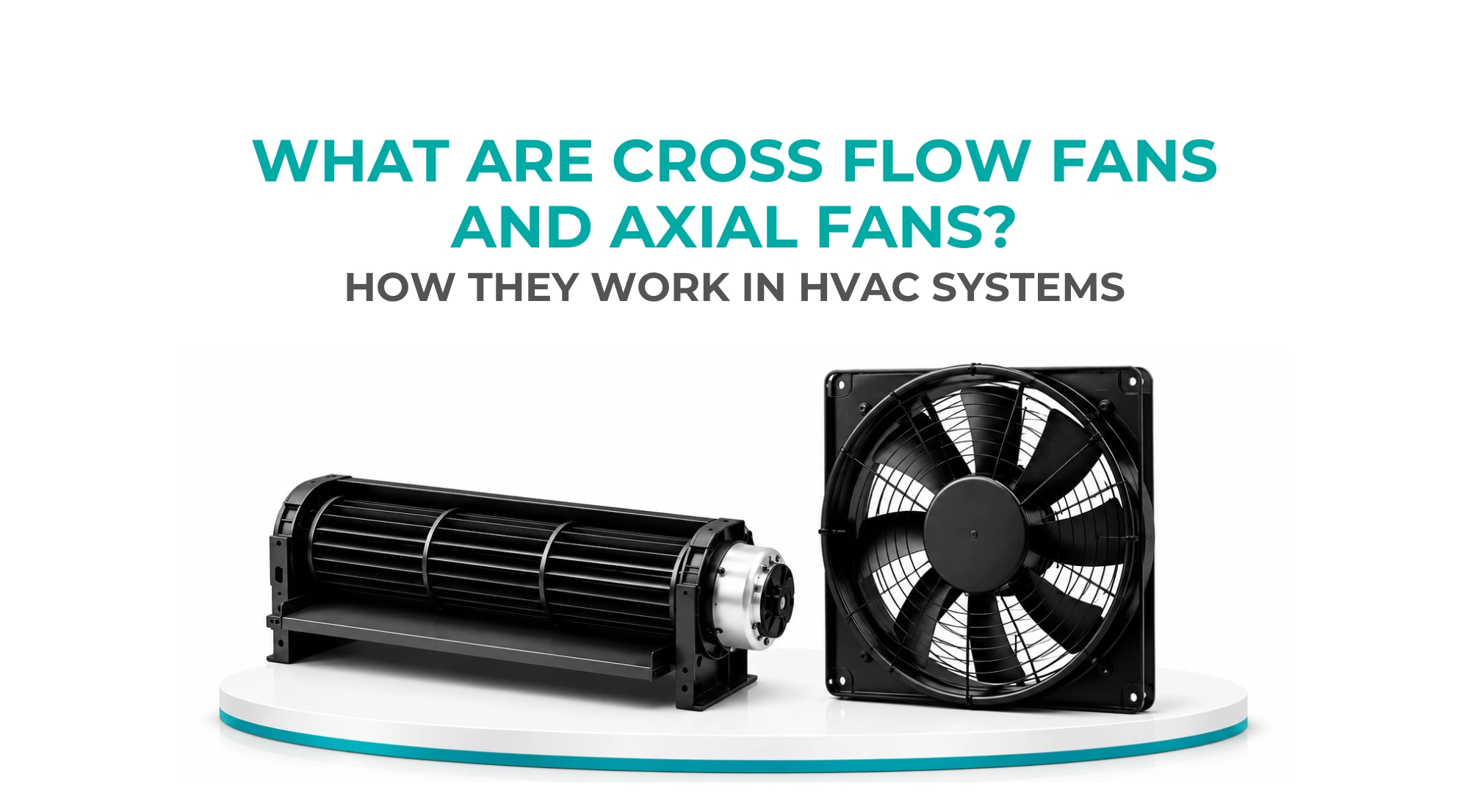


Fans are one of the most critical components in any HVAC system, responsible for moving air efficiently to maintain indoor comfort, ventilation and temperature control. Whether it’s a split air conditioner, air handling unit or refrigeration equipment, the fan technology behind the system directly determines airflow performance, energy efficiency and long-term reliability.
Among the various types used in HVAC applications, axial fans and cross flow fans are the two most widely specified. They are often discussed together but differ fundamentally in how they move air and where they are best suited.
In this guide, we’ll explain what cross flow fans and axial fans are, how they work, where they are used in HVAC systems, and the key differences between them to help you understand which fan is best suited for different applications.
What Are Axial Fans?
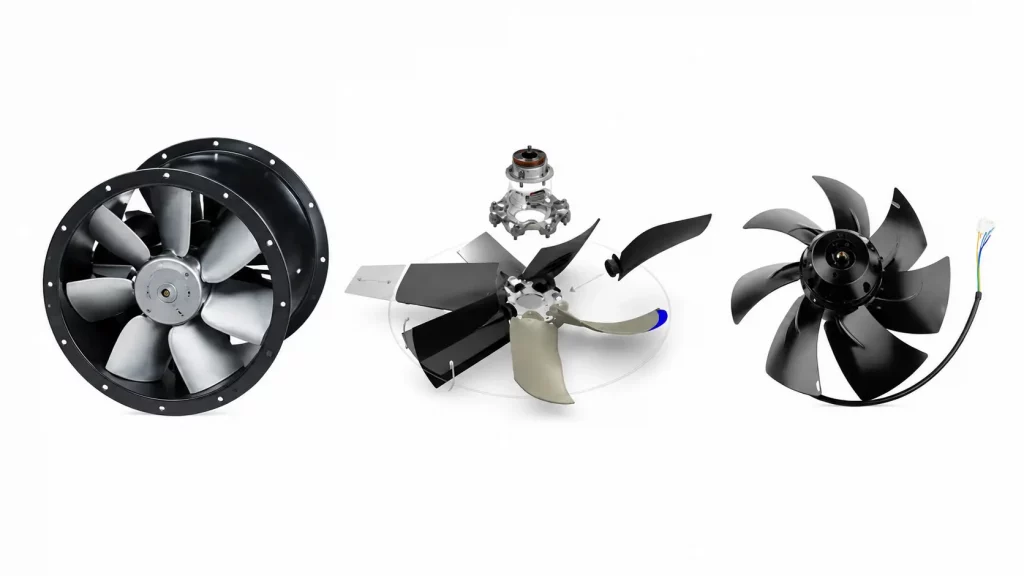
An axial fan is a mechanical fan that moves air parallel to its rotating shaft. Similar to the propeller of an aircraft, the fan blades rotate around a central hub, drawing air from one side and pushing it forward in the same direction as the shaft. This simple yet highly efficient operating principle enables axial fans to move large volumes of air while consuming relatively low power.
Because of their high airflow capacity and compact design, axial fans are among the most widely used fans in HVAC systems. They are commonly found in outdoor air conditioning units, cooling towers, Air Handling Units (AHUs), condensers, exhaust systems and industrial ventilation equipment where continuous airflow is essential.
How Do Axial Fans Work?
An axial fan operates using a motor-driven hub fitted with multiple blades. As the motor rotates the hub, the specially designed blades create a pressure difference that draws air into the fan and pushes it forward along the same axis as the shaft.
Unlike centrifugal fans, which redirect airflow at a 90-degree angle, an axial fan in HVAC systems moves air in a straight line. This design allows the fan to deliver high airflow efficiently, making it ideal for applications where large air volumes need to be circulated with relatively low static pressure.
The performance of an axial fan depends on several design factors, including blade shape, blade pitch, fan diameter and motor speed. These parameters determine the volume of air the fan can move and the pressure it can generate for a specific HVAC application.
Main Components of an Axial Fan
Most axial fans consist of the following key components:
- Impeller (Fan Blades): Rotating blades that generate airflow.
- Hub: Connects the blades to the motor shaft and transfers rotational motion.
- Electric Motor: Powers the fan assembly.
- Fan Housing or Casing: Supports and protects the fan components.
- Protective Guard (where applicable): Improves operational safety and prevents accidental contact with rotating blades.
Types of Axial Fans
Axial fans are available in different configurations depending on the airflow, pressure and installation requirements. The three most common types used in HVAC and industrial applications include:
1. Propeller Axial Fans
Propeller axial fans are the simplest and most widely used type of axial fan. Featuring propeller-shaped blades mounted on a central hub, they are designed to move large volumes of air in low static pressure environments.
These fans are commonly used in cooling towers, condenser units, warehouse ventilation and general air circulation systems where unrestricted airflow is required.
2. Tube Axial Fans
Tube axial fans, also known as tube fans, consist of an axial fan enclosed within a cylindrical housing. The casing helps guide airflow more effectively, making these fans suitable for ducted ventilation systems and applications requiring slightly higher static pressure than open propeller fans.
They are frequently used in HVAC ducting, industrial exhaust systems and commercial ventilation installations.
3. Vane Axial Fans
Vane axial fans incorporate stationary guide vanes positioned behind the rotating blades. These guide vanes help straighten the airflow, reduce turbulence and improve pressure generation, making vane axial fans suitable for demanding industrial HVAC applications.
They are commonly used in process industries, power plants, tunnel ventilation and large-scale air handling systems where higher efficiency and pressure performance are required.
Advantages of Axial Fans
Axial fans remain one of the most preferred choices for HVAC applications because they offer several operational and economic benefits.
1. High Airflow Capacity
Axial fans can move large volumes of air efficiently, making them ideal for ventilation, cooling and heat rejection applications.
2. Energy-Efficient Operation
Their simple aerodynamic design allows them to deliver high airflow while consuming relatively low power, helping reduce energy consumption.
3. Compact and Lightweight Design
Compared to many other industrial fan types, axial fans are compact and lightweight, allowing easy installation across a wide range of HVAC systems.
4. Cost-Effective Solution
Their straightforward construction makes axial fans economical to manufacture, install and maintain, reducing both initial investment and long-term operating costs.
5. Easy Maintenance
With fewer moving parts and a simple mechanical design, axial fans require minimal maintenance, contributing to reliable long-term operation.
6. Wide Range of Applications
From residential air conditioners and commercial HVAC systems to industrial ventilation and refrigeration equipment, axial fans can be adapted to numerous airflow requirements through different sizes and configurations.
Limitations of Axial Fans
While axial fans offer many advantages, they may not be the ideal solution for every HVAC application.
1. Limited Static Pressure Capability
Axial fans perform best in low static pressure environments. Their efficiency decreases significantly when airflow encounters high resistance within ducts or complex air distribution systems.
2. Concentrated Airflow
Unlike cross flow fans that provide a wide curtain of air, axial fans generate a more focused airflow, which may not be suitable for applications requiring uniform air distribution.
3. Higher Noise at Increased Speeds
As operating speeds increase, axial fans can produce more aerodynamic noise due to blade turbulence, particularly in large industrial installations.
4. Performance Depends on Installation Conditions
Obstructions, poorly designed ductwork or airflow restrictions can reduce the efficiency of axial fans, making proper system design essential for achieving optimal performance.
What Are Cross Flow Fans?
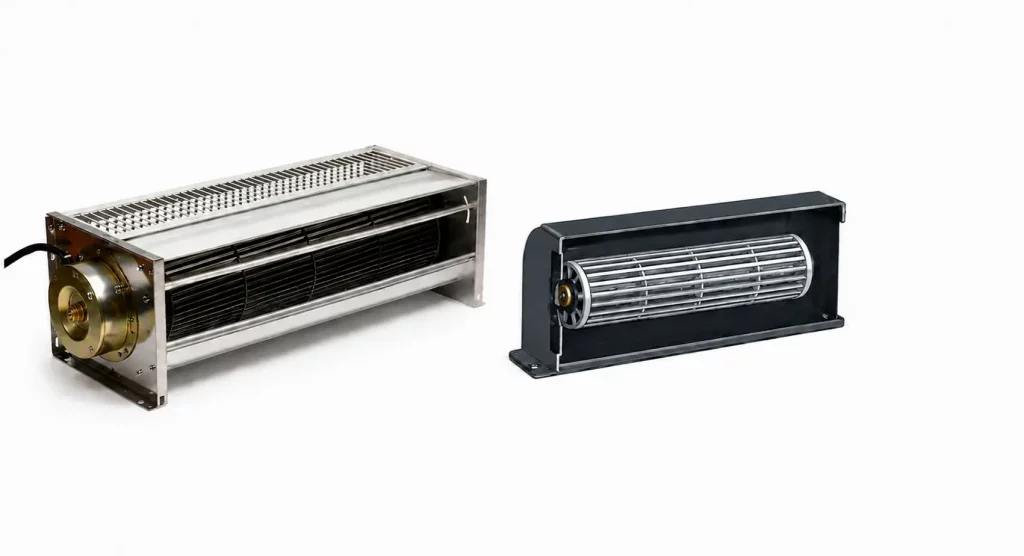
A cross-flow fan, also known as a tangential fan or cross blower fan, is a type of fan designed to produce a broad, uniform stream of air across the entire length of its cylindrical impeller. Unlike an axial fan, which moves air parallel to its shaft, a cross-flow fan draws air into one side of the impeller and discharges it across the opposite side, creating a continuous curtain of airflow.
This unique airflow pattern allows cross flow fans to distribute air evenly over a wide area, making them an excellent choice for HVAC equipment where consistent air delivery, compact design and low operating noise are essential.
Because of these characteristics, cross flow fans are widely used in wall-mounted air conditioners, fan coil units, air curtains, heat pumps and other indoor HVAC systems where occupant comfort depends on smooth and balanced airflow.
How Do Cross Flow Fans Work?
A cross-flow fan operates using a long cylindrical impeller fitted with multiple forward curved blades. As the impeller rotates, air enters through one side of the fan, passes through the rotating blades and exits from the opposite side. Unlike axial fans, where air passes through the fan only once, the airflow inside a cross-flow fan circulates through the impeller before being discharged, resulting in a wider and more uniform airflow pattern.
The forward curved blades play a crucial role in guiding the air smoothly through the impeller while minimising turbulence. This design enables the fan to deliver a consistent curtain of air across its entire length, improving temperature distribution and indoor comfort in HVAC applications.
Because the airflow is evenly distributed rather than concentrated, cross flow fans are particularly effective in equipment where maintaining uniform airflow across heat exchangers or occupied spaces is important.
Main Components of a Cross Flow Fan
Most cross-flow fans consist of the following key components:
- Cylindrical Impeller: A long rotating impeller that generates airflow across the full width of the fan.
- Forward Curved Blades: Specially designed blades that move air efficiently while reducing turbulence and noise.
- Electric Motor: Drives the impeller at the required operating speed.
- Fan Housing: Directs and controls the airflow through the fan assembly.
- Stabiliser (Vortex Wall): Improves airflow efficiency by reducing recirculation inside the fan.
Types of Cross Flow Fans
Cross flow fans are available in different configurations depending on airflow requirements, motor type and equipment design. While they all operate on the same working principle, selecting the appropriate type helps optimise HVAC performance for specific applications.
1. Single Inlet Cross Flow Fans
Single inlet cross flow fans draw air through one side of the impeller and discharge it uniformly across the outlet. Their compact construction makes them suitable for residential air conditioners, fan coil units and compact ventilation equipment where moderate airflow is sufficient.
2. Dual Inlet Cross Flow Fans
Dual inlet cross flow fans are designed to handle higher airflow requirements by allowing air to enter from both sides of the fan assembly. They are commonly used in larger HVAC systems and commercial equipment that require greater air distribution while maintaining uniform airflow.
3. AC Cross Flow Fans
Powered by alternating current (AC) motors, AC cross flow fans are widely used in conventional HVAC equipment because of their dependable performance, simple operation and cost-effective design. They are commonly found in split air conditioners, air curtains and commercial ventilation systems.
4. DC Cross Flow Fans
DC cross flow fans use direct current (DC) motors that offer improved speed control, higher energy efficiency and quieter operation. They are increasingly used in modern HVAC systems, energy-efficient appliances and electronic cooling applications where precise airflow control is important.
Advantages of Cross Flow Fans
Cross flow fans are widely used in HVAC systems because they provide several performance advantages that improve both system efficiency and occupant comfort.
1. Uniform Air Distribution
Unlike axial fans that produce a concentrated stream of air, cross flow fans create a broad curtain of airflow across the entire outlet, resulting in more consistent temperature distribution.
2. Low Noise Operation
The combination of a cylindrical impeller and forward curved blades allow air to move smoothly with reduced turbulence, making cross flow fans quieter than many conventional fan designs.
3. Compact and Space-Efficient Design
Their slim profile enables easy integration into compact HVAC equipment such as wall-mounted air conditioners, fan coil units and air curtains where installation space is limited.
4. Improved Indoor Comfort
Even airflow distribution helps eliminate hot and cold spots, improving occupant comfort in residential and commercial spaces.
5. Energy-Efficient Performance
By delivering consistent airflow exactly where it is needed, cross flow fans contribute to efficient heating and cooling performance while reducing unnecessary energy consumption.
Limitations of Cross Flow Fans
Although cross flow fans offer excellent airflow distribution, they also have certain limitations that should be considered during HVAC system design.
1. Lower Airflow Capacity
Cross flow fans generally move lower volumes of air compared to axial fans, making them less suitable for applications requiring high airflow over large distances.
2. Limited Static Pressure Capability
These fans are designed primarily for low-pressure applications and are not ideal where significant airflow resistance or complex ducting is involved.
3. More Complex Construction
Compared to the simple propeller design of axial fans, cross flow fans have a more intricate internal structure, which can increase manufacturing complexity and maintenance requirements.
4. Not Suitable for Heavy Industrial Ventilation
For large industrial ventilation systems or applications requiring high airflow and pressure, axial or centrifugal fans are generally more appropriate than cross flow fans.
Cross Flow Fans vs Axial Fans: Key Differences
While both cross-flow fans and axial fans are designed to move air, they differ significantly in how they generate airflow, the pressure they produce and the applications they are best suited for. Understanding these differences helps HVAC designers, OEMs and engineers select the right fan for optimal system performance.
| Feature | Cross Flow Fans | Axial Fans |
|---|---|---|
| Airflow Direction | Air flows across the cylindrical impeller, creating a wide and uniform air curtain. | Air flows parallel to the fan shaft in a straight direction. |
| Air Distribution | Wide, even airflow across the entire fan length. | Concentrated airflow in one direction. |
| Static Pressure | Suitable for low to moderate static pressure applications. | Best for high airflow with low static pressure. |
| Noise Level | Generally quieter due to smooth airflow distribution. | Can produce higher noise levels at increased speeds. |
| Design | Long cylindrical impeller with forward curved blades. | Propeller-style blades mounted on a central hub. |
| Common HVAC Applications | Indoor air conditioners, fan coil units, air curtains and heat pumps. | Condensers, cooling towers, ventilation systems and exhaust units. |
Each fan type offers distinct advantages and the right choice depends on the airflow pattern, available installation space and the performance requirements of the HVAC system.
Where Are Axial Fans Used in HVAC Systems?
Thanks to their ability to move large volumes of air efficiently, axial fans are widely used in HVAC applications where high airflow and effective ventilation are essential. Their simple design, energy-efficient operation and reliable performance make them suitable for both residential and industrial systems.
Common applications include:
- Outdoor air conditioning condenser units
- Air Handling Units (AHUs)
- Cooling towers
- Industrial ventilation systems
- Exhaust and fresh air systems
- Refrigeration and heat rejection equipment
In these applications, an axial fan in HVAC systems helps improve heat transfer, maintain consistent airflow and support efficient equipment operation.
Where Are Cross Flow Fans Used in HVAC Systems?
A cross-flow fan in HVAC systems is preferred where uniform air distribution and quiet operation are important. Its long cylindrical impeller delivers an even curtain of air, making it ideal for compact indoor equipment that requires consistent airflow across a larger outlet.
Typical applications include:
- Wall-mounted split air conditioners
- Fan Coil Units (FCUs)
- Air curtains
- Heat pumps
- Air purifiers
- Compact ventilation equipment
- Commercial HVAC indoor units
By providing smooth and evenly distributed airflow, cross flow fans enhance occupant comfort while improving the overall efficiency of heating and cooling systems.
How to Choose the Right Fan for Your HVAC System
Selecting the right fan is essential for achieving efficient airflow, reliable performance and long-term energy savings. Since axial fans and cross flow fans are designed for different airflow requirements, the ideal choice depends on your HVAC application’s operating conditions.
Consider the following factors before selecting a fan:
1. Airflow Requirement
If your system requires moving a large volume of air, axial fans are often the preferred choice. For applications requiring a wide, even airflow, cross flow fans are more suitable.
2. Static Pressure
Axial fans perform best in low static pressure environments, while cross flow fans are better suited for applications that require controlled and uniform air distribution.
3. Available Installation Space
Cross flow fans feature a slim, compact design that fits easily into wall-mounted air conditioners, fan coil units and other space-constrained HVAC equipment. Axial fans are generally used where installation space is less restricted.
4. Noise Levels
For indoor environments where quieter operation is important, cross flow fans are often preferred because they produce smooth and uniform airflow with lower noise levels.
5. HVAC Application
The intended application should ultimately determine the fan selection. Axial fans are commonly used for condensers, cooling towers and ventilation systems, whereas cross flow fans are widely used in indoor air conditioning units, air curtains and fan coil units.
Selecting the appropriate fan based on these factors helps improve system efficiency, airflow performance and overall HVAC reliability.
Why Precision Components Matter in HVAC Fans
The performance of any HVAC fan depends not only on its design but also on the quality of the components used in its assembly. Precision-machined parts help ensure smooth rotation, proper blade alignment and consistent airflow while reducing vibration, noise and premature wear. Even minor dimensional variations can affect fan efficiency, leading to higher energy consumption and reduced equipment reliability.
Manufacturers therefore rely on high-quality precision components to maintain the performance and longevity of axial fans, cross flow fans and other HVAC equipment. Components such as shafts, hubs, connectors, inserts and housings must be manufactured to tight tolerances to ensure reliable operation under continuous working conditions.
By combining precision machining with rigorous quality control, manufacturers can produce components that support efficient airflow, improved system performance and longer service life across a wide range of HVAC applications.
Looking for a Reliable Manufacturing Partner for Precision HVAC Components?
For over a decade, Schilthorn Precision has supported leading HVAC OEMs with high-precision machined components and assemblies manufactured to exact customer specifications. Our expertise includes brass HVAC connectors, brass distributors, fabricated components for heat exchanger chillers, precision-machined components and custom assemblies, produced using advanced CNC machining, fabrication and rigorous quality inspection processes.
Whether you’re developing next-generation HVAC equipment or sourcing precision-engineered components for critical applications, our team delivers consistent quality, tight tolerances and dependable manufacturing support from prototype development to high-volume production.
Get in touch with our engineering team today to discuss your HVAC component manufacturing requirements.
Frequently Asked Questions (FAQs)
1. What is the difference between a cross-flow fan and an axial fan?
The main difference is the airflow pattern. An axial fan moves air parallel to its shaft, making it suitable for high-volume airflow applications, while a cross-flow fan produces a wide, uniform curtain of air, making it ideal for indoor HVAC equipment where even air distribution is required.
2. Where are axial fans commonly used in HVAC systems?
Axial fans are commonly used in outdoor air conditioning units, cooling towers, Air Handling Units (AHUs), exhaust systems and industrial ventilation applications where large volumes of air need to be moved efficiently.
3. Is a cross flow fan the same as a tangential fan?
Yes. A cross-flow fan is also known as a tangential fan or cross blower fan. These terms refer to the same type of fan that uses a long cylindrical impeller to deliver uniform airflow across its entire length.
4. Which fan is quieter: a cross-flow fan or an axial fan?
In general, cross flow fans operate more quietly because they distribute air evenly and generate less turbulence. This makes them well suited for indoor HVAC applications where low noise levels are important.
5. How do I choose the right fan for an HVAC system?
The right fan depends on factors such as airflow requirements, static pressure, available installation space, noise levels and the intended application. Axial fans are preferred for high-volume airflow, while cross flow fans are better suited for applications requiring uniform air distribution and compact installation.