
Moulding Inserts Explained: What They Are and Where They’re Used
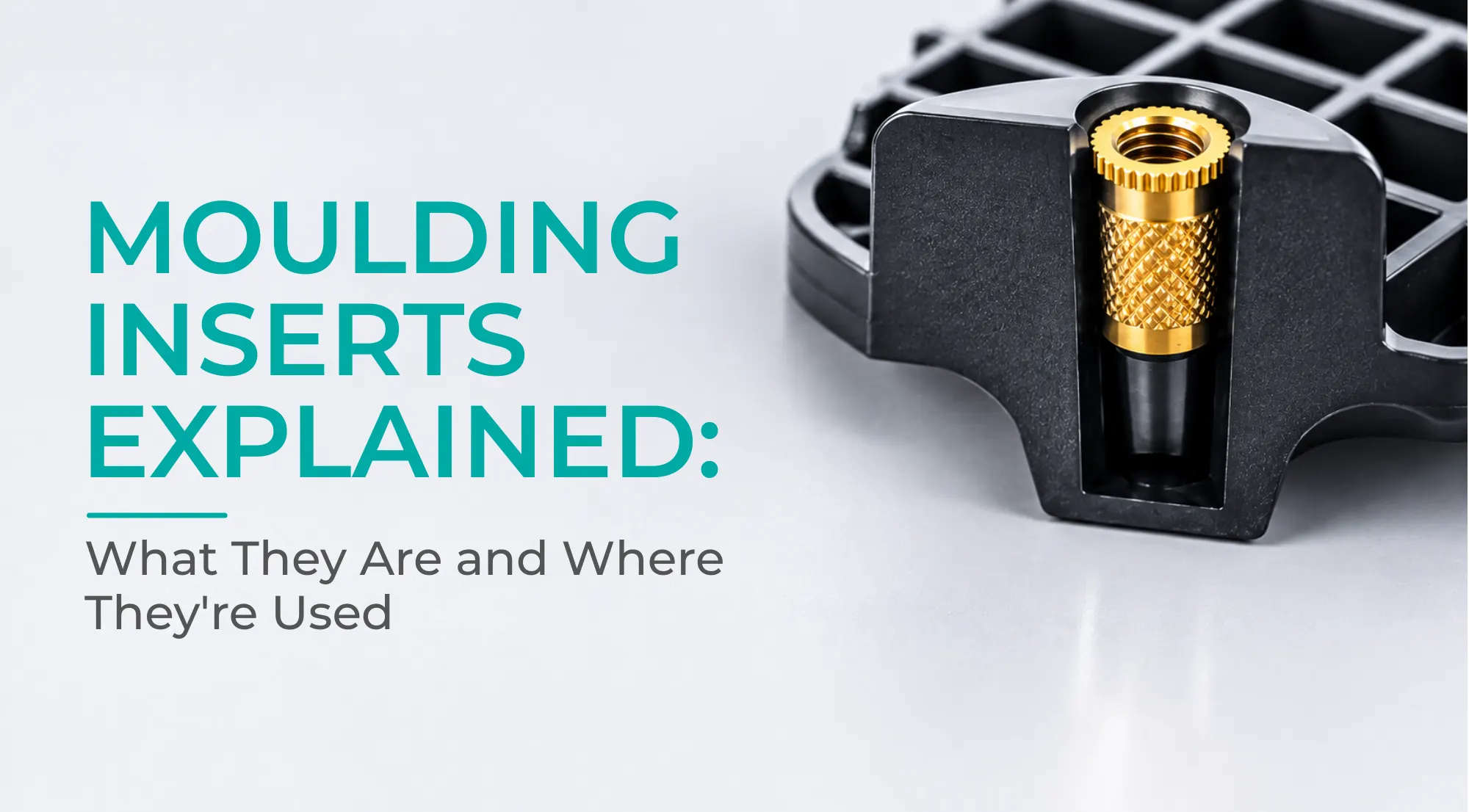


A moulded component may need more than the base material can provide. Plastic parts may require durable threads or mounting points, while rubber components may need rigid sleeves or connection interfaces. Moulding inserts provide a way to integrate these functional features directly into a moulded component.
An insert can be made from brass, steel, stainless steel, copper or other suitable materials and incorporated into plastic, rubber, elastomers and other mouldable materials. In the insert molding process, the preformed insert is positioned in the mould and the moulding material is formed around or against it, creating an integrated component.
From threaded inserts and brass moulding inserts to custom-shaped components, the right insert depends on the material, application, required load and final assembly.
This guide explains how moulding inserts work, where they are used, the materials and types available and the key factors to consider when selecting and manufacturing them.
What Are Moulding Inserts?
Moulding inserts are preformed components incorporated into a moulded part to provide a specific mechanical, structural or functional feature. The insert is positioned at a predetermined location and the moulding material is formed around or against it during the manufacturing process.
The insert becomes part of the finished component rather than simply being added after production.
For example, a plastic housing may need a threaded connection for a screw. A brass threaded insert can be incorporated into the housing during moulding, giving the finished component a durable fastening point. In another application, a rubber mounting component may contain a metal sleeve that provides a rigid interface for installation while the rubber absorbs vibration.
Depending on the component design, moulding inserts can provide:
- Internal or external threads
- Mounting points
- Bushes and sleeves
- Reinforcement
- Electrical contacts
- Alignment features
- Connection interfaces
- Load-bearing points
- Spacing features
- Interfaces between different materials
The insert can therefore solve a specific functional requirement without requiring the entire component to be manufactured from the same material.
It is also important to distinguish moulding inserts from mold inserts. A moulding insert becomes part of the finished component, whereas a mold insert is generally a tooling element used within a mould to create a particular feature.
How Moulding Inserts Work in the Moulding Process
The exact method used to incorporate an insert depends on the moulding material, component geometry and production requirements. However, the basic principle is straightforward: a preformed insert is accurately positioned, the moulding material is introduced around it and the finished material solidifies or cures while retaining the insert.
Insert Design
The process begins by defining the required insert geometry. Dimensions, thread specifications, tolerances, material and retention features are selected according to the finished component. The external surface may include knurling, grooves, flats or other profiles to improve mechanical retention.
Insert Manufacturing
The insert is manufactured according to the required specifications. Depending on its shape and complexity, manufacturing may involve turning, milling, drilling, threading, forming or other precision processes.
Dimensional accuracy is particularly important because the insert must fit correctly within the mould and meet the requirements of the final assembly.
Insert Placement
The finished insert is positioned inside the mould at the required location. Depending on production volume, placement may be manual, fixture-assisted or automated. The insert must remain stable during mould closing and material introduction.
Material Introduction
The moulding material is then introduced into the mould. In plastic injection molding, molten plastic flows around the insert. In rubber or elastomer moulding, the material is formed and cured around or against the insert according to the specific process.
The mould must be designed so that the material can flow or form correctly around the insert while maintaining the required position and coverage.
Cooling, Curing or Solidification
The moulded material then cools, cures or solidifies. During this stage, the material establishes its final shape and retains the insert. Process parameters such as temperature, pressure and cycle time can influence the quality of the finished component.
Inspection
After the component is removed from the mould, the insert and finished part are checked for position, dimensional accuracy, thread condition, retention, material coverage and surface defects such as flash or cracks. Depending on the application, alignment and functional performance may also be verified. For precision components, critical dimensions of both the insert and finished moulded part are inspected to ensure they meet the required specifications.
Types of Moulding Inserts Used in Manufacturing
Different moulding applications require different insert geometries. The right design depends on whether the insert is intended for fastening, mounting, reinforcement, electrical connection or another function.
Threaded Inserts
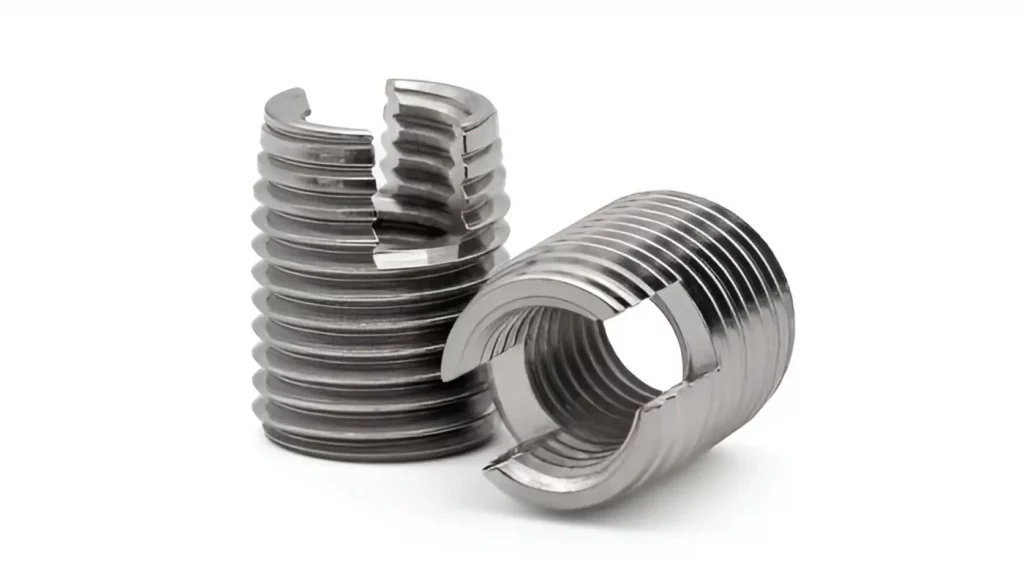
Threaded inserts provide internal or external threads within a moulded component, allowing screws, bolts or other fasteners to be securely connected. They are particularly useful when the surrounding plastic or rubber does not provide sufficient thread strength or durability for the application.
The insert material and external profile are important to its performance. Brass moulding inserts are commonly used for precision threaded applications because they offer good machinability and allow accurate thread and retention features. Depending on the application, the insert may also include knurling, grooves or other external profiles to improve resistance to rotation and pull-out.
Thread size, insert length, surrounding wall thickness and expected assembly loads should be considered during design. Proper positioning is also important, as misalignment can affect fastening and the final assembly.
Knurled Inserts
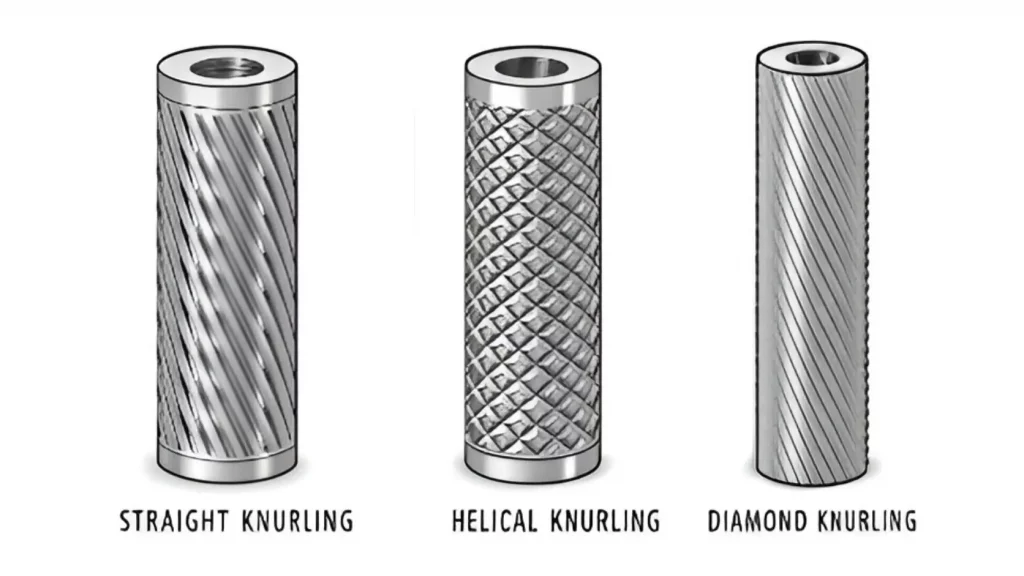
Knurled inserts use a patterned external surface to create mechanical engagement between the insert and the surrounding moulding material. This helps improve resistance to rotation and pull-out, making knurl geometry an important consideration when designing an insert for a moulded component.
The knurl pattern can be selected according to the insert geometry, moulding material and retention requirements. Common patterns include straight, helical and diamond knurling, each providing a different external contact profile.
- Straight knurling: consists of parallel ridges running along the insert. It provides a straightforward mechanical interface and can be suitable where the primary requirement is to increase the grip between the insert and moulded material.
- Helical knurling: uses angled or spiral ridges around the insert. The angled profile creates mechanical engagement along the insert surface and can be considered where the retention requirements and insert geometry favour a helical pattern.
- Diamond knurling: creates an intersecting ridge pattern on the external surface. This provides multiple points of mechanical engagement with the surrounding material and can be useful where resistance to movement is an important design consideration.
The choice between straight, helical and diamond knurling should not be made solely on the basis of the pattern. Insert diameter, embedded length, surrounding wall thickness, moulding material, expected torque and pull-out load should also be considered when determining the appropriate knurl configuration.
For precision moulding inserts, consistent knurl geometry is important because variation in the external profile can affect how the insert interacts with the surrounding moulded material.
Bushes and Sleeves
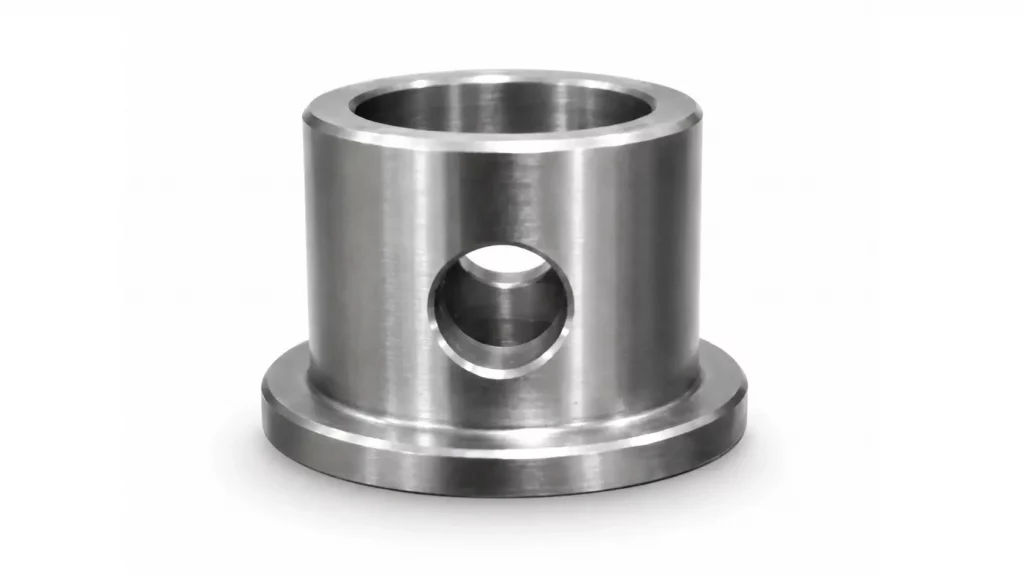
Bushes and sleeves provide controlled openings, mounting points and rigid mechanical interfaces within moulded components. They are commonly used for:
- Shaft alignment and guidance
- Bolt and fastener mounting
- Spacing between components
- Load distribution
- Providing a stable mechanical interface
They are particularly useful when the surrounding moulded material needs to remain flexible, lightweight or vibration-resistant, while the insert provides a rigid and dimensionally stable surface. This makes sleeves especially useful in rubber and elastomer components, where the surrounding material can absorb movement or vibration while the sleeve supports the mounting connection.
The inner diameter, outer diameter, length and wall thickness should be selected according to the supported component and expected loads to maintain proper alignment and reliable performance.
Custom-Shaped Inserts
Not every application can be addressed with a standard insert geometry. Custom molding inserts can be designed with specific dimensions, profiles, holes, threads, retention features or other characteristics according to the final component requirements.
Custom designs are particularly useful when the insert must fit within a specialised mould or perform multiple functions within one component.
Which Materials Are Used for Moulding Inserts?
Material selection should be based on the function of the insert, the surrounding moulding material and the operating environment.
| Insert Material | Why It May Be Selected | Typical Considerations |
|---|---|---|
| Brass | Good machinability and suitable corrosion resistance | Threaded inserts, fittings, HVAC, electrical applications |
| Steel | High strength and durability | Higher mechanical loads and structural interfaces |
| Stainless Steel | Corrosion resistance | Moisture, chemicals and demanding environments |
| Copper | Electrical and thermal conductivity | Conductive and specialised applications |
| Bronze | Good wear resistance and corrosion resistance | Bushes, sleeves and applications requiring durability |
| Aluminium | Low weight and good machinability | Lightweight components and applications where weight reduction is important |
| Plastic / Polymer | Low weight, insulation and material compatibility | Applications where electrical insulation or non-metallic construction is required |
Brass
Brass is widely used for precision inserts, particularly for threaded applications. It offers good machinability and suitable corrosion resistance for many industrial applications. Its ability to be accurately machined makes it suitable for producing threads, knurling and other detailed features.
Brass moulding inserts are commonly considered for applications involving plastic fittings, HVAC components, plumbing components, electrical assemblies and industrial products.
Steel and Stainless Steel
Steel inserts can be selected when higher mechanical strength and durability are required. Stainless steel can be preferred where corrosion resistance is an important consideration. The specific material grade should be selected based on the operating environment and performance requirements.
These materials can be used for mounting points, sleeves, structural interfaces and other demanding applications.
Copper and Other Alloys
Copper may be selected when electrical conductivity or thermal performance is important. Other alloys can also be considered for specialised applications where a particular combination of strength, corrosion resistance, conductivity, temperature resistance or machinability is required.
Plastic and Other Materials
Metal is not the only option. Plastic or polymer inserts can be suitable for applications where low weight, electrical insulation, chemical resistance or compatibility with the surrounding moulded material is required.
Material selection should therefore be based on the complete component rather than simply the insert manufacturing process.
Bronze
Bronze can be considered where wear resistance, durability and corrosion resistance are important. Depending on the application, it may be used for bushes, sleeves and other components requiring a durable material interface.
Aluminium
Aluminium can be selected when low weight and good machinability are important. It may be suitable for applications where weight reduction is a consideration and the mechanical requirements do not require a heavier insert material.
Moulding Inserts for Plastic, Rubber and Other Components
Moulding inserts are not restricted to one type of moulded material. Their application changes according to the material and manufacturing process.
-
Plastic Moulding Applications
Plastic is one of the most common materials used with inserts. In insert moulding, a preformed insert is positioned inside the mould before plastic is injected around it. Injection molding inserts are useful when a plastic component requires a durable thread, mounting point, electrical contact or other functional interface.
-
Rubber and Elastomer Applications
Rubber and elastomers can also be moulded with inserts. In these applications, the insert can provide a rigid mounting point, reinforcement, sleeve or connection interface while the rubber provides flexibility, sealing, vibration isolation or damping.
For example, a rubber mounting component may incorporate a metal sleeve. The sleeve provides a controlled mounting surface while the rubber helps absorb vibration and movement.
-
Other Specialised Moulding Applications
Specialised moulding and composite manufacturing can also use embedded components or inserts where a finished part requires an additional structural or functional element.
The terminology can differ between manufacturing processes, so the insert should always be evaluated according to the specific material and production method being used.
Key Design Considerations for Moulding Inserts
Designing an effective moulding insert requires consideration of both the insert and the final moulded component.
Insert Geometry: The shape of the insert should support its intended function and provide adequate retention within the moulded material.
Dimensional Accuracy: The insert needs to meet specified dimensions and tolerances so that it fits correctly into the mould and performs as required in the finished product.
Positioning: Accurate positioning is essential, particularly for threaded inserts, electrical contacts and mounting points. Incorrect positioning can affect assembly, wall thickness, alignment and overall component performance.
Retention: The insert needs to remain securely positioned during the moulding process and throughout the service life of the component. Knurling, grooves, flats and other external features can be used where appropriate to improve retention.
Material Compatibility: The insert material and moulding material should be compatible with the operating and processing conditions. Temperature, chemical exposure, moisture and differences in thermal expansion may all need to be considered.
Mould Design: The mould must accommodate the insert accurately and allow the moulding material to form around it correctly. Poor mould design can contribute to movement, incomplete material coverage, flash or other defects.
Where Are Moulding Inserts Used?
Molding inserts are used across industries where a moulded component needs a durable thread, mounting point, electrical connection or mechanical interface.
Automotive and Transportation: Used in sensor housings, connectors, mounting components and rubber vibration-control parts where plastic or rubber needs a stronger interface.
HVAC and Refrigeration: Brass inserts are used in moulded fittings, housings and connection components where a durable threaded or mechanical connection is required.
Electrical and Electronics: Used in connector bodies, electrical housings, terminals and mounting points to provide reliable mechanical or conductive interfaces.
Plumbing and Fluid Handling: Metal inserts can provide threaded connection points in plastic components used for fittings and fluid-handling assemblies.
Industrial Equipment: Used in machine housings, protective covers, instruments, fittings and mounting components where moulded materials require reinforced connection points.
Consumer Products: Found in housings, handles and internal assemblies where durable fastening or mounting points are required.
How to Choose the Right Moulding Inserts for Your Application
Choosing the right insert begins with understanding what the finished component needs to do.
Consider:
- Application requirements – Identify the exact function the insert must provide.
- Moulding material – Determine whether the component will use plastic, rubber, elastomer or another material.
- Insert material – Select brass, steel, stainless steel, copper, plastic or another suitable material.
- Mechanical loads – Consider pull-out force, torque, vibration and repeated fastening.
- Thread requirements – Define thread size, pitch, depth and tolerance where applicable.
- Operating environment – Consider temperature, moisture, chemicals and other environmental factors.
- Insert geometry – Select suitable retention and functional features.
- Production volume – Determine the appropriate manufacturing and insert-placement approach.
- Dimensional requirements – Establish critical dimensions and tolerances.
- Inspection requirements – Define how the insert and finished component will be verified.
The objective is not simply to select the strongest insert. The insert should provide the required performance while remaining compatible with the moulding material, manufacturing process and final assembly.
Why Choose Schilthorn for Moulding Inserts?
With 15+ years of experience in precision engineering and manufacturing, Schilthorn Precision Engineering manufactures precision moulding inserts for applications across HVAC, automotive and other industrial sectors. Its moulding inserts are manufactured in brass and can be produced with straight, helical and diamond knurl patterns according to application requirements.
Schilthorn also manufactures CPVC fitting inserts and supports customised insert requirements based on specified dimensions and materials.
Have a moulding insert requirement?
Share your drawing, sample or specifications with Schilthorn to discuss your requirement with the manufacturing team. Connect with us today.
Frequently Asked Questions About Moulding Inserts
1. Can moulding inserts be used for high-temperature applications?
Yes, moulding inserts can be used in high-temperature applications, but both the insert and surrounding moulding material must be suitable for the operating temperature. Metal inserts such as brass, steel or stainless steel can withstand significantly higher temperatures than many polymers, but the surrounding plastic or rubber remains a key limitation. Thermal expansion between the insert and moulding material should also be considered during design.
2. Can one moulded component have multiple inserts?
Yes. A single moulded component can incorporate multiple inserts when several threaded, mounting, electrical or mechanical interfaces are required. Their locations must be accurately defined in the mould so that the inserts remain correctly positioned during the moulding cycle.
3. Do moulding inserts affect the cycle time of injection molding?
They can. Insert placement, positioning and removal requirements may add steps to the moulding cycle, particularly when inserts are loaded manually. The effect depends on the number of inserts, component geometry, placement method and degree of automation. High-volume applications may use fixtures or automated placement to improve consistency and cycle efficiency.
4. What happens if a moulding insert is incorrectly positioned?
Incorrect insert positioning can cause thread misalignment, uneven material coverage, dimensional problems or difficulty during final assembly. In applications where the insert connects the moulded component to another part, even a small positional error can affect fitment and function.
5. What tolerances are important for moulding inserts?
Important tolerances depend on the insert’s function and may include outside diameter, inside diameter, thread dimensions, length, concentricity and positional accuracy. The critical dimensions should be defined according to the mould, surrounding material and final assembly requirements.
6. Can moulding inserts be manufactured according to a drawing?
Yes. Custom moulding inserts can be manufactured according to an engineering drawing specifying dimensions, tolerances, material, thread details and other critical features. For application-specific requirements, a drawing or sample can help define the required insert geometry accurately.