
Understanding Flanges: Types, Standards & Industrial Applications
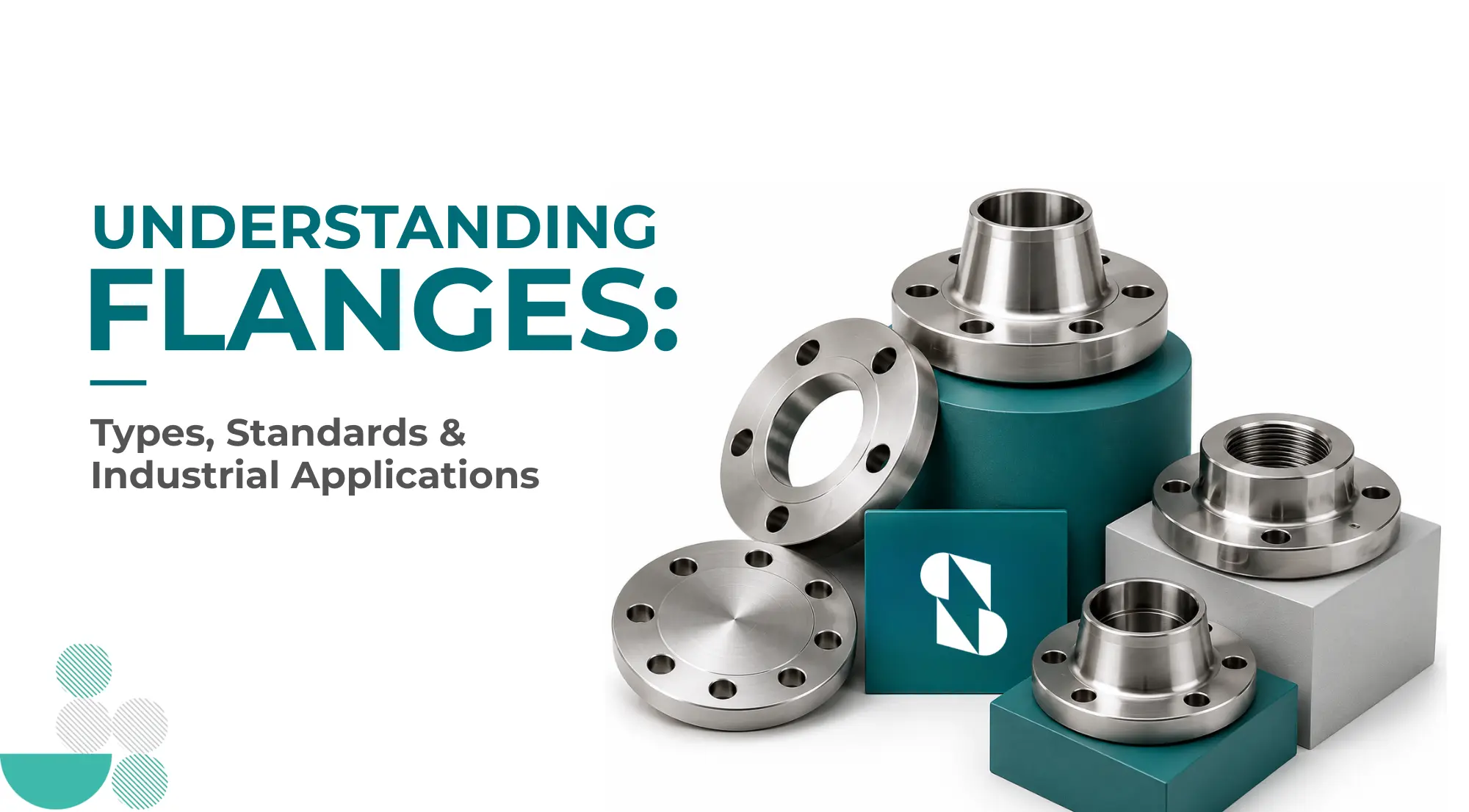


The word “flange” traces back to the 1680s derived from an old French word meaning “side” or “edge.” For over 200 years, it remained a niche engineering term. Today, it holds together a USD 6.4 billion global industry, powering oil & gas pipelines, power plants, chemical refineries, HVAC systems and aerospace assemblies across the world.
Yet for something so fundamental, flanges are surprisingly misunderstood. Most buyers know they need one. Far fewer understand which type, which standard, or which material is right for their application and that gap between assumption and specification is where failures happen.
This guide breaks it down clearly: what flanges are, the main types used in industrial applications, the standards that govern them, and how to select the right one for your system whether you’re working in high-pressure oil lines, precision HVAC assemblies, or heavy industrial machinery.
What Is an Industrial Flange?
A flange is a mechanical component that connects pipes, valves, pumps and pressure vessels into a unified piping system. It does this through a simple but engineered assembly: two matching flange faces, a gasket seated between them, and bolts that clamp the joint under controlled pressure.
The result is a connection that holds reliably under high pressure, high temperature and demanding operating conditions, while still allowing the system to be dismantled for maintenance, inspection or replacement without cutting into the pipeline.
That last point is what makes flanges indispensable. Unlike permanent welded joints, a flanged connection gives engineers and maintenance teams access to the system. Equipment can be isolated, inspected, serviced and reassembled without disrupting the entire line.
A standard flange joint has three components working together:
- Flanges: attached to the pipe ends or equipment being connected
- Gasket: seated between the flange faces to create a leak-proof seal
- Bolts and nuts: that draw the flanges together, compressing the gasket evenly across the joint
Available in a wide range of designs, materials and pressure ratings, industrial flanges are one of the most versatile and widely used connection methods across oil & gas, HVAC, power generation, chemical processing and industrial machinery applications.
Why Industrial Flanges Are Preferred
Industrial flanges offer several advantages over other pipe connection methods:
- Easy installation and removal during maintenance
- Reliable sealing under demanding operating conditions
- Compatibility with a wide range of pipe sizes and materials
- Simplified inspection, cleaning and equipment replacement
- Suitable for both low-pressure and high-pressure applications
Because of these benefits, industrial flanges are widely used in pipelines carrying liquids, gases, steam and other process media across numerous industries.
Types of Industrial Flanges
Selecting the appropriate flange depends on several factors, including operating pressure, temperature, piping layout, maintenance requirements and the type of fluid being handled. Different flange designs are engineered for specific applications, making it important to understand their characteristics before selecting one.
Below are the most commonly used types of industrial flanges.
1. Weld Neck Flange
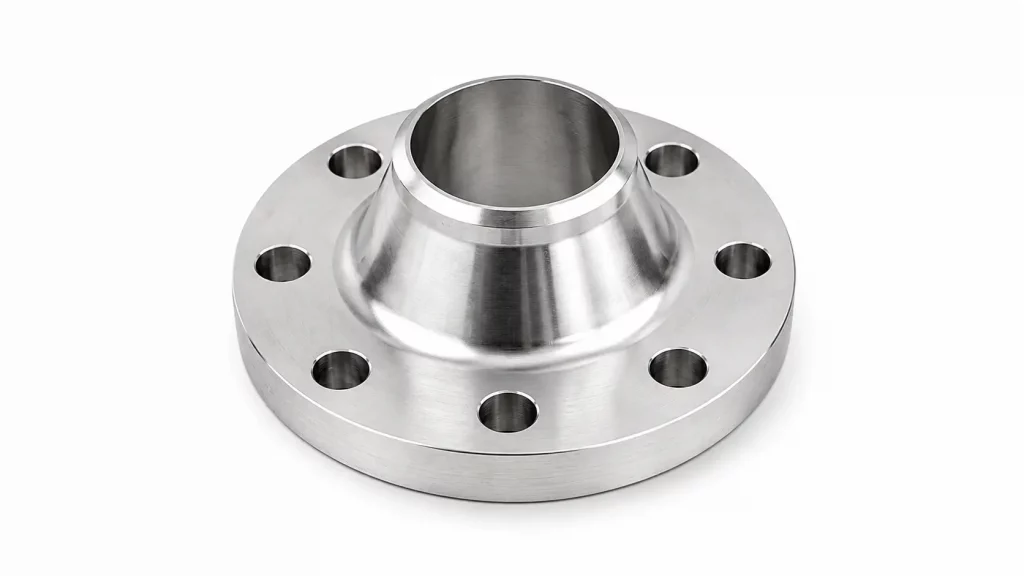
The weld neck flange is one of the strongest and most reliable flange types used in industrial piping systems. It features a long-tapered hub that gradually transfers stress from the flange to the pipe, reducing stress concentration at the weld joint.
Because of its superior strength and excellent fatigue resistance, weld neck flanges are commonly used in high-pressure, high-temperature and critical process applications.
Common Applications
- Oil and gas pipelines
- Petrochemical plants
- Power generation
- High-pressure steam systems
Key Advantages
- Withstands high-pressure and high-temperature operating conditions, making it suitable for critical industrial piping systems.
- Minimises fatigue caused by repeated pressure fluctuations and thermal cycling, improving long-term reliability.
- Distributes stress evenly between the flange and pipe, reducing the risk of weld joint failure.
- Delivers a long service life with lower maintenance requirements compared to many other flange types.
2. Slip-On Flange
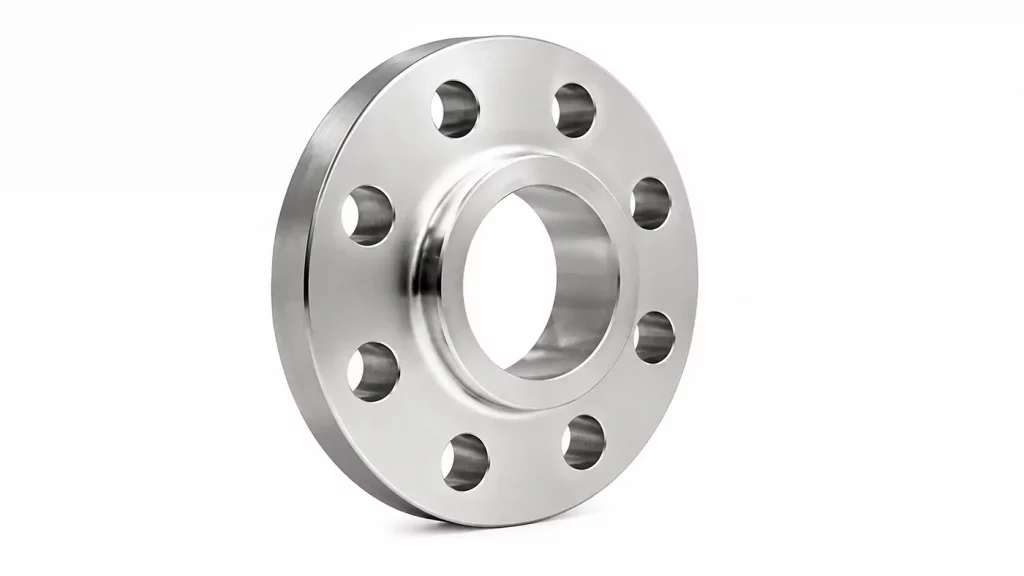
Slip-on flanges are designed to slide over the outside diameter of the pipe before being welded from both the inside and outside. Their simple design makes installation easier and more economical than weld neck flanges.
Although they are not recommended for highly demanding applications, slip-on flanges are widely used in moderate-pressure piping systems where cost-effectiveness and ease of installation are important considerations.
Common Applications
- Water distribution systems
- Cooling water pipelines
- Fire protection systems
- Low to medium-pressure process piping
Key Advantages
- Offers a cost-effective solution for low to medium-pressure piping systems without compromising performance.
- Slides easily over the pipe, simplifying alignment and reducing installation time.
- Requires less machining and simpler welding procedures, making fabrication more economical.
- Well suited for general industrial, utility and HVAC applications where moderate operating conditions are expected.
3. Blind Flange
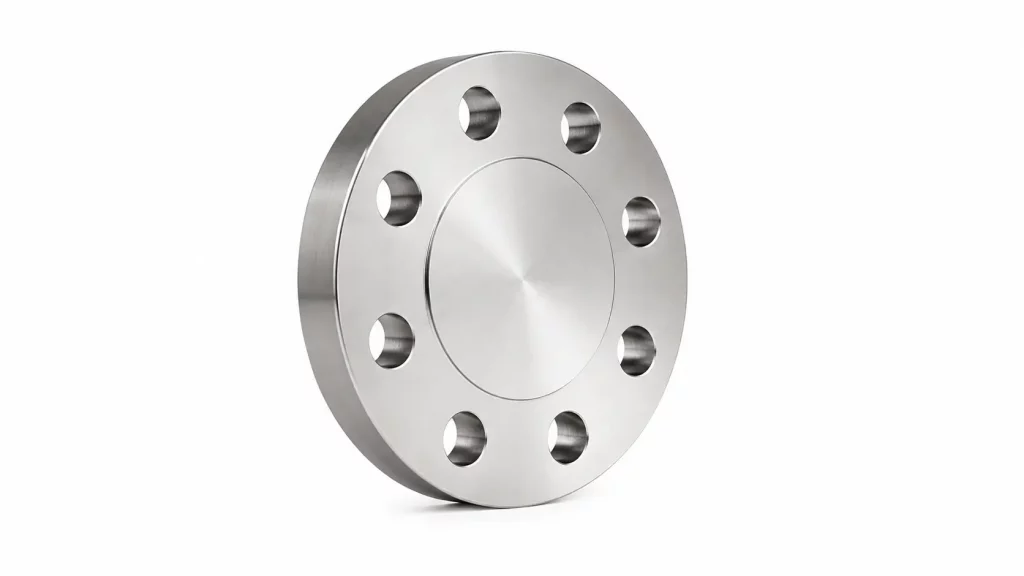
A blind flange is a solid flange without a bore, used to close the end of a pipeline, pressure vessel or equipment nozzle. Unlike other flange types that allow fluid flow, blind flanges completely seal the system while still providing access for future inspection or expansion.
Blind flange carbon steel designs are among the most commonly used in industrial applications because they offer excellent strength, durability and cost-effectiveness. Depending on the operating environment, carbon steel blind flange solutions are available in various pressure classes and sizes to meet industry requirements.
Common Applications
- Pipeline end closures
- Pressure vessel openings
- Future pipeline expansion points
- Equipment maintenance isolation
Key Advantages
- Provides a reliable pressure-tight seal for safely terminating pipelines, pressure vessels and equipment nozzles.
- Allows pipelines to be easily reopened for future expansion, inspection or system modifications.
- Can be removed and reinstalled without cutting or altering the piping system, simplifying maintenance.
- Performs reliably in high-pressure and high-temperature applications when manufactured to the appropriate ASME pressure class.
4. Socket Weld Flange
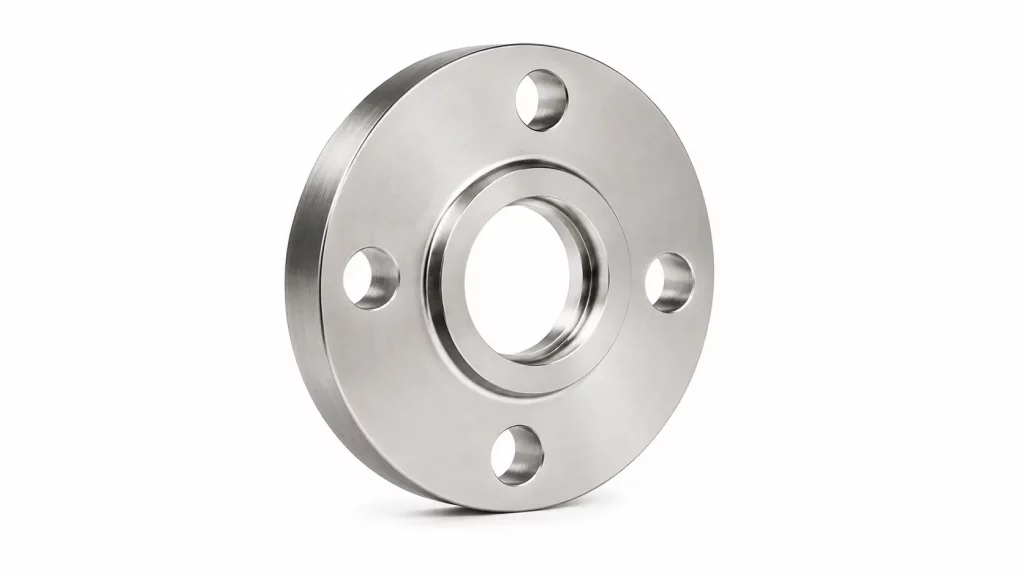
Socket weld flanges are designed primarily for small-diameter, high-pressure piping systems. The pipe is inserted into a recessed socket before being fillet welded around the outside, creating a strong and leak-resistant connection.
Because the internal bore remains smooth, socket weld flanges minimise turbulence and pressure loss within the piping system.
Common Applications
- Hydraulic systems
- Steam lines
- Chemical processing
- High-pressure instrumentation piping
Key Advantages
- Provides a strong, leak-resistant welded connection for small-diameter, high-pressure piping systems.
- Maintains a smooth internal bore that reduces turbulence and minimises pressure loss.
- Well suited for compact piping installations where strength and space efficiency are important.
- Delivers reliable performance in high-pressure and high-temperature applications such as steam, hydraulic and instrumentation systems.
5. Threaded Flange
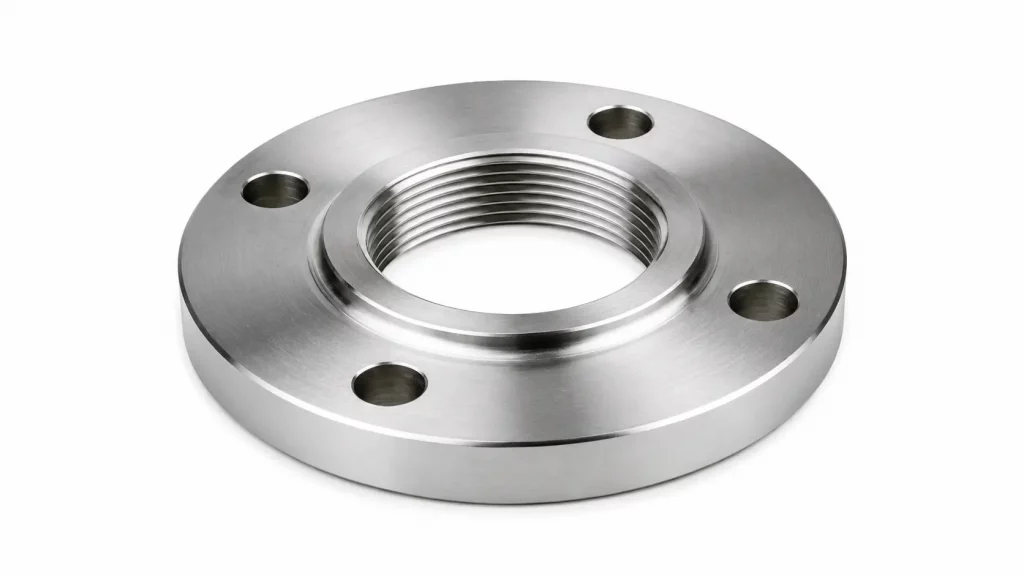
Threaded flanges connect to pipes using internal threads instead of welding. This makes them particularly useful in applications where welding is impractical, hazardous or not permitted.
Although threaded flanges are generally limited to lower-pressure services, they remain a practical solution for temporary installations and systems requiring easy assembly.
Common Applications
- Utility pipelines
- Gas distribution
- Low-pressure water systems
- Hazardous environments where welding is restricted
Key Advantages
- Eliminates the need for welding, making installation safer and more convenient in restricted or hazardous environments.
- Enables quick assembly and disassembly, reducing installation time and maintenance effort.
- Simplifies inspection, repair and replacement without requiring specialised welding equipment.
- Offers a cost-effective solution for low-pressure piping systems where welded connections are not necessary.
6. Lap Joint Flange
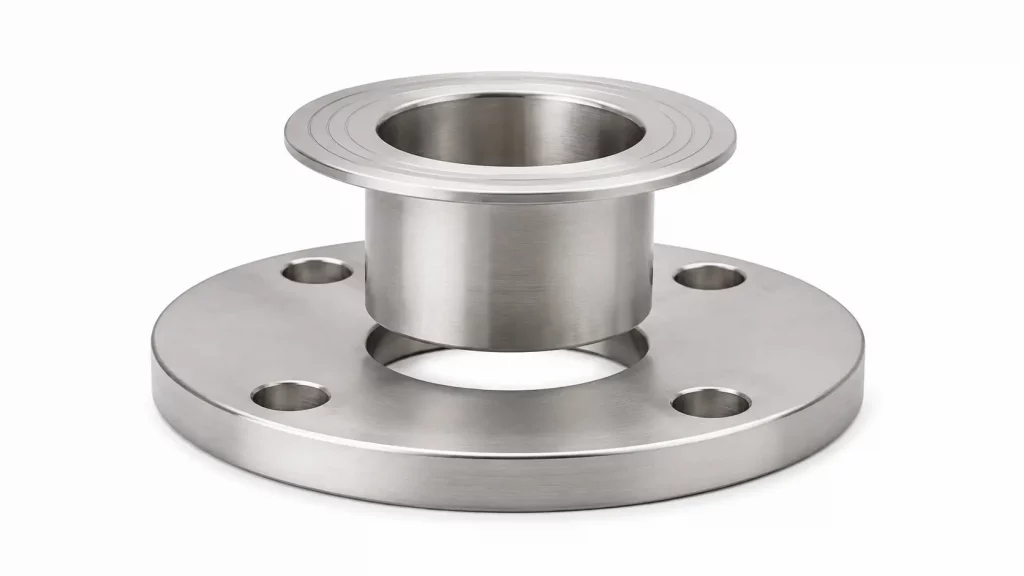
Lap joint flanges are used together with stub ends, allowing the flange to rotate freely around the pipe. This design makes bolt alignment easier and simplifies dismantling where equipment requires frequent maintenance.
They are commonly selected for systems handling corrosive fluids because the flange itself does not come into direct contact with the process media.
Common Applications
- Food processing
- Pharmaceutical plants
- Chemical processing
- Systems requiring frequent dismantling
Key Advantages
- Allows the flange to rotate freely, making bolt alignment faster and simplifying installation.
- Enables quick dismantling and reassembly, making it ideal for systems requiring frequent maintenance.
- Keeps the flange isolated from the process fluid, making it well suited for corrosive service applications.
- Allows the flange to be reused with a new stub end, reducing replacement costs and improving maintenance efficiency.
7. Orifice Flange
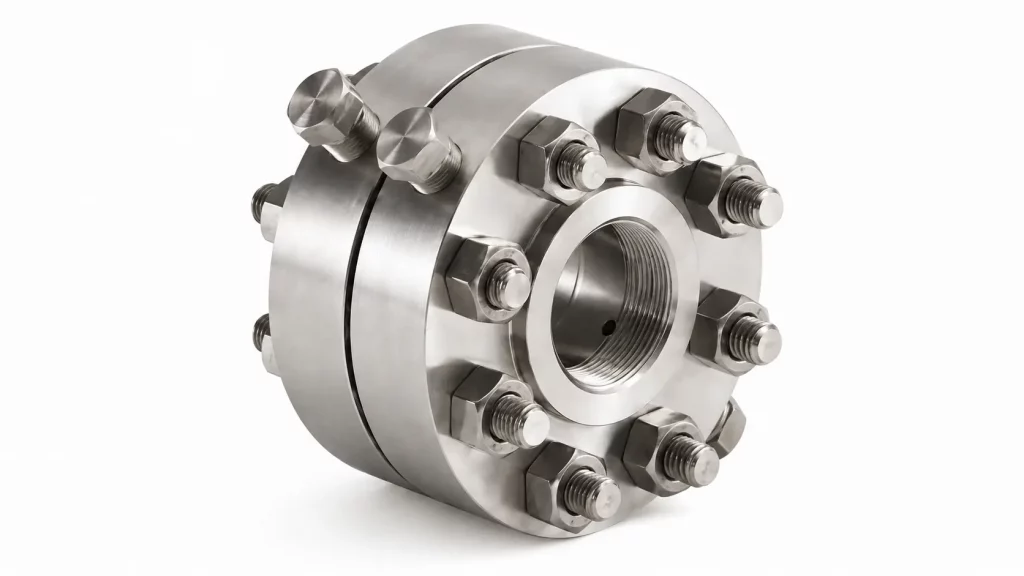
Orifice flanges are specially designed to support flow measurement devices within piping systems. They incorporate pressure tap holes that allow differential pressure instruments to accurately measure fluid flow.
These flanges are widely used in industries where precise process monitoring and control are essential.
Common Applications
- Oil and gas processing
- Chemical plants
- Power stations
- Industrial process control systems
Key Advantages
- Supports accurate and reliable flow measurement by accommodating differential pressure instruments.
- Integrates pressure tapping points directly into the flange, eliminating the need for additional pipe fittings.
- Simplifies the installation and maintenance of flow measurement equipment in process piping systems.
- Provides dependable performance in critical applications where precise process monitoring and control are essential.
Partner with Schilthorn for custom industrial flanges designed to meet your exact technical and quality requirements.
Industrial Flange Comparison
| Flange Type | Best Suited For | Typical Pressure Service | Common Industries |
|---|---|---|---|
| Weld Neck | High-pressure pipelines | High | Oil & Gas, Power, Petrochemical |
| Slip-On | General piping systems | Low to Medium | Water Treatment, HVAC |
| Blind | Closing pipe ends and equipment | Medium to High | Process Industries, Refineries |
| Socket Weld | Small-bore high-pressure piping | High | Chemical, Steam Systems |
| Threaded | Non-welded installations | Low | Utilities, Gas Distribution |
| Lap Joint | Frequent maintenance applications | Low to Medium | Food, Pharma, Chemical |
| Orifice | Flow measurement systems | Medium to High | Oil & Gas, Process Plants |
Types of Flange Faces
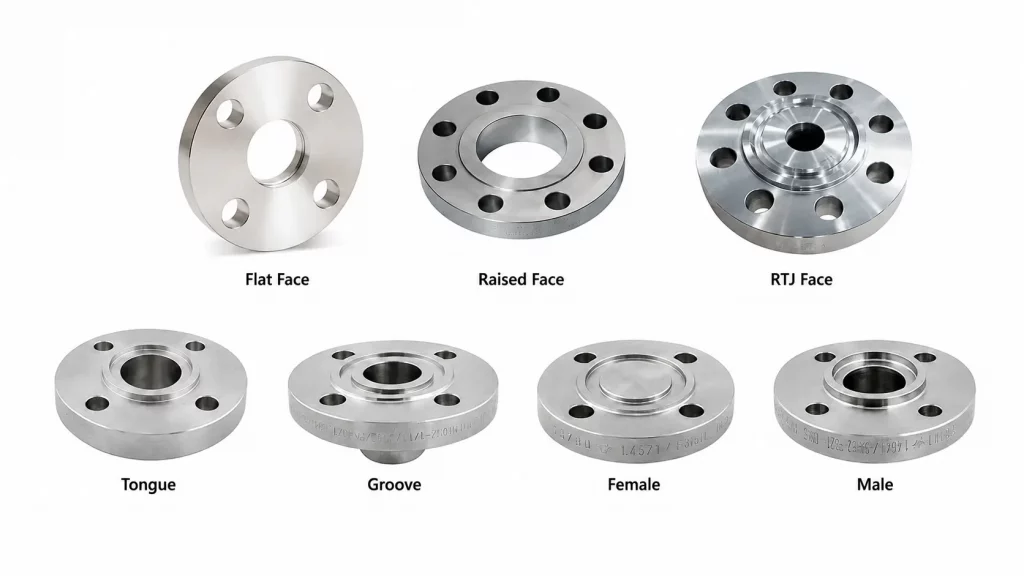
The flange type determines how a connection is built. The flange face determines how it seals. Get the face wrong and the joint will leak, fail prematurely or simply not assemble at all.
A flange face is the machined surface where two flanges meet with a gasket between them. Its geometry determines what gasket can be used, how sealing pressure is distributed and what operating conditions the joint can handle.
There are five main face types used in industrial piping.
1. Raised Face (RF)
The most common face type globally. A small raised ring concentrates bolt load onto a smaller gasket area creating higher interface pressure and a more reliable seal. Compatible with flat ring, spiral wound and metallic composite gaskets across most ASME pressure classes.
Best for: General industrial service, oil and gas, HVAC, chemical processing.
2. Flat Face (FF)
No raised step the gasket surface sits flush with the bolt circle. A full-face gasket distributes load evenly, making it the safe choice when connecting to cast iron or fibreglass equipment where concentrated pressure would risk cracking.
Never bolt a flat face flange to a raised face flange the surfaces do not match and the joint will not seal.
Best for: Low-pressure utility systems, connections to cast iron or fibreglass equipment.
3. Ring Type Joint (RTJ)
A solid metal ring seats into a precision-machined groove in the flange face. When bolts are tightened, the ring deforms slightly into the groove creating a metal-to-metal seal the most reliable sealing method available for extreme service conditions.
Required for Class 600 and above, high temperature systems above 427°C and applications where vibration or thermal cycling would degrade a conventional gasket.
Best for: Upstream oil and gas, high-pressure pipelines, critical process equipment.
4. Tongue and Groove (T&G)
Matched pairs only one flange has a raised tongue; the mating flange has a corresponding groove. The gasket sits fully enclosed within the groove, protected and self-aligned during assembly. Ideal for systems that are regularly dismantled and reassembled.
Best for: High-pressure steam systems, applications requiring repeatable sealing.
5. Male and Female (M&F)
Similar to tongue and groove but the gasket contacts the process fluid directly making gasket material selection critical in corrosive services. Most commonly found on heat exchanger shell-to-bonnet joints and specialised pressure vessel connections.
Best for: Heat exchangers, pressure vessel and specialised equipment joints.
Quick Reference: Flange Face Types
| Flange Face Type | Typical Pressure Range | Common Gasket Type | Typical Applications |
|---|---|---|---|
| Raised Face (RF) | Low to High | Spiral wound, flat ring | General industrial piping, oil & gas, HVAC systems |
| Flat Face (FF) | Low | Full-face soft gasket | Cast iron equipment, utility and water piping |
| Ring Type Joint (RTJ) | High (Class 600+) | Metal ring gasket | Upstream oil & gas, refineries, high-temperature and high-pressure process systems |
| Tongue & Groove (T&G) | Moderate to High | Soft or metallic gasket | Steam systems, process piping and applications requiring frequent maintenance |
| Male & Female (M&F) | Moderate to High | Soft or metallic gasket | Heat exchangers, pressure vessels and critical process equipment |
Common Materials Used for Industrial Flanges
Selecting the right flange material is just as important as choosing the correct flange type. Industrial flanges operate under different temperatures, pressures and process conditions, making material compatibility essential for ensuring long-term performance, corrosion resistance and structural integrity.
The most commonly used flange materials include carbon steel, stainless steel, alloy steel and forged steel. Each material offers distinct advantages depending on the application and operating environment.
1. Carbon Steel Flanges
Carbon steel pipe flanges are among the most widely used flange materials due to their excellent strength, durability and cost-effectiveness. They perform well in applications involving moderate temperatures and pressures, making them suitable for general industrial piping systems.
Carbon steel flanges are commonly found in:
- Oil and gas pipelines
- Water treatment plants
- Power generation facilities
- General process industries
2. Stainless Steel Industrial Flanges
When corrosion resistance is a primary concern, stainless steel industrial flanges are often the preferred choice. Their ability to withstand aggressive chemicals, moisture and high temperatures makes them ideal for hygienic and corrosive environments.
Typical applications include:
- Chemical processing plants
- Food and beverage industries
- Pharmaceutical manufacturing
- Marine applications
3. Forged Steel Flanges
A forged steel flange is manufactured by shaping heated steel under high pressure, resulting in a stronger and more uniform grain structure than cast components. This process improves mechanical strength, impact resistance and fatigue performance, making forged steel flanges suitable for demanding industrial environments.
They are widely used in:
- High-pressure steam systems
- Refineries
- Petrochemical plants
- Power generation facilities
4. Alloy Steel and Special Material Flanges
For highly demanding operating conditions, specialised materials such as Duplex Stainless Steel, Super Duplex, Inconel, Monel and Hastelloy provide enhanced corrosion resistance and mechanical strength. These materials are commonly selected for offshore, marine and chemical processing applications where standard carbon steel may not provide sufficient durability.
Understanding ASME Flange Standards
A flange is only as good as the standard behind it. You can have the right type, the right material and the right size but if the flange isn’t manufactured to a recognised standard, none of that matters. It won’t mate correctly; it won’t hold its rated pressure reliably and it will create compliance risk on any project governed by international piping codes.
In industrial piping, that standard is almost always ASME the American Society of Mechanical Engineers. ASME flange standards define the complete performance framework: dimensions, tolerances, pressure-temperature ratings, material requirements and marking. For engineers and procurement teams, knowing which standard applies to your application is not a technical detail, it is the starting point for every correct flange decision.
1. ASME B16.5: Where Most Industrial Flange Decisions Begin
ASME B16.5 covers pipe flanges from ½ inch up to 24 inches in diameter. It spans seven pressure classes 150, 300, 400, 600, 900, 1500 and 2500 and covers all major flange types including weld neck, slip-on, blind, threaded, socket weld and lap joint configurations.
For most industrial applications like oil and gas piping, chemical plant flange fittings, HVAC flanges, power generation and general process piping B16.5 is the governing standard. When a project specification calls for ASME industrial flanges without further qualification, B16.5 is almost always what is meant.
Flange Pressure Ratings Explained
Pressure ratings define the maximum pressure and temperature conditions under which a flange can safely operate. Selecting the correct pressure class is essential to maintaining system safety and preventing leakage.
Common ASME pressure classes include:
| Pressure Class | Typical Applications |
|---|---|
| Class 150 | Low-pressure water, HVAC and utility services |
| Class 300 | General industrial processing |
| Class 600 | Medium to high-pressure process systems |
| Class 900 | Refinery and petrochemical services |
| Class 1500 | High-pressure industrial applications |
| Class 2500 | Critical high-pressure systems |
Here is something many buyers get wrong: a pressure class number is not a fixed pressure limit. ASME ratings are always tied to temperature. The higher the operating temperature, the lower the allowable pressure. A carbon steel flange running at high temperature can lose more than 70% of its ambient pressure capacity. Specifying a flange by class alone without accounting for operating temperature is one of the most common and expensive mistakes in flange procurement.
2. ASME B16.47: When the Pipe Gets Bigger
Once pipe diameter exceeds 24 inches, B16.5 no longer applies. ASME B16.47 takes over, covering weld neck and blind flanges from 26 inches up to 60 inches across pressure classes 75 through 900.
What makes B16.47 distinct is its two-series structure and the difference matters:
- Series A: Heavier, larger outside diameter with fewer bolt holes. Common in large pipeline and heavy industrial applications. Originally developed under MSS SP-44.
- Series B: More compact design with a smaller bolt circle. Preferred in offshore and space-constrained process environments. Derived from the former API 605 standard.
A Class 600 flange specified under B16.5 and one specified under B16.47 carry the same pressure rating but their dimensions and bolt patterns are different. They cannot be used interchangeably. For procurement teams sourcing large-diameter flanges across multiple suppliers, this distinction can mean the difference between a system that assembles cleanly and one that doesn’t assemble at all.
3. ASME B16.21: The Gasket Standard That Ties It Together
Flanges don’t seal on their own gaskets do. ASME B16.21 defines the dimensions and tolerances for gaskets used with B16.5 and B16.47 flanges, covering raised face, flat face and ring joint configurations. Specifying the correct gasket to B16.21 ensures the sealing interface performs as designed under the actual pressure and temperature the system will see in service, not just under test conditions.
What This Means When Evaluating a Flange Supplier
ASME compliance is a baseline not a selling point. Any credible industrial flange manufacturer should be working to these standards as a matter of course. What separates a reliable supplier from an unreliable one is whether they can demonstrate it: through material certifications, dimensional inspection records and documented traceability back to the correct ASME specification.
When reviewing a supplier, confirm:
- The correct ASME standard for your flange size and pressure class
- Material specification alignment, ASTM A105 for carbon steel, A182 for stainless and alloy grades
- Documented dimensional inspection against ASME tolerances
- Pressure class and operating temperature both considered together, never class alone
Industrial Applications of Flanges
Flanges are not sector-specific components they are foundational infrastructure. Wherever a piping system needs to be connected, isolated, inspected or maintained, an industrial pipe flange is almost always involved.
What changes across industries is not the principle but the specification the flange type, material grade, pressure class and facing type must all match the demands of the operating environment.
1. Oil & Gas
Few industrial environments are as unforgiving as oil and gas. Pipelines carry hydrocarbons under extreme pressure and high temperatures across upstream wellheads, midstream transfer lines and downstream refining facilities. A joint failure here is not just a maintenance problem it is a safety and environmental incident.
Oil and gas piping flanges are specified to handle exactly this reality:
- Weld neck flanges: preferred at critical connections for their fatigue resistance under pressure cycling
- Forged steel flanges: the material standard, offering superior mechanical strength over cast alternatives
- Carbon steel blind flanges: widely used for pipeline terminations and pressure vessel isolation, available from ASME Class 150 through Class 2500
Material grades such as ASTM A105 carbon steel and A182 stainless and alloy steel are selected based on process media and operating conditions, all governed by ASME industrial flanges specifications.
2. Chemical Processing
In chemical plants, it is not just pressure and temperature that degrade a joint it is what flows through the pipe. Aggressive acids, alkalis and solvents attack carbon steel over time, making material selection as critical as dimensional specification.
Common specifications in chemical processing:
- 304L and 316L stainless steel industrial flanges for standard corrosive service
- Duplex stainless steel and nickel alloys for the most aggressive process environments
- Lap joint flanges where the flange body must stay isolated from process fluid contact
- Carbon steel pipe flanges where the process environment permits
Chemical plant flange fittings must be selected with both the chemical compatibility and the pressure-temperature profile of the system in mind not just one or the other.
3. HVAC Systems
HVAC flanges connect chilled water circuits, hot water distribution lines, steam systems and air handling equipment. The operating conditions are less extreme than oil and gas, but reliability and maintenance accessibility are equally non-negotiable in systems that run continuously.
- Slip-on carbon steel pipe flanges are the most common choice economical and easy to install
- Stainless steel industrial flanges are specified where hygiene or corrosion is a concern
- Correctly flanged HVAC connections can be broken and reassembled quickly, without disrupting the wider system reducing maintenance downtime significantly
4. Power Generation
Power plants run on pressure. Steam drives turbines, heat exchangers transfer energy and boilers operate at the upper limits of material performance. Every flange connection must hold across thousands of hours of continuous operation and repeated thermal cycling.
Standard specifications in power generation:
- Weld neck and forged steel flanges for structural integrity under combined pressure, temperature and fatigue loading
- Blind flange carbon steel construction for pressure vessel isolation and maintenance access points
- ASME industrial flanges at Class 900 and Class 1500 ratings for high-pressure steam circuits
5. Water & Wastewater Treatment
Water treatment facilities handle large volumes of fluid through pumps, valves, filtration equipment and distribution networks. Pressures are generally moderate, but industrial pipe flange reliability and maintenance access directly affect how efficiently these systems run.
- Slip-on flanges: the workhorse choice, economical and easy to maintain
- Carbon steel blind flanges: used at isolation and inspection points throughout the system
- Stainless steel industrial flanges: specified where saline water, treated effluent or chemically dosed streams would degrade carbon steel over time
6. Food, Pharmaceutical & Hygienic Processing
In food and pharmaceutical manufacturing, industrial flanges must do something no other application demands: support product purity. Any surface contacting the process media must be smooth, cleanable and fully corrosion-resistant contamination at the pipe joint level can compromise an entire production batch.
Why stainless steel is non-negotiable here:
- 316L stainless steel industrial flanges provide the corrosion resistance and surface finish required for hygienic service
- Smooth face finishes support effective CIP clean-in-place procedures
- Lap joint flanges allow full system dismantling for cleaning without leaving crevices where contamination can accumulate
- Meets food safety and pharmaceutical regulatory standards for process contact surfaces
How to Choose the Right Industrial Flange
Selecting the right flange is essential for ensuring the safety, efficiency and long-term reliability of a piping system. While flange type is an important consideration, factors such as operating conditions, material compatibility and applicable standards also influence the final selection.
When choosing an industrial pipe flange, consider the following:
- Operating pressure and temperature: Ensure the flange pressure class matches the system’s operating conditions.
- Process fluid: Consider whether the fluid is corrosive, abrasive or hygienic, as this affects material selection.
- Pipe size and connection type: Select a flange compatible with the pipe dimensions and installation method.
- Applicable standards: Choose flanges manufactured in accordance with ASME or other required industry standards.
- Maintenance requirements: Applications requiring frequent dismantling may benefit from lap joint or slip-on flanges.
- Material compatibility: Select a flange material that offers adequate strength and corrosion resistance for the operating environment.
Working with an experienced industrial flange manufacturer helps ensure the selected flange meets both technical and operational requirements.
Why Choose Schilthorn for Precision Industrial Flanges?
Schilthorn combines 15+ years of precision engineering expertise with advanced CNC machining capabilities to manufacture high-quality industrial flanges for demanding applications across multiple industries.
Our capabilities include:
- Precision CNC machining of industrial flanges to customer drawings and specifications
- Manufacturing of carbon steel pipe flanges, stainless steel and alloy steel flanges
- High-quality forged steel flange machining for demanding applications
- Strict dimensional inspection and quality control
- Complete material traceability and documentation
- Support for prototype development, replacement flanges and production-scale manufacturing
Whether you require standard or custom-engineered industrial flanges, Schilthorn delivers precision-manufactured solutions designed for reliable performance, long service life and compliance with industry standards.
Need a custom flange solution? Share your drawings or technical specifications with our engineering team to discuss the right manufacturing solution for your application.
Frequently Asked Questions
1. What are industrial flanges used for?
Industrial flanges are used to connect pipes, valves, pumps and pressure vessels in piping systems. They provide a secure, leak-proof connection while allowing equipment to be easily assembled, inspected, maintained or replaced.
2. Which type of flange is best for high-pressure applications?
Weld neck flanges are generally preferred for high-pressure and high-temperature applications because their tapered hub distributes stress evenly, providing superior strength and long-term reliability.
3. What is the difference between a blind flange and a weld neck flange?
A blind flange is used to close the end of a pipeline or pressure vessel, preventing fluid flow. A weld neck flange, on the other hand, is designed to connect pipes and is commonly used in high-pressure piping systems.
4. Why are forged steel flanges preferred for critical applications?
A forged steel flange offers greater strength, improved grain structure and better fatigue resistance than many cast alternatives. This makes it ideal for high-pressure, high-temperature and safety-critical industrial applications.
5. Which material is best for industrial flanges?
The most suitable material depends on the operating environment. Carbon steel is commonly used for general industrial services, while stainless steel, duplex stainless steel and specialised alloys are preferred for corrosive or high-temperature applications.
6. What are ASME flange standards?
ASME flange standards define the dimensions, pressure ratings, materials and manufacturing requirements for industrial flanges. Compliance ensures compatibility, safety and reliable performance across piping systems.
7. How do I choose the right industrial flange?
Flange selection should consider operating pressure, temperature, process fluid, pipe size, material compatibility, maintenance requirements and applicable industry standards. Consulting an experienced flange manufacturer can help ensure the right choice for your application.
8. Why is precision machining important for industrial flanges?
Precision machining ensures accurate dimensions, smooth sealing surfaces and proper bolt hole alignment. These factors improve sealing performance, reduce leakage risks and contribute to the long-term reliability of industrial piping systems.