
Common Failure Modes in Heat Exchanger Tube sheets and How to Prevent Them
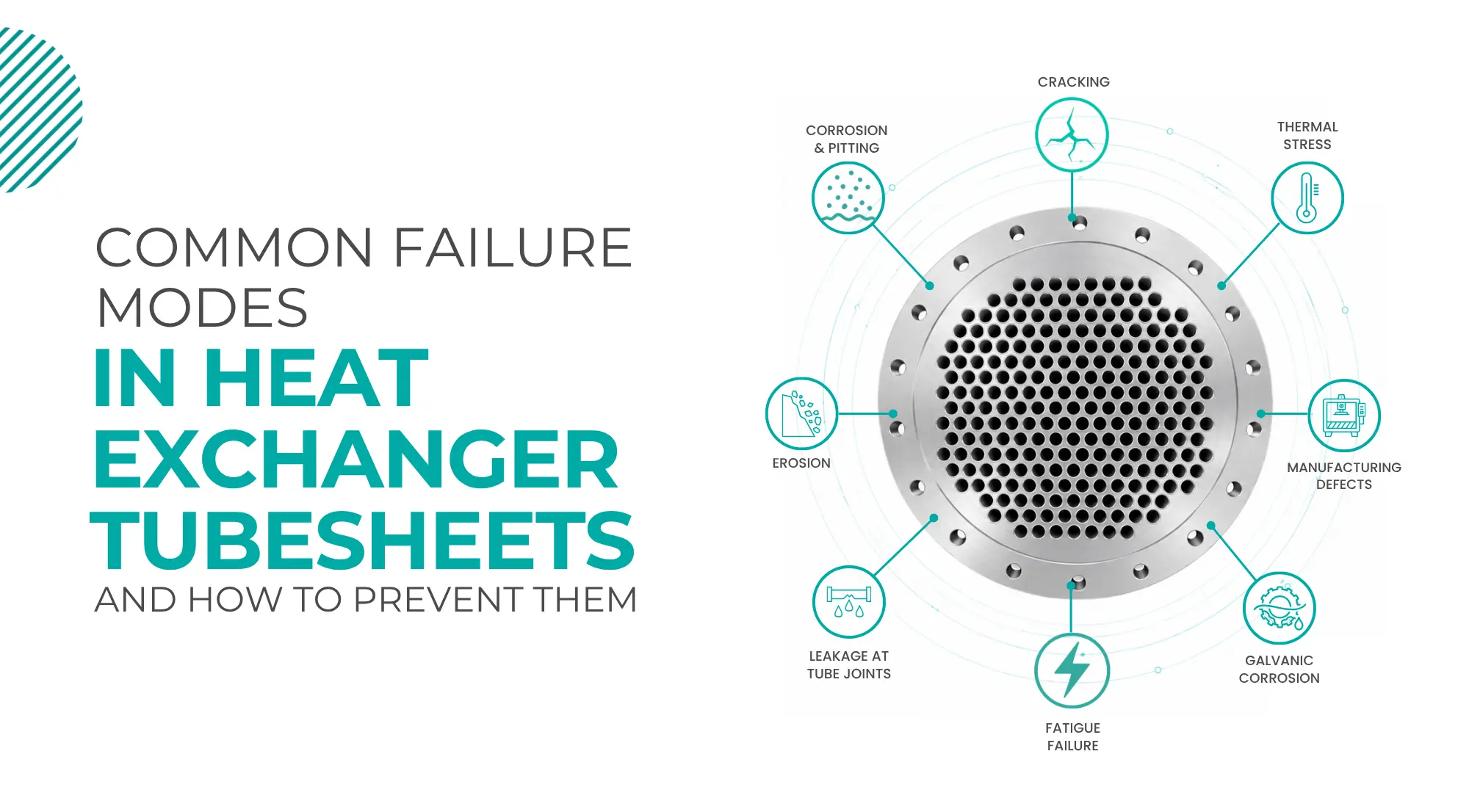


The tube sheet is often the deciding factor between a heat exchanger that performs reliably for years and one that fails prematurely.
Shell and tube heat exchangers remain a cornerstone of thermal management across chemical processing, power generation, HVAC, marine, pharmaceuticals and oil and gas. While tubes, shells and baffles typically receive the most maintenance focus, the tube sheet plays an equally critical role anchoring the tube bundle, separating process fluids and preserving pressure integrity. Even minor defects here can lead to leaks, reduced thermal efficiency and costly unplanned downtime.
Most tube sheet failures don’t occur suddenly. They develop gradually through corrosion, fouling, thermal stress, improper tube expansion, material incompatibility or inadequate maintenance often going unnoticed until repair costs escalate significantly.
This article examines the most common tube sheet failure modes, their underlying causes and the design, material selection and manufacturing practices that help prevent them.
What Causes Heat Exchanger Tube Sheet Failure?
Heat exchanger tube sheet failures typically occur due to corrosion, fouling, thermal fatigue, erosion, vibration, improper tube-to-tube sheet expansion, material incompatibility and excessive operating stresses. These issues can lead to heat exchanger leaking, reduced heat transfer efficiency and premature heat exchanger tube failure. Most failures can be prevented through proper engineering design, precision machining, appropriate material selection, regular inspections and preventive maintenance.
Why the Tube sheet Is Critical in Shell and Tube Heat Exchangers
A tube sheet is one of the most important pressure-retaining components in shell and tube heat exchangers. It is a thick metal plate precision-machined with hundreds or even thousands of accurately positioned holes that hold the heat exchanger tubes in place. Each tube is mechanically expanded, welded or both into these holes to create a leak-tight seal between the shell-side and tube-side fluids.
Its role extends far beyond simply supporting the tube bundle. The tube sheet is responsible for maintaining structural stability, preventing fluid cross-contamination and ensuring efficient heat transfer throughout the equipment’s service life.
Key Functions of a Tube sheet
| Function | Why It Matters |
|---|---|
| Supports heat exchanger tubes | Prevents tube movement, vibration and mechanical damage during operation. |
| Separates process fluids | Keeps shell-side and tube-side media isolated to prevent contamination. |
| Maintains pressure integrity | Withstands operating pressure and thermal loads without deformation. |
| Ensures accurate tube alignment | Promotes efficient heat transfer and smooth fluid flow. |
| Provides leak-tight tube joints | Minimises the risk of fluid leakage and performance loss. |
Because the tube sheet connects every heat transfer tube within the exchanger, even a localized defect can affect the performance of the entire unit. Corrosion around tube holes, loose tube joints or cracks caused by thermal cycling can eventually result in leakage, pressure loss and unscheduled plant downtime.
For this reason, precision machining, proper material selection and strict quality control during manufacturing are essential to ensuring long-term reliability.
Most Common Heat Exchanger Tube Sheet Failure Modes
Although tube sheets are designed to withstand demanding operating conditions, they are constantly exposed to pressure fluctuations, temperature cycling, aggressive chemicals and mechanical stresses. Over time, these operating conditions can lead to different types of heat exchanger failure modes if not properly managed.
Understanding how each failure develops allows maintenance teams to detect problems early, minimise downtime and extend equipment service life.
1. Corrosion Damage
Corrosion is one of the leading heat exchanger failure causes and remains the most common reason for premature tube sheet deterioration. Since tube sheets are continuously exposed to process fluids, moisture, chemicals and varying temperatures, selecting an unsuitable material or operating outside design conditions can accelerate corrosion significantly.
Unlike surface discoloration, corrosion gradually removes metal from the tube sheet, weakening its structural integrity and creating leakage paths around tube joints.
Common Types of Corrosion Affecting Tube sheets
- Pitting Corrosion: Localised attack that forms deep pits, particularly in stainless steel exposed to chlorides.
- Crevice Corrosion: Develops in narrow gaps around tube joints, gaskets or deposits where stagnant fluids remain trapped.
- Galvanic Corrosion: Occurs when dissimilar metals are used together in the presence of an electrolyte, causing one metal to corrode faster.
- Uniform Corrosion: Even material loss across the surface due to continuous chemical exposure.
Common Causes
- Incorrect material selection for the process media
- High chloride concentrations
- Acidic or alkaline process fluids
- Poor water treatment
- Long-term exposure to aggressive chemicals
- Inadequate protective coatings
Warning Signs
- Rust or discoloration around tube holes
- Surface pitting
- Tube joint leakage
- Reduced wall thickness
- Visible metal loss during inspection
2. Fouling and Deposit Build-Up
Among the most overlooked heat exchanger problems, fouling develops gradually but can have a significant impact on both heat transfer efficiency and tube sheet integrity.
Fouling in heat exchangers occurs when unwanted materials such as scale, corrosion products, sludge, biological growth or suspended solids accumulate on heat transfer surfaces. As these deposits thicken, they restrict fluid flow, reduce thermal performance and create stagnant zones where corrosion can accelerate.
Although fouling primarily affects heat exchanger tubes, the deposits frequently extend to the tube sheet surface and tube joints, increasing the likelihood of leakage and corrosion.
Common Types of Fouling
- Mineral scale deposits
- Biological fouling
- Sediment and sludge accumulation
- Corrosion product deposits
- Oil and organic residue build-up
Warning Signs
- Declining thermal performance
- Increased operating pressure
- Higher energy consumption
- Frequent cleaning requirements
- Uneven temperature distribution
3. Tube-to-Tubesheet Joint Failure
The connection between the heat exchanger tubes and the tube sheet is one of the most critical sealing points within the exchanger. These joints are created through mechanical expansion, hydraulic expansion, welding or a combination of both to ensure pressure-tight performance.
If these joints are improperly manufactured or begin to deteriorate during service, they become one of the most common sources of heat exchanger leaking and heat exchanger tube failure.
Joint failures often begin as microscopic gaps that gradually enlarge due to vibration, thermal expansion or corrosion.
Common Causes
- Improper tube expansion
- Poor welding quality
- Tube vibration
- Thermal cycling
- Corrosion around tube holes
- Manufacturing inaccuracies
Warning Signs
- Fluid leakage around tube ends
- Cross-contamination between shell-side and tube-side fluids
- Moisture near tube joints
- Reduced pressure retention
- Repeated tube failures in the same location
4. Thermal Fatigue Cracking
Many industrial processes involve repeated heating and cooling cycles. Over time, these temperature fluctuations cause the tube sheet and heat exchanger tubes to expand and contract at different rates, generating cyclic mechanical stresses.
When these stresses exceed the material’s fatigue strength, small cracks begin to develop around tube holes or other high-stress regions. If left undetected, these cracks can propagate, eventually leading to leakage or structural failure.
Thermal fatigue is particularly common in applications with frequent start-stop operations, rapid temperature changes or inconsistent process control.
Common Causes
- Rapid temperature fluctuations
- Frequent startup and shutdown cycles
- Uneven temperature distribution
- High thermal gradients
- Inadequate design for thermal expansion
Warning Signs
- Fine cracks near tube holes
- Progressive leakage
- Reduced structural integrity
- Repeated failures at identical locations
- Crack growth detected during inspections
5. Erosion Damage
Unlike corrosion, which is caused by chemical reactions, erosion is the gradual wearing a way of metal surfaces due to the continuous impact of high-velocity fluids or abrasive particles. In shell and tube heat exchangers, erosion typically affects the inlet region of the tube sheet where process fluids enter at high speed.
Over time, this mechanical wear removes protective surface layers, thins the material and increases the likelihood of leakage. When erosion occurs alongside corrosion, a phenomenon known as erosion-corrosion, the rate of material degradation accelerates significantly.
Common Causes
- Excessive fluid velocity
- Suspended solid particles or abrasive media
- Poor flow distribution
- Turbulence near inlet nozzles
- Inadequate material selection for abrasive applications
Warning Signs
- Grooves or worn areas near tube entrances
- Localised metal thinning
- Increased leakage around tube joints
- Reduced equipment efficiency
- Premature wear in high-flow zones
6. Stress Corrosion Cracking (SCC)
Stress Corrosion Cracking (SCC) is one of the most challenging heat exchanger failure modes because it can occur with little visible warning. It results from the combined effect of tensile stress and a corrosive environment, leading to fine cracks that may rapidly propagate through the tube sheet.
Stainless steel tube sheets operating in chloride-rich environments are particularly vulnerable if material selection and operating conditions are not properly evaluated during design.
Common Causes
- High chloride concentrations
- Residual manufacturing stresses
- Elevated operating temperatures
- Improper material selection
- Tensile stresses from pressure or thermal expansion
Warning Signs
- Hairline surface cracks
- Unexpected leakage despite minimal corrosion
- Crack growth around tube holes
- Premature failure under normal operating loads
Because SCC often progresses beneath the surface before becoming visible, advanced inspection methods such as dye penetrant testing, ultrasonic testing or eddy current testing are recommended for critical equipment.
7. Mechanical Distortion and Pressure Damage
Tube sheets are designed to withstand significant internal pressure while maintaining accurate tube alignment. However, excessive operating pressure, poor structural support or manufacturing inaccuracies can cause permanent deformation over time.
Mechanical distortion places additional stress on tube joints and may eventually result in leakage, vibration or reduced equipment performance.
Common Causes
- Operating beyond design pressure
- Improper support structures
- Uneven bolt loading
- Manufacturing defects
- Excessive thermal expansion
Warning Signs
- Visible warping
- Tube misalignment
- Gasket leakage
- Difficulty assembling components
- Increased vibration during operation
How to Prevent Heat Exchanger Tube Sheet Failure
Preventing tube sheet failure requires a proactive approach that combines sound engineering practices, quality manufacturing and routine maintenance. Rather than reacting after failures occur, organisations can significantly extend equipment life by addressing potential risks during design, fabrication and operation.
1. Select the Right Material for the Application
Material selection has a direct impact on corrosion resistance, mechanical strength and service life. A tube sheet must withstand the operating environment throughout the equipment’s lifecycle, making it essential to choose a material that matches the process conditions rather than simply opting for the lowest-cost option.
Factors such as process fluid chemistry, operating temperature, pressure, corrosive media and mechanical loading should all be evaluated during the design stage. Depending on the application, commonly used tube sheet materials include:
- Carbon Steel
- Stainless Steel (304 and 316)
- Duplex and Super Duplex Stainless Steel
- Titanium
- Copper-Nickel Alloys
- Nickel-Based Alloys
Selecting the appropriate material reduces the risk of corrosion, improves structural integrity and helps extend the service life of the heat exchanger.
2. Prioritise Precision Manufacturing
Even the highest-grade material cannot compensate for poor manufacturing quality. Precision machining is critical because even minor variations in tube hole diameter, spacing or surface finish can affect tube expansion, sealing performance and long-term reliability.
A well-manufactured tube sheet ensures accurate tube alignment, uniform load distribution and leak-tight tube-to-tube sheet joints. These factors collectively minimise stress concentrations and reduce the likelihood of premature failures in shell and tube heat exchangers.
To achieve this level of accuracy, manufacturers typically rely on advanced processes such as:
- CNC drilling and machining
- Precision boring
- Dimensional inspection
- Surface finish verification
- Quality control at every production stage
3. Implement a Preventive Maintenance Programme
Routine heat exchangers maintenance remains one of the most effective ways to prevent unexpected failures. Small issues such as minor corrosion, loose tube joints or early-stage fouling can often be corrected before they develop into major repairs or unplanned shutdowns.
A preventive maintenance programme should combine regular inspections with condition monitoring to assess the health of the equipment over time. Typical maintenance activities include:
- Visual inspections
- Leak testing
- Hydrostatic pressure testing
- Eddy current testing
- Ultrasonic thickness measurement
- Tube integrity assessments
- Vibration monitoring
By identifying defects early, maintenance teams can schedule repairs during planned shutdowns instead of responding to costly emergency failures.
4. Prevent Fouling Before It Becomes a Problem
Fouling in heat exchangers develops gradually as scale, sludge, corrosion products or biological deposits accumulate on heat transfer surfaces. Although it may initially appear to be a performance issue, excessive fouling can also accelerate corrosion around the tube sheet, increase pressure drop and reduce overall equipment efficiency.
Preventing fouling requires a combination of good operating practices and regular cleaning. Effective measures include water treatment, chemical or mechanical cleaning, filtration systems and continuous monitoring of pressure drop and heat transfer performance.
Keeping heat transfer surfaces clean not only improves efficiency but also reduces energy consumption and helps protect critical components from long-term damage.
5. Monitor Operating Conditions Continuously
Many heat exchanger failure causes are linked to operating conditions rather than manufacturing defects. Running equipment outside its design limits can accelerate thermal fatigue, erosion and tube joint deterioration.
Operators should continuously monitor key parameters such as operating pressure, fluid temperature, flow velocity, vibration levels and differential pressure. Tracking these values helps identify abnormal trends early, allowing corrective action before irreversible damage occurs.
6. Conduct Periodic Non-Destructive Testing (NDT)
Not all defects are visible during routine inspections. Cracks, internal corrosion and wall thinning often develop beneath the surface long before external signs appear, making periodic Non-Destructive Testing (NDT) an essential part of any maintenance strategy.
Depending on the application, commonly used NDT methods include:
- Ultrasonic Testing (UT)
- Eddy Current Testing (ECT)
- Dye Penetrant Testing (PT)
- Magnetic Particle Inspection (MPI)
- Radiographic Testing (RT)
These inspection techniques enable maintenance teams to detect hidden defects without dismantling the equipment, reducing the risk of unexpected failures and extending the operational life of the tube sheet.
Heat Exchanger Tube Sheet Failure Modes: Causes & Prevention Summary
| Failure Mode | Main Cause | Quick Prevention |
|---|---|---|
| Corrosion | Aggressive chemicals, unsuitable materials | Select corrosion-resistant materials and inspect regularly |
| Fouling | Scale, sludge and deposits | Routine cleaning and water treatment |
| Tube-to-Tubesheet Joint Failure | Poor expansion, welding or vibration | Precision machining and leak testing |
| Thermal Fatigue | Repeated heating and cooling cycles | Design for thermal expansion and stable operation |
| Erosion | High fluid velocity and abrasive particles | Control flow velocity and use wear-resistant materials |
| Stress Corrosion Cracking (SCC) | Chlorides, tensile stress and high temperatures | Choose suitable materials and perform periodic NDT |
| Mechanical Distortion | Excessive pressure and poor support | Operate within design limits and ensure proper installation |
Repair or Replacement? When Can a Heat Exchanger Tube Sheet Be Saved?
Not every tube sheet defect requires complete replacement. In many cases, early-stage damage can be repaired, restoring equipment performance while reducing downtime and replacement costs. However, the feasibility of repair depends on the extent of the damage, the operating conditions and the remaining structural integrity of the tube sheet.
Timely inspection is crucial. Delaying repairs can allow minor issues such as corrosion or leakage to progress into severe structural damage that may no longer be repairable.
Common Tube sheet Repair Methods
Depending on the failure mode, repair options may include:
- Tube plugging to isolate damaged tubes and prevent leakage.
- Tube replacement where only a limited number of tubes have failed.
- Tube-to-tubesheet joint re-expansion to restore sealing performance.
- Weld repair for localized cracks or defects, following qualified welding procedures.
- Machining and surface restoration to remove damaged material and restore sealing surfaces.
These repair techniques are generally suitable when the overall structure of the tube sheet remains sound and damage is confined to specific areas.
When Replacement Is the Better Option
In some situations, replacing the tube sheet is more economical and reliable than repeated repairs. Complete replacement is often recommended when:
- Corrosion has significantly reduced material thickness.
- Extensive cracking is detected across multiple tube holes.
- Permanent mechanical distortion affects tube alignment.
- Repeated repairs fail to resolve leakage issues.
- The tube sheet no longer meets pressure or safety requirements.
- The equipment has reached the end of its service life.
Replacing a severely damaged tube sheet with a precision-manufactured component not only restores equipment performance but also reduces the likelihood of recurring failures.
How Precision Manufacturing Reduces Heat Exchanger Failure
The reliability of a heat exchanger begins with precision manufacturing. Even minor inaccuracies in tube hole positioning, dimensions or surface finish can compromise tube expansion, sealing performance and structural integrity, increasing the risk of leakage and premature failure.
Advanced manufacturing processes such as CNC machining, precision boring, dimensional inspection, material traceability and non-destructive testing (NDT) ensure every tube sheet meets stringent quality standards. By combining precision engineering with rigorous quality control, manufacturers can improve sealing performance, minimise stress concentrations and extend the service life of heat exchangers.
Why Choose Schilthorn for Precision Heat Exchanger Tube Sheets?
With over 15 years of precision engineering expertise, Schilthorn is a trusted manufacturer of precision heat exchanger tube sheets for HVAC, process industries, power generation, marine and industrial applications. Our focus on engineering excellence, advanced manufacturing and stringent quality standards enables us to deliver tube sheets that perform reliably in demanding operating environments.
- Advanced CNC machining capabilities, including precision drilling, boring, milling and machining of complex tube sheet designs.
- Manufacturing expertise in carbon steel, stainless steel, duplex stainless steel, super duplex, titanium and other engineering alloys.
- Custom manufacturing based on customer drawings, specifications and application requirements.
- Tight dimensional tolerances to ensure accurate tube hole positioning and reliable tube-to-tube sheet joints.
- Rigorous quality assurance, including dimensional inspection, material traceability and in-process quality checks.
- Support for prototypes, replacement tube sheets and production-scale manufacturing with consistent quality and on-time delivery.
Need a Precision-Manufactured Tube Sheet for Your Heat Exchanger?
Whether you’re manufacturing a new heat exchanger or replacing an existing tube sheet, Schilthorn delivers precision-machined solutions tailored to your exact requirements. Share your drawings or technical specifications with our engineering team to discuss a custom manufacturing solution tailored to your application.
Frequently Asked Questions (FAQs)
1. What are the warning signs of a failing tube sheet?
Common indicators include:
- Heat exchanger leaking
- Reduced thermal performance
- Increased pressure drop
- Corrosion around tube holes
- Frequent tube failures
- Cross-contamination between process fluids
- Rising maintenance costs
- Visible cracks or distortion
Early detection allows repairs to be carried out before major equipment damage occurs.
2. Can a damaged tube sheet be repaired instead of replaced?
Yes. Localised damage such as minor corrosion, limited cracking or isolated tube joint leakage can often be repaired. However, extensive corrosion, severe cracking or structural distortion generally requires complete tube sheet replacement.
3. Which material is best for corrosion-resistant tube sheets?
The most suitable material depends on the operating environment. Stainless steel, duplex stainless steel, titanium and nickel-based alloys are commonly selected for applications involving corrosive fluids or high temperatures. Material selection should always be based on process chemistry, operating pressure and temperature.
4. What happens if a tube sheet fails?
A failed tube sheet can cause fluid leakage, reduced heat transfer efficiency, pressure loss, cross-contamination and in severe cases, unplanned plant shutdowns. Early detection helps minimise repair costs and operational disruption.
5. Can a corroded tube sheet be repaired?
Yes, localized corrosion can often be repaired through machining, weld restoration or tube replacement, depending on the extent of the damage. However, if corrosion has significantly reduced the structural strength of the tube sheet or affected multiple tube holes, replacement is generally the safer and more cost-effective option.