
Why Venturi (Nozzle) Is Used in Axial Fans: A Practical Engineering Explanation


If you have ever stood near an industrial cooling system or walked past a large HVAC installation, you have likely heard the steady, powerful movement of air in operation. At the core of that setup is a widely used industrial air-moving system.
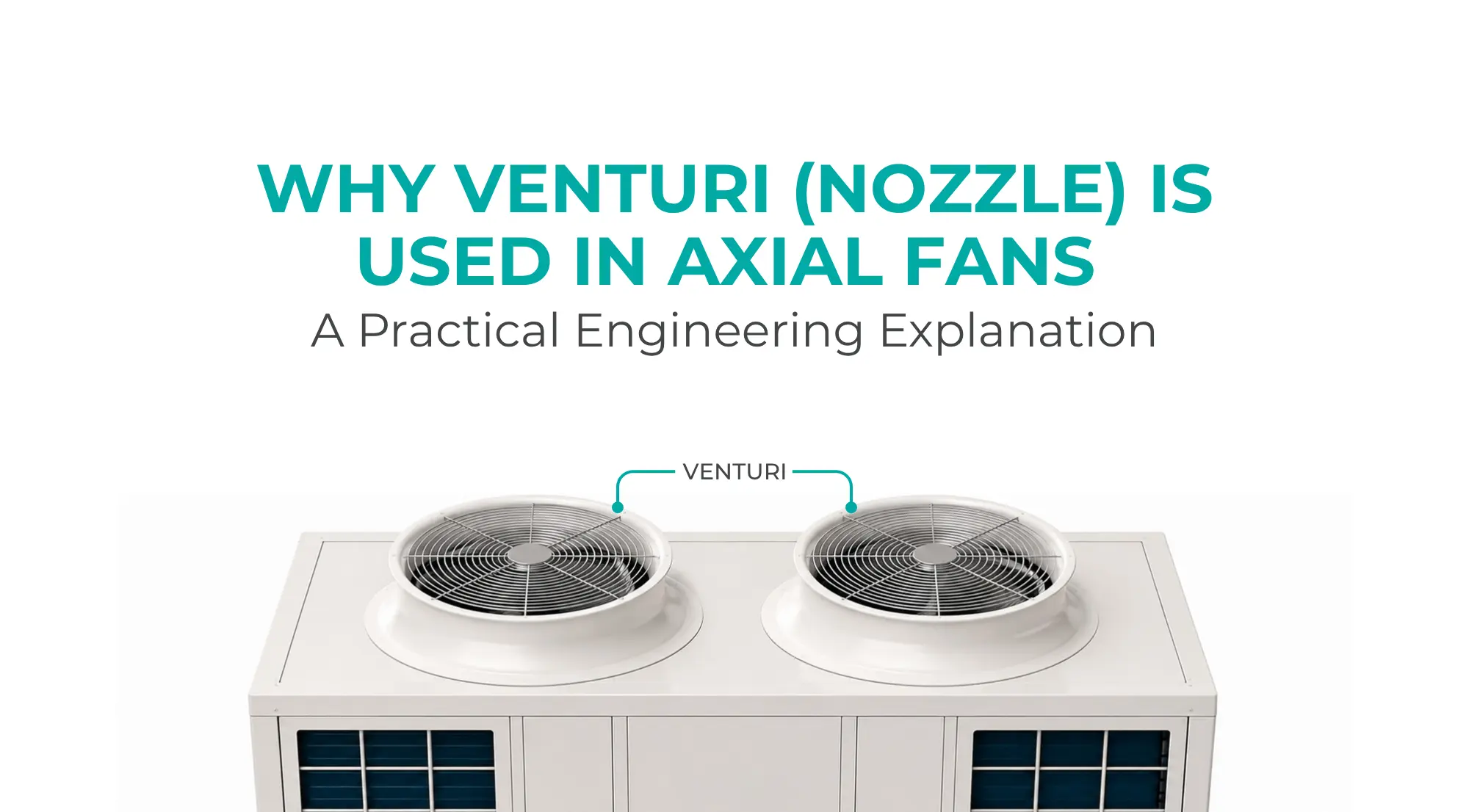
However, an axial fan blower is rarely just a set of rotating blades. Surrounding the fan assembly, you will typically find a carefully engineered ring curved, aerodynamically shaped, and precisely manufactured to control how air enters and exits the system. This component is known as a venturi nozzle in axial fan design.
At first glance, it may appear simple. In reality, it plays a critical role in determining airflow and overall efficiency.
The venturi is one of the most overlooked yet essential elements in fan engineering. Its design and manufacturing precision directly influence whether a fan operates at optimal performance or experiences continuous energy loss and reduced output.
In this blog, we explore why venturi is used in axial fans, how it functions, and how venturi improves fan efficiency across real-world industrial applications.
What Is an Axial Fan?
An axial fan is a type of fan that moves air parallel to the axis of the rotating blades. In simple words, air flows straight through the fan, making it ideal for applications where high airflow is required.
These fans are built for one job: moving large volumes of air with relatively low resistance.
They are used wherever airflow not pressure is the primary requirement. This makes them the go-to choose for:
- Cooling towers in power plants and refineries
- HVAC systems in large commercial and industrial buildings
- Heat exchangers in oil and gas processing
- Condenser coils in refrigeration equipment
- Ventilation in tunnels, mines, and manufacturing facilities
The blades in this type of fan are pitched at a specific angle. As the rotor spins, each blade cuts through air and pushes it axially forward, through the system. The performance of this mechanism depends on how cleanly air enters the blade assembly and how efficiently it exits.
This is exactly where the venturi comes in.
What Is a Venturi (Nozzle)?
A venturi, in its most basic form, is a shaped passage that accelerates fluid by gradually narrowing and then expanding again. The principle comes from Bernoulli’s theorem: when a fluid flows through a constricted section, its velocity increases and its pressure drops.
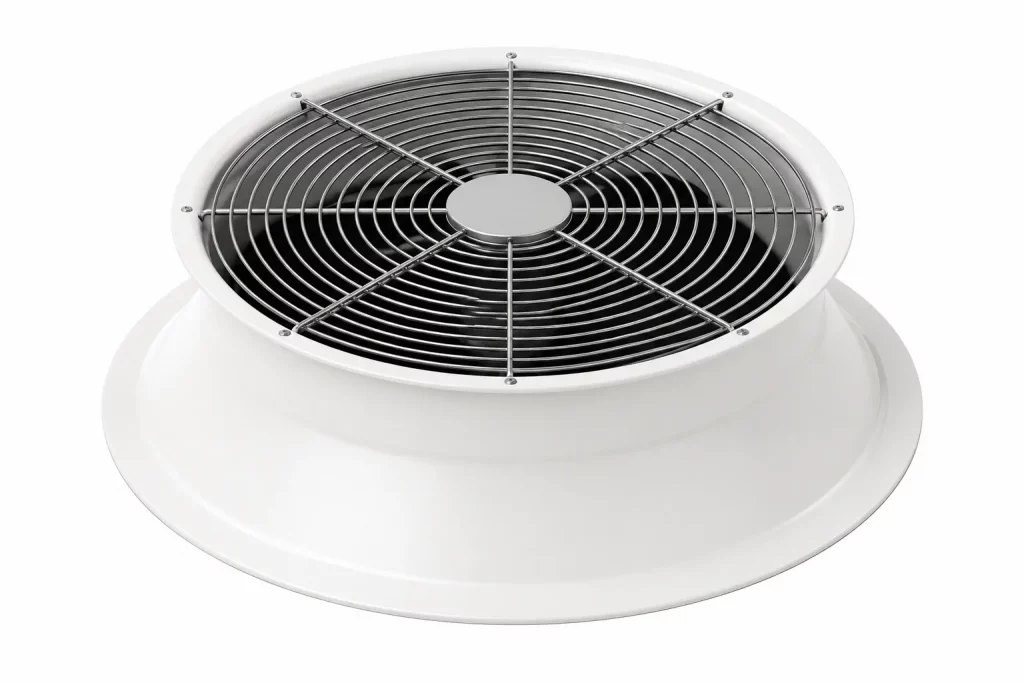
In the context of an axial fan, the venturi refers to the inlet nozzle the curved, funnel-shaped ring that surrounds the fan blades at the inlet. It is also called a bell mouth inlet or inlet cone, depending on the configuration.
The shape is not arbitrary. It is mathematically defined typically following an elliptical or toroidal profile to ensure that air entering the fan does so with:
- Uniform velocity distribution across the blade span
- Minimal turbulence at the blade leading edge
- Maximum possible conversion of static pressure to velocity pressure
The venturi is usually a separate machined or fabricated component that bolts or mounts to the fan casing. It appears simple. But the tolerances involved particularly the gap between the blade tip and the inner nozzle surface are critical.
Why Venturi Is Used in Axial Fans
Understanding why venturi is used in axial fans comes down to one core objective maximizing performance while minimizing energy loss. The venturi is not just an add-on; it is a critical aerodynamic component that directly influences how efficiently the fan operates.
Let’s look at how it makes a difference:
1. Improves Airflow Smoothness
In a standard setup, air entering an axial fan can be uneven and turbulent, especially at the edges. The venturi nozzle helps streamline this entry by guiding air smoothly toward the fan blades.
This controlled airflow:
- Reduces turbulence at the inlet
- Prevents flow separation
- Ensures uniform axial fan airflow across the blade span
As a result, the fan operates more consistently and efficiently.
2. Increases Air Velocity
The venturi works on a simple aerodynamic principle when air passes through a narrowed section, its velocity increases.
In an axial fan blower, this means:
- Faster air movement through the fan
- Higher volumetric airflow output
- Improved delivery without increasing motor load
This is one of the key reasons how venturi improves fan efficiency in practical applications.
3. Enhances Axial Fan Efficiency
Energy losses in fans are often caused by turbulence, recirculation, and inefficient air entry. The venturi nozzle in axial fan systems minimizes these losses by optimizing airflow paths.
This leads to:
- Better conversion of input power into useful airflow
- Reduced energy wastage
- Noticeable improvement in axial fan efficiency
Even small improvements here can result in significant energy savings over time.
4. Improves Pressure Handling
In industrial environments, maintaining stable airflow under varying resistance is critical. The venturi helps manage pressure distribution more effectively within the system.
This results in:
- Improved static pressure performance
- More stable airflow under load conditions
- Better suitability for demanding industrial applications
Overall, the venturi plays a crucial role in transforming a basic axial fan into a high-performance, energy-efficient airflow system.
How Venturi Improves Axial Fan Performance
Let’s get specific. These are the measurable performance improvements that a well-engineered venturi delivers:
1. Higher Volumetric Flow Rate
A smooth, guided inlet reduces inlet losses. The fan moves more air per revolution which means either higher airflow at the same motor speed, or the same airflow at a lower motor speed.
2. Improved Fan Efficiency
Fan efficiency is a ratio of useful power delivered to air versus total input power. Poor inlet conditions can drop efficiency by 5 to 15 percent in real installations. A properly profiled venturi recovers a significant portion of that loss.
3. Reduced Power Consumption
When the fan achieves its designed operating point with less inlet turbulence, the motor does not have to work as hard to move the required air volume. In large installations cooling towers, industrial heat exchangers this directly reduces operating costs over the equipment lifecycle.
4. Lower Noise Levels
Much of the aerodynamic noise in axial fans originates from turbulent inflow striking the blade leading edge. A venturi inlet significantly reduces this turbulence, resulting in quieter operation. For HVAC applications in occupied buildings or noise-sensitive environments, this is a genuine engineering requirement not a preference.
5. Extended Blade and Bearing Life
Turbulent inflow creates unsteady aerodynamic forces on the blades. These forces translate into vibrational loads on the shaft and bearings. A cleaner inlet reduces these loads and extends mechanical life.
6. Predictable, Repeatable Performance
When a fan is rated at a specific airflow and static pressure, that rating assumes designed inlet conditions. A precision-manufactured venturi ensures the fan consistently delivers its rated performance batch after batch, installation after installation.
Industrial Applications of Venturi-Based Axial Fans
Venturi-equipped axial fans are not a niche product. They appear in almost every heavy industry sector.
HVAC and Air Handling
Large commercial and industrial HVAC systems use axial fans with bell-mouth venturi inlets in air handling units, cooling coils, and roof-mounted ventilation systems. Performance consistency is critical because these systems are designed to meet specific building load calculations.
Cooling Towers
Industrial cooling towers used in power generation, refineries, chemical plants, and data centres rely on large fans to push or pull air through the fill material. The venturi nozzle here is typically a large-diameter fabricated component. Even small dimensional deviations affect tip clearance and reduce cooling tower efficiency at a facility-wide level.
Heat Exchangers and Air-Cooled Condensers
In oil and gas processing and petrochemical facilities, air-cooled heat exchangers use forced or induced draft fan system. These operate in high-temperature environments where thermal expansion adds dimensional complexity to venturi design. The tip clearance must account for growth at operating temperature which means the cold-state geometry must be precisely controlled.
Refrigeration and Condensing Units
Evaporator and condenser fans in industrial refrigeration use axial fan and venturi combinations in high volumes. Here, manufacturing repeatability is as important as individual part accuracy a supplier must hold the same tolerance across thousands of units.
Automotive and Industrial OEM Equipment
Engine cooling radiator fans, transmission oil coolers, and industrial machinery ventilation all use fan assemblies. OEM procurement teams require documented dimensional compliance and batch traceability not just part function.
Manufacturing consideration for venturi
Designing an efficient venturi profile is only the first step. Its real performance depends on how accurately that design is translated into a physical component. Even the most optimized aerodynamic design will fail to deliver results if manufacturing precision is compromised.
The effectiveness of a venturi depends on several critical manufacturing parameters:
- Inlet radius profile: The inlet curve must precisely match the intended elliptical or toroidal geometry. Even minor deviations can disrupt smooth airflow entry.
- Cylindrical bore concentricity: The venturi must remain perfectly aligned with the fan shaft axis to maintain uniform tip clearance throughout the circumference. Any misalignment can lead to uneven airflow and efficiency loss.
- Surface finish at the inlet: A rough or stepped surface can cause flow separation exactly where the design aims to ensure smooth air transition, directly affecting performance.
- Flatness of mounting faces: Improper flatness can introduce distortion during assembly, altering the designed geometry and reducing effectiveness.
- Dimensional repeatability: Consistency across every manufactured unit is essential to ensure predictable and reliable fan performance.
In high-performance systems, tolerances are not flexible. A venturi manufactured with a ±0.5 mm variation in a design that requires ±0.1 mm precision does not just cause minor inefficiencies; it leads to inconsistent airflow, reduced axial fan efficiency and performance that becomes difficult to validate.
This is the critical difference between a component that is simply acceptable and one that is truly engineered to perform.
Optimize Your Axial Fan Performance with Schilthorn
At Schilthorn, we go beyond standard manufacturing to deliver precision-engineered axial fan solutions that perform reliably in real-world conditions.
From advanced aerodynamic design to tight-tolerance manufacturing, our expertise in venturi nozzle in axial fan systems ensures:
- Higher axial fan efficiency
- Improved airflow performance
- Reduced energy consumption
- Long-term operational reliability
Whether you are upgrading an existing axial fan blower or developing a new system, we help you achieve consistent, measurable performance.
To ensure the right fit for your application, our team can review your design specifications and recommend precision-optimized venturi nozzle solutions based on your operating conditions. You can request a detailed quote or share your drawings for a tolerance review to get started.
FAQs
1. How often should a venturi nozzle be inspected or replaced?
Standard industrial HVAC: every two to three years. Outdoor and cooling tower installations: annually. Corrosive or high-temperature environments: every six months. Replace when tip clearance has grown beyond design tolerance or surface corrosion has affected the inlet profile. Visual checks are not enough dimensional re-verification is required.
2. Can an axial fan be retrofitted with a new venturi nozzle?
Yes. A retrofit venturi can improve airflow by 5 to 12 percent at the same motor power, reduce noise, and extend bearing life without replacing the full fan assembly. It requires accurate site measurements and a build-to-print manufacturing partner who can verify dimensions before delivery.
3. How does a venturi nozzle reduce axial fan noise?
The venturi reduces two major noise sources. First, it delivers uniform airflow to the blade, reducing turbulent inlet noise. Second, tighter tip clearance reduces blade-tip vortex noise. Industrial axial fans typically run between 75 and 95 dB(A). A properly manufactured venturi consistently helps achieve the lower end of that range.
4. What material is used for industrial axial fan venturi nozzles?
Material depends on the operating environment. Mild steel suits general HVAC. Stainless steel SS 304 or SS 316 is used in corrosive or coastal conditions. Aluminium works where weight is a concern. FRP is preferred for cooling towers with chemical exposure. Never select material on cost alone wrong material selection leads to dimensional degradation and early replacement.
5. What is the ideal tip clearance between an axial fan blade and the venturi nozzle?
The accepted range is 0.5% to 1.5% of fan diameter. For a 1000 mm fan, that is 5 mm to 15 mm. High-efficiency designs target the tighter end. Beyond 1.5%, backflow recirculation increases and airflow drops. Below 0.5%, thermal expansion risks blade-to-nozzle contact. Always design clearance for operating temperature, not assembly temperature.