
Exploring Different Types of Industrial Fasteners: The Essential Guide
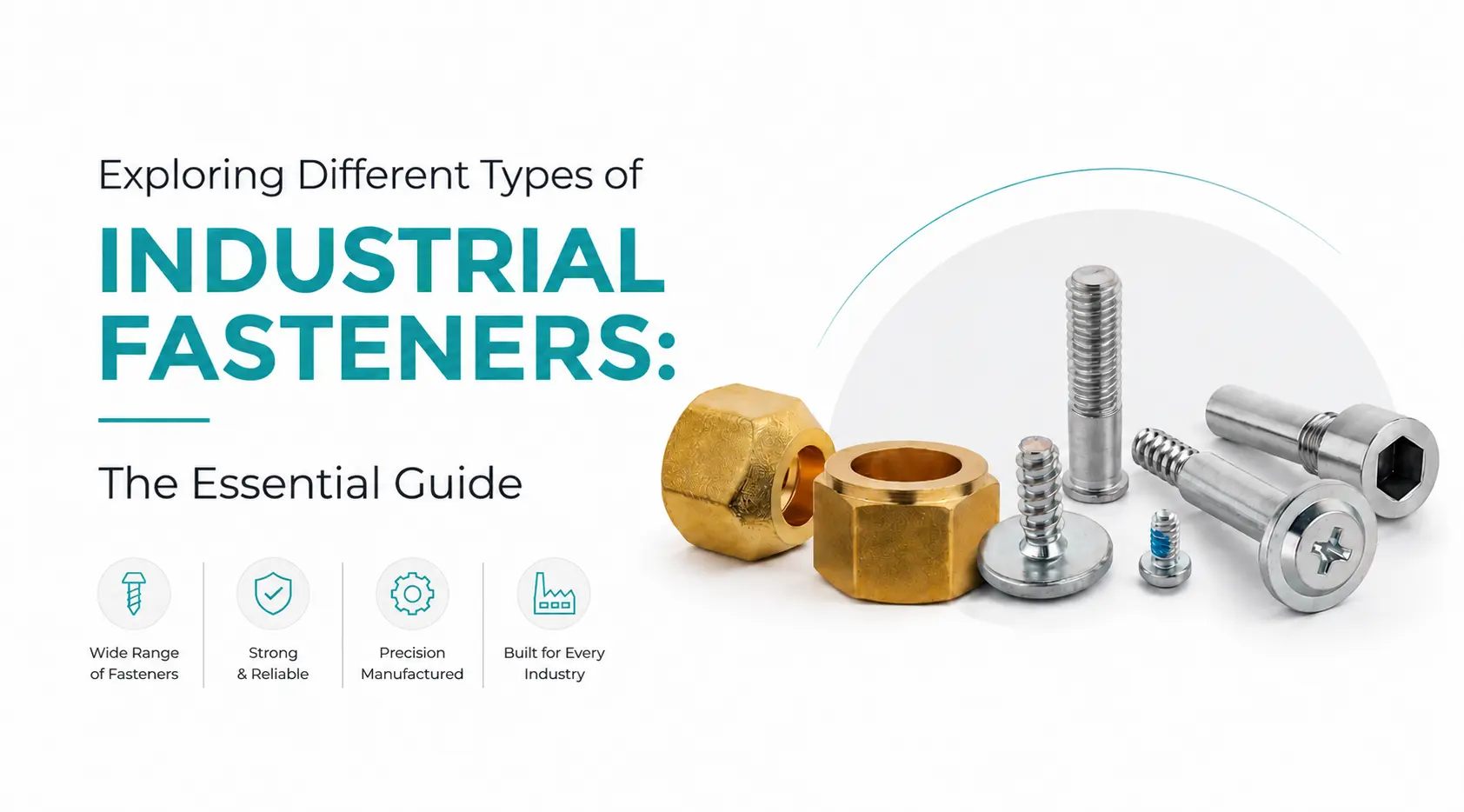


Industrial fasteners are the backbone of modern engineering, manufacturing and construction. According to industry estimates, a single automobile can contain over 3,000 fasteners, while large commercial aircraft may use more than one million fasteners to ensure structural integrity and safety. The global industrial fasteners market is valued at over USD 90 billion, highlighting their critical role across industries worldwide. Recent market reports also indicate that the Asia-Pacific region accounts for approximately 41%–49% of global fastener demand, making it the largest regional market and reflecting the rapid pace of industrialization, infrastructure development and manufacturing growth across the region.
The right fastener can significantly impact product durability, load-bearing capacity, safety and overall operational efficiency. With numerous types of industrial fasteners available, selecting the appropriate fastening solution is essential for achieving reliable and cost-effective assemblies.
While standard fasteners are readily available, industries such as aerospace, automotive and industrial engineering often require custom fasteners manufactured to precise tolerances. This is where precision machining partners like Schilthorn Precision Engineering play a critical role.
What You Need to Know About Industrial Fasteners
Industrial fasteners are mechanical hardware components used to join two or more parts together securely. Unlike welding or adhesives, many fasteners allow assemblies to be disassembled when maintenance, repairs or modifications are required.
Fasteners serve as critical elements in mechanical assemblies by providing strong, reliable connections that can withstand operational loads, vibrations and environmental conditions.
Permanent vs. Non-Permanent Fastening Methods
Fastening methods generally fall into two categories:
Permanent Fastening Methods
- Rivets
- Welded fasteners
- Certain adhesive-based fastening systems
These methods create joints that cannot be removed without damaging the assembly.
Non-Permanent Fastening Methods
- Bolts and nuts
- Screws
- Studs
These fasteners can be removed and reused, making maintenance and replacement easier.
As essential industrial hardware components, fasteners help structural integrity, safety and efficient manufacturing processes across industries.
Why Choosing the Right Fastener Matters
Selecting the correct fastener is about more than simply joining components together. It directly affects the strength, reliability and lifespan of the final assembly.
-
Structural Integrity and Load-Bearing Requirements
Different applications need fasteners capable of handling varying tensile, shear and compression loads. Using an undersized or unsuitable fastener can compromise the strength of the entire structure.
-
Safety and Reliability
Fasteners are often used in safety-critical applications such as aircraft, vehicles, bridges and industrial equipment. A properly selected fastener helps prevent failures that could result in accidents or costly downtime.
-
Environmental Resistance
Exposure to moisture, chemicals, extreme temperatures and corrosive environments can significantly impact fastener performance. Material and coating selection play a crucial role in ensuring long-term reliability.
-
Cost Savings and Maintenance Benefits
Choosing the right fastener reduces maintenance frequency, minimizes replacement costs and improves equipment uptime, leading to lower overall lifecycle costs.
Need precision Industrial fasteners for aerospace, automotive or industrial applications?
Main Types of Industrial Fasteners
1. Bolts
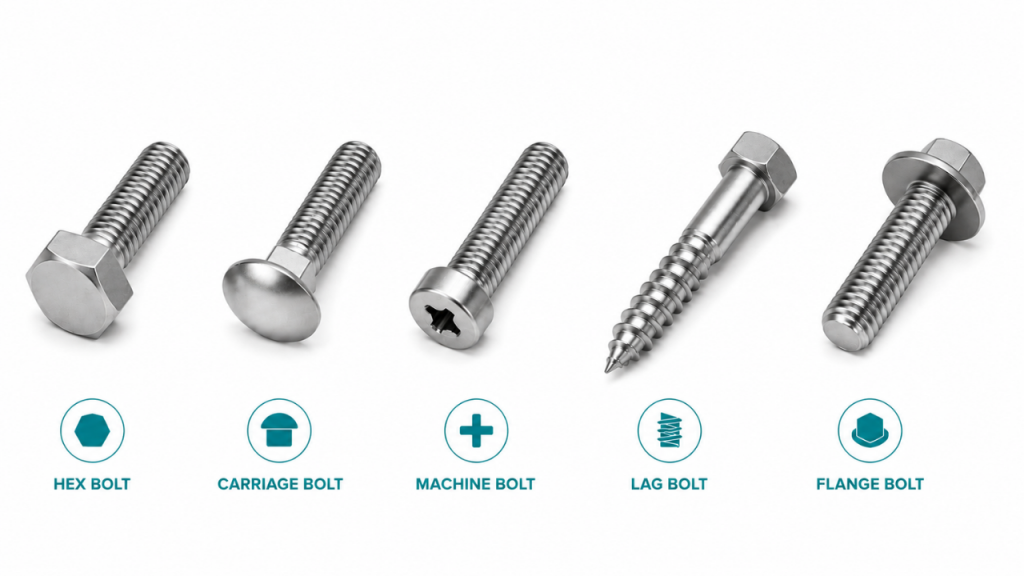
Bolts are threaded fasteners designed to join components securely when used together with matching nuts. They are available in several designs to suit different applications, including hex bolts for general-purpose fastening, carriage bolts for wood and structural assemblies and machine bolts for equipment and machinery.
Manufactured from materials such as carbon steel, alloy steel and stainless-steel bolts provide excellent strength and load-bearing capability. They are widely used in construction, manufacturing, automotive systems and heavy industrial equipment where reliable and removable connections are required.
Types and Common Applications
- Hex Bolts: Widely used in construction, machinery, automotive assemblies and industrial equipment.
- Carriage Bolts: Commonly used in wood-to-wood and wood-to-metal fastening applications.
- Machine Bolts: Suitable for precision equipment, manufacturing systems and mechanical assemblies.
- Lag Bolts: Used for heavy-duty wood construction, decking and structural support applications.
- Flange Bolts: Frequently found in automotive, piping and industrial machinery where load distribution is important.
Advantages
- Provide strong and reliable fastening for high-load applications.
- Easy to install, remove and replace when maintenance is required.
- Available in a wide range of materials, sizes and strength grades.
- Suitable for both temporary and permanent assembly requirements.
- Offer excellent load-bearing and clamping capabilities.
Limitations
- Require matching nuts or threaded holes for installation.
- May loosen under vibration if locking mechanisms are not used.
- Installation typically requires access to both sides of the assembly.
2. Nuts
Nuts are internally threaded fasteners used in combination with bolts and threaded rods to form secure mechanical connections. By tightening onto the threaded fastener, nuts generate the clamping force needed to hold components firmly together.
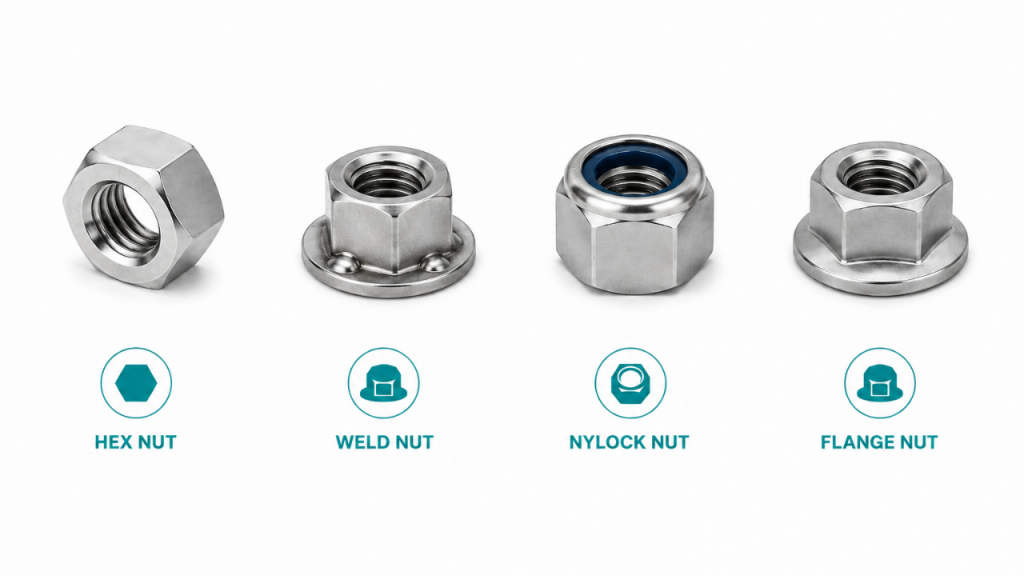
Common varieties include hex nuts, Weld Nuts, Nylock Nuts and Flange Nuts, each designed for specific operational needs. In environments subject to vibration or movement, locking nuts help maintain joint integrity and reduce the risk of loosening over time.
Types and Common Applications
- Hex Nuts: Used in construction, machinery and general industrial fastening.
- Weld Nuts: Used in automotive and metal fabrication applications requiring a permanent threaded connection.
- Nylock Nuts: Used in vibration-prone applications such as automotive and industrial equipment.
- Flange Nuts: Used where better load distribution and secure fastening are required.
Advantages
- Provide secure and reliable fastening when used with compatible bolts.
- Available in a wide range of materials, thread sizes and strength grades.
- Certain types, such as Nylock nuts, offer enhanced resistance to vibration-induced loosening.
- Specialized designs like flange and weld nuts improve load distribution and simplify assembly processes.
Limitations
- Require compatible bolts or threaded studs for proper installation.
- Some nut types may require specialized tools or welding equipment during assembly.
- Corrosion or thread damage may affect performance if the wrong material or coating is selected for the application.
3. Screws
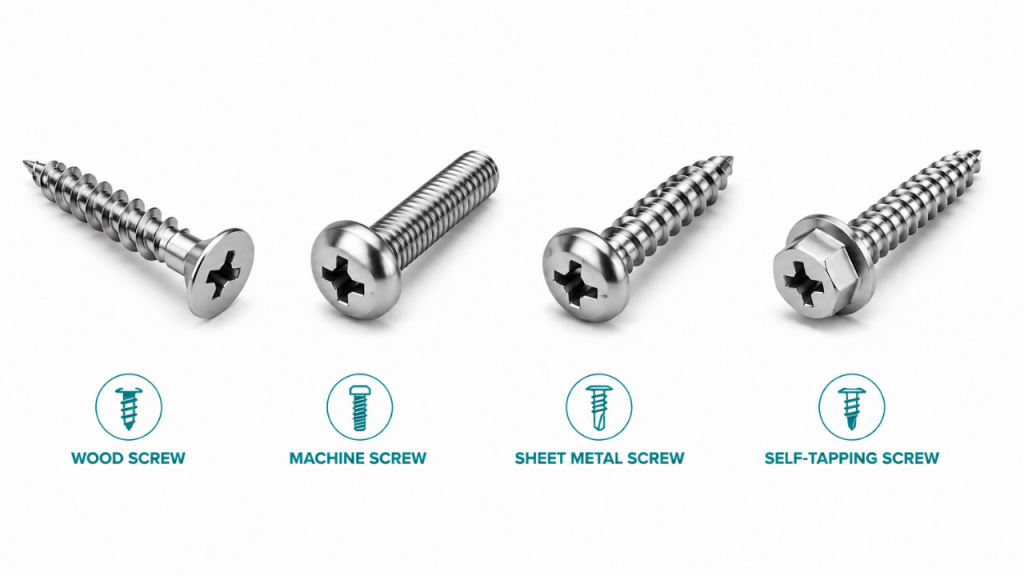
Screws are versatile fasteners that create secure joints by threading directly into a material or a pre-threaded hole. Depending on the application, different screw types may be used, including wood screws, sheet metal screws, machine screws and self-tapping screws.
Their ease of installation and strong holding power make screws a preferred fastening solution across industries. They are Available in various materials and designs, including stainless steel screws, wood screws, sheet metal screws, machine screws and self-tapping screws, they are widely used across industrial and commercial applications.
Types and Common Applications
- Wood Screws: Used in furniture, cabinetry and wooden structures.
- Machine Screws: Common in machinery, electronics and equipment assembly.
- Sheet Metal Screws: Designed for fastening thin metal sheets.
- Self-Tapping Screws: Create their own threads in metal, plastic or other materials.
Advantages
- Easy and quick to install, helping reduce assembly time and labour costs.
- Often eliminate the need for a separate nut, making them ideal for applications with limited access.
- Available in a wide variety of sizes, materials, thread types and head designs to suit different applications.
- Provide strong holding power and secure fastening in wood, metal, plastic and composite materials.
- Suitable for both permanent and removable connections, simplifying maintenance and repairs.
Limitations
- Threads may wear out after repeated removal and reinstallation.
- Not ideal for extremely heavy load-bearing applications.
- Incorrect installation can damage the material being fastened.
4. Washers
Washers are thin components placed between a fastener and the surface being fastened. Their primary function is to distribute load evenly, reduce surface damage and improve the overall stability of the joint.
Different washer types serve different purposes. Flat washers help spread the load; spring washers provide tension and lock washers help resist loosening caused by vibration. Washers are commonly used in structural, mechanical and industrial applications to enhance fastener performance and longevity.
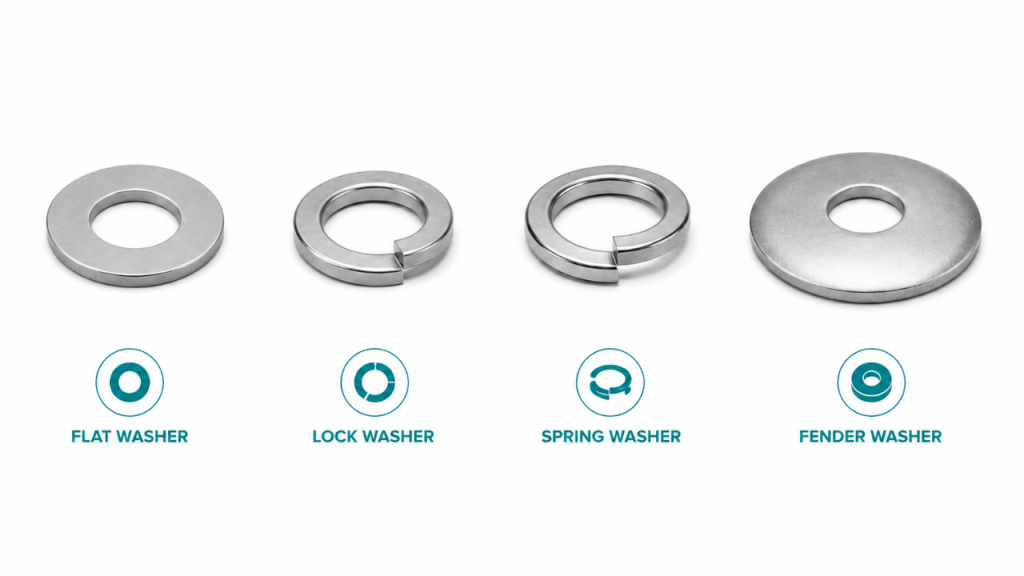
Types and Common Applications
- Flat Washers: Distribute load and protect surfaces.
- Lock Washers: Help prevent loosening caused by vibration.
- Spring Washers: Provide tension and maintain preload.
- Fender Washers: Used when a larger bearing surface is required.
Advantages
- Improve load distribution by spreading the fastening force over a larger surface area.
- Help protect materials from surface damage, indentation and deformation during tightening.
- Reduce wear and stress on fastened components, contributing to longer joint life.
- Certain washer types, such as lock and spring washers, help minimize loosening caused by vibration and dynamic loads.
- Available in various sizes and designs to meet the requirements of different industrial applications.
Limitations
- Usually require additional components such as bolts or nuts.
- Improper washer selection can reduce fastening effectiveness.
- Add extra components to inventory and assembly processes.
5. Rivets
Rivets are permanent fasteners used to create strong and durable joints between two or more materials. Once installed, they form a fixed connection that cannot be easily removed without damaging the rivet itself.
Because of their strength, reliability and lightweight characteristics, rivets, including stainless steel rivets, are extensively used in aerospace, transportation, shipbuilding, construction and metal fabrication industries.
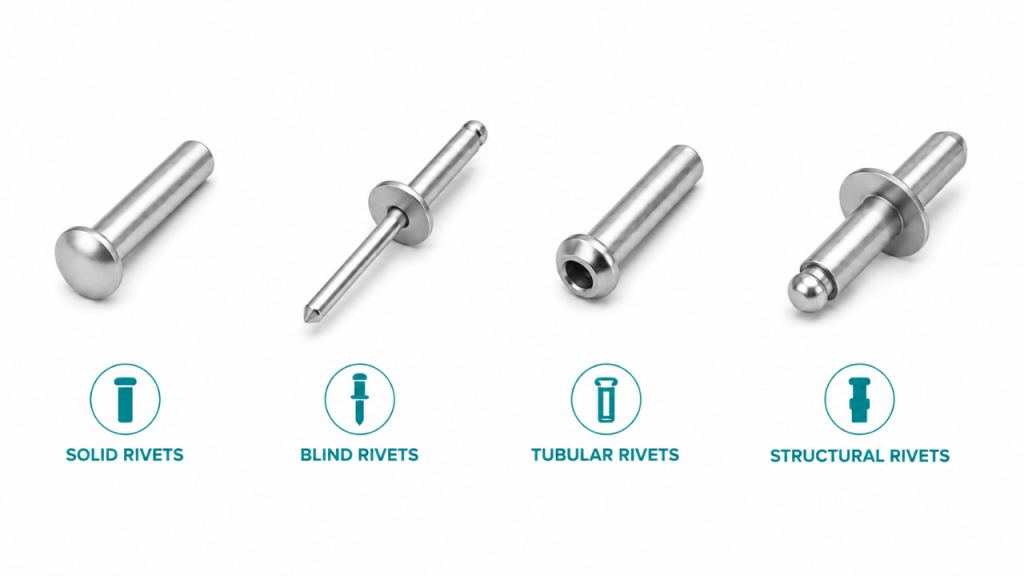
Types and Common Applications
- Solid Rivets: Common in aerospace and structural applications.
- Blind Rivets: Used when access is available from only one side.
- Tubular Rivets: Frequently found in light-duty assemblies and consumer products.
- Structural Rivets: Designed for high-strength industrial and construction applications.
Advantages
- Create strong, reliable and permanent joints that maintain their integrity over time.
- Offer excellent resistance to vibration, shock and mechanical stress, making them suitable for demanding applications.
- Lightweight and cost-effective compared to certain welding and fastening methods.
- Can be used to join a wide range of materials, including metal, plastic and composite components.
- Require minimal maintenance once installed and provide consistent long-term performance.
Limitations
- Difficult to remove without damaging the rivet.
- Not reusable after installation.
- May require specialized installation tools.
6. Studs
Studs are rod-shaped fasteners that feature threads on both ends or along their entire length. They are commonly used in applications where components need to be assembled and disassembled repeatedly without causing wear to the threaded holes of the connected parts.
Studs provide excellent load distribution and secure fastening in high-pressure and high-temperature environments. They are frequently used in engines, pipelines, pressure vessels, heavy machinery and structural assemblies where strength, reliability and maintenance accessibility are critical.
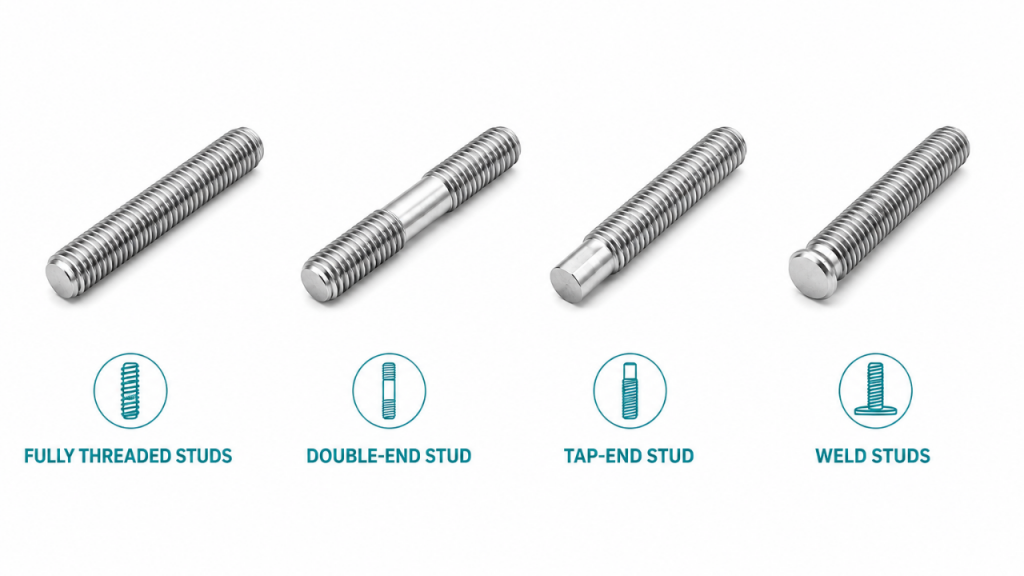
Types and Common Applications
- Fully Threaded Studs: Used in construction, piping systems and heavy equipment.
- Double-End Studs: Common in engines, pumps and pressure vessels.
- Tap-End Studs: Frequently used in machinery and industrial equipment.
- Weld Studs: Used for attaching components to metal surfaces.
Advantages
- Provide excellent load distribution, helping improve joint strength and stability.
- Perform reliably in high-temperature, high-pressure and heavy-duty industrial applications.
- Allow components to be assembled and disassembled multiple times without damaging the primary threaded connection.
- Help reduce wear on mating threads, extending the service life of equipment and assemblies.
- Available in various lengths, materials and grades to meet diverse engineering and industrial requirements.
Limitations
- Require additional nuts for fastening.
- Installation can be more time-consuming than standard bolts.
- Proper alignment is necessary for effective assembly.
7. Anchors
Anchors are specialized fasteners designed to secure objects to materials such as concrete, brick, stone or masonry. They create a strong attachment point when standard screws or bolts cannot achieve sufficient holding power in solid base materials.
Various anchor types are available, including wedge anchors, sleeve anchors, expansion anchors and chemical anchors, each suited for specific load and installation requirements. Anchors are widely used in construction, infrastructure projects, industrial facilities and commercial buildings to safely mount equipment, structural components, railings and fixtures.
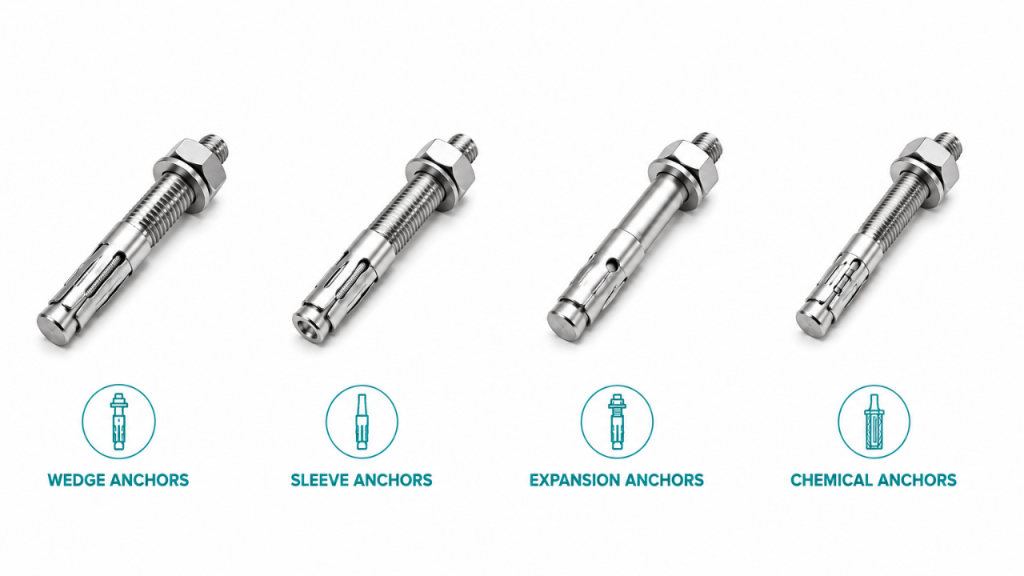
Types and Common Applications
- Wedge Anchors: Used for securing heavy equipment to concrete.
- Sleeve Anchors: Suitable for concrete, brick and masonry applications.
- Expansion Anchors: Common in construction and infrastructure projects.
- Chemical Anchors: Used for high-load and critical structural installations.
Advantages
- Provide strong and reliable fastening in concrete, brick, stone and other masonry materials.
- Capable of supporting heavy loads in structural, industrial and construction applications.
- Available in various designs to suit different load requirements and installation environments.
- Enhance safety, stability and long-term structural performance.
- Offer excellent resistance to pull-out forces and vibration when properly installed.
Limitations
- Installation often requires drilling and precise placement.
- Some anchor types are permanent and difficult to remove.
- Performance depends heavily on the condition of the base material.
Fastener Types and Uses: A Quick Comparison
| Fastener Type | Primary Function | Common Industries |
|---|---|---|
| Bolts & Nuts | Strong detachable joints | Manufacturing, Construction |
| Screws | Secure materials together | Automotive, Electronics |
| Washers | Load distribution | Machinery, Equipment |
| Rivets | Permanent fastening | Aerospace, Automotive |
| Studs | High-strength connections | Energy, Heavy Equipment |
| Anchors | Secure into concrete and masonry | Construction |
What Materials and Coatings Are Used in Industrial Fasteners?
The performance, durability and reliability of industrial fasteners depend heavily on the materials and coatings used in their manufacture. Selecting the right combination ensures that fasteners can withstand environmental conditions, mechanical loads, temperature variations and exposure to corrosive substances.
Common Fastener Materials
- Carbon Steel
Carbon steel fasteners is one of the most widely used materials for industrial fasteners due to its strength, affordability and versatility. It is commonly used in construction, manufacturing and general engineering applications where corrosion resistance is not a primary concern.
- Stainless Steel
Stainless steel fasteners offer excellent resistance to rust and corrosion, making them ideal for outdoor, marine, food processing and chemical industry applications. They also provide an attractive finish and require minimal maintenance.
- Alloy Steel
Alloy steel fasteners are engineered for high-strength applications that demand superior mechanical performance. They are frequently used in heavy machinery, automotive systems, energy infrastructure and structural projects where high load-bearing capacity is essential.
- Brass
Brass fasteners are valued for their corrosion resistance, electrical conductivity and decorative appearance. They are commonly found in electrical equipment, plumbing systems and architectural applications.
- Aluminium
Aluminium fasteners are lightweight and naturally resistant to corrosion. They are often used in aerospace, transportation, electronics and applications where weight reduction is important.
Common Fastener Coatings
- Zinc Plating
Zinc-plated fasteners feature a thin protective layer of zinc that helps prevent corrosion and extends service life. This coating is widely used for indoor and moderately corrosive environments.
- Hot-Dip Galvanizing
Hot-dip galvanizing involves coating fasteners with a thick layer of molten zinc, providing enhanced protection against rust and harsh weather conditions. It is commonly used in construction, infrastructure and outdoor installations.
- Black Oxide Coating
Black oxide coatings improve appearance and offer mild corrosion resistance while reducing light reflection. These coatings are often used in machinery, tools and automotive components.
- PTFE Coating
PTFE-coated fasteners provide excellent chemical resistance and reduce friction during installation. They are commonly used in chemical processing, marine and industrial applications.
- Nickel and Chrome Plating
Nickel and chrome coatings enhance corrosion resistance while providing a polished and professional finish. These coatings are often selected for decorative, automotive and specialized industrial uses.
How Are Industrial Fasteners Used Across Different Industries?
Industrial fasteners are essential components that ensure the strength, reliability and safety of assemblies across various industries. From securing structural components to supporting high-performance equipment, fasteners play a critical role in maintaining operational efficiency and product integrity.
- Aerospace
In the aerospace industry, aerospace fasteners are used to assemble aircraft structures, engines and critical aerospace systems where precision and reliability are essential. These components must perform under extreme temperatures, vibration and high-stress conditions. Schilthorn Precision supports aerospace manufacturers with AS9100-certified precision machining and stringent quality control processes, helping deliver components that meet demanding industry standards.
- Automotive
Industrial fasteners are widely used in automotive applications, including engines, chassis, braking systems and vehicle assemblies. They help structural strength and long-term performance. Schilthorn Precision manufactures high-precision components for the automotive sector, supporting OEMs with reliable machining solutions that meet strict quality and performance requirements.
- HVAC Systems
HVAC equipment depends on precision fasteners and fittings to maintain secure connections and efficient system performance. These components play a crucial role in heating, cooling and refrigeration applications. Schilthorn Precision supplies precision-engineered HVAC components and connectors designed to support durability, efficiency and consistent operation.
- Fittings & Fasteners Manufacturing
The fittings and fasteners industry relies on precision manufacturing to produce components that meet exact specifications and performance standards. From threaded inserts to custom-machined parts, accuracy is critical for reliable assemblies. Schilthorn Precision specializes in manufacturing high-quality machined components and fastening solutions that deliver strength, consistency and dependable performance across industrial applications.
How to Choose the Right Industrial Fastener
- Consider the Application Requirements
- Evaluate Material Compatibility
- Assess Environmental Conditions
- Determine Strength Requirements
- Select the Appropriate Coating
- Consider Installation and Maintenance Needs
- Ensure Compliance with Industry Standards
Find the Right Fastening Solution with Schilthorn Precision Engineering
At Schilthorn Precision Engineering, we combine over 15+ years of precision manufacturing expertise with AS9100 and ISO 9001-certified quality systems to deliver industrial fasteners that meet the highest standards of performance, reliability and durability. Our fasteners are engineered to support demanding applications across aerospace, automotive, HVAC, manufacturing and heavy engineering industries.
With advanced manufacturing capabilities, rigorous quality control processes and a commitment to continuous improvement, we provide fastening solutions designed to perform consistently in challenging operating environments. Whether you require standard fasteners or custom-engineered components, our team works closely with you to ensure the right solution for your application.
Looking for high-quality industrial fasteners backed by engineering expertise? Contact Schilthorn today to discuss your requirements and discover how our precision-engineered solutions can support your next project.
Frequently Asked Questions (FAQs)
-
What’s the actual difference between a bolt and a screw aren’t they the same thing?
It’s a common misconception but bolts and screws are not exactly the same. Bolts are typically used with nuts to create a secure clamping force between components, while screws are generally driven into a threaded hole or directly into a material. Although they may look similar, using the correct fastener is important for ensuring proper fit, strength and performance.
-
Why do aerospace fasteners cost so much more than hardware store bolts?
Aerospace fasteners are designed for environments where failure is simply not an option. They must withstand extreme temperatures, vibration, pressure changes and heavy loads while maintaining consistent performance. To achieve this, manufacturers use specialized materials, precision manufacturing processes and rigorous quality testing, all of which contribute to their higher cost.
-
How do I know if a fastener failure is due to wrong type selection or poor installation?
The cause often becomes clear when you look at the failure pattern. If the same issue occurs repeatedly across multiple fasteners, the selected fastener may not be suitable for the application’s load or environment. On the other hand, isolated failures are often linked to installation errors such as improper tightening, misalignment or incorrect torque. A careful inspection can help identify the root cause.
-
Can I replace a worn fastener with a stronger grade one? Isn’t stronger always better?
Not necessarily. While a higher-grade fastener can provide greater strength, it may not always be the best choice for the application. Different assemblies are designed with specific fastener grades in mind and replacing them without proper evaluation can affect performance, load distribution or even the safety of the entire system. It’s always best to follow the manufacturer’s recommendations.
-
What fastener grade should I use for outdoor or coastal environments?
The answer depends on the level of exposure to moisture and corrosive elements. For general outdoor applications, galvanized fasteners are often a reliable choice due to their enhanced corrosion resistance. In coastal, marine or chemically aggressive environments, stainless steel fasteners are typically preferred because they offer superior protection against rust and long-term environmental damage.