
EDM Machining Explained: How Electrical Discharge Machining Works
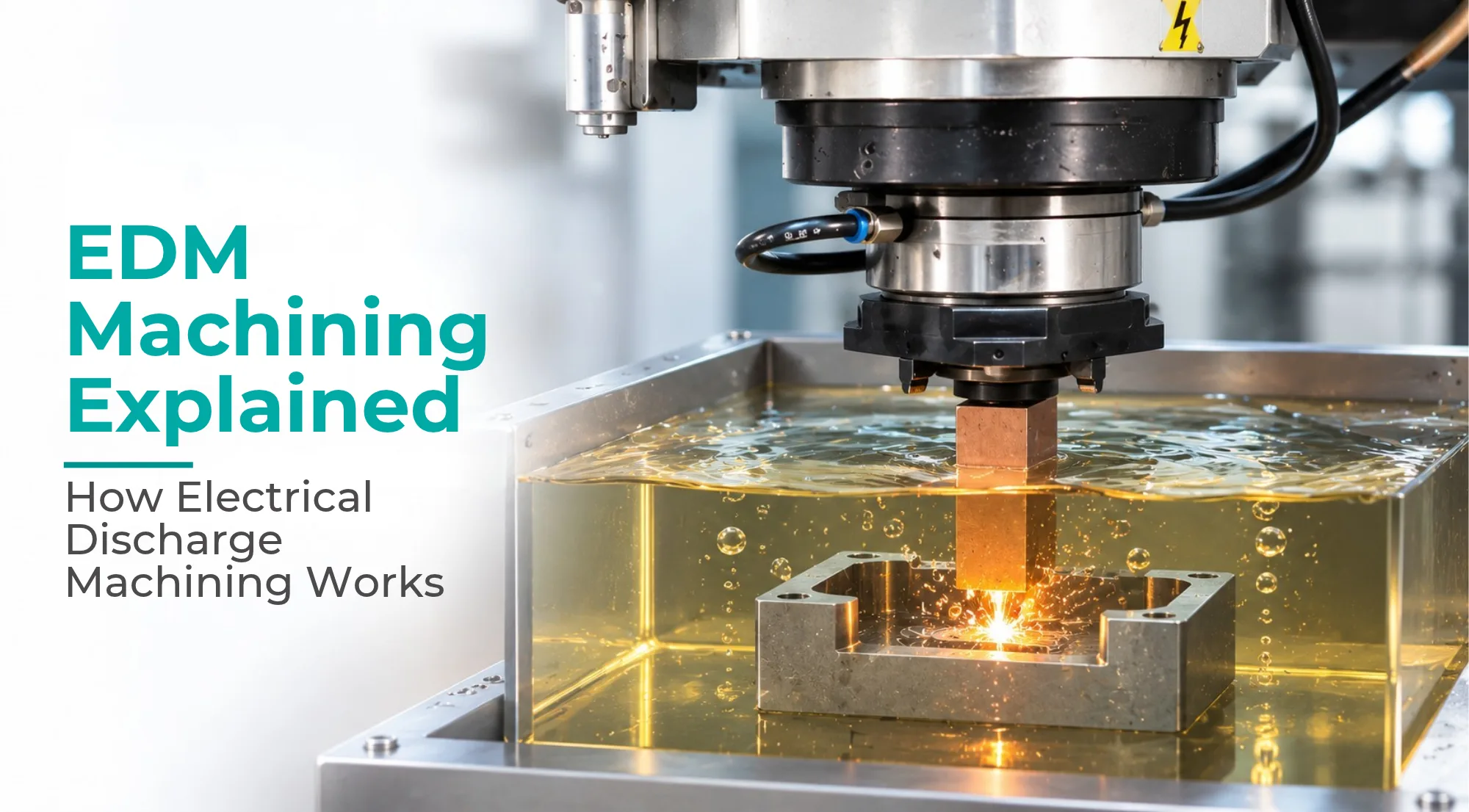


Manufacturing complex components often involves working with hard materials and intricate features that can be difficult to machine using conventional methods. Hardened steels, narrow slots and detailed cavities may require an alternative approach when traditional cutting tools cannot achieve the required geometry efficiently.
This is where Electrical Discharge Machining (EDM) becomes useful. Unlike conventional machining, which removes material through direct contact between a cutting tool and the workpiece, EDM uses controlled electrical sparks to erode material and produce the desired shape. The process is particularly suitable for machining hard, electrically conductive materials and creating intricate features.
EDM machining is widely used in precision manufacturing, tool and die production, aerospace and automotive industries. Understanding how electrical discharge machining works, its different types and applications help manufacturers identify when it is the right choice for a component.
What Is EDM Machining?
Electrical Discharge Machining (EDM), also known as spark erosion machining, is a non-traditional manufacturing process that removes material from an electrically conductive workpiece using controlled electrical sparks.
During the process, sparks are generated between an electrode and the workpiece, producing intense heat that melts and vaporises small amounts of material. A dielectric fluid helps remove the eroded particles from the machining area.
Unlike conventional CNC milling or CNC turning, EDM removes material without direct contact between a cutting tool and the workpiece. It is commonly used to machine hard materials and produce complex profiles, narrow slots and intricate cavities that can be difficult to achieve through conventional machining.
How Does Electrical Discharge Machining Work?
The EDM process depends on controlled electrical discharges between two electrically conductive components: the electrode and the workpiece. Both are positioned close to each other without making direct physical contact.
A dielectric fluid fills the gap between them and acts as an insulating medium under normal conditions. When the applied voltage becomes sufficient, the dielectric breaks down locally and allows an electrical spark to pass through the gap. This spark produces concentrated heat, causing a small amount of material to melt and vaporise. The process repeats rapidly at controlled intervals until the required shape or feature is produced.
The working process can be understood through the following steps.
Step 1: Positioning the Electrode and Workpiece
The process begins by securing the workpiece on the EDM machine table. An electrode is selected according to the required machining operation and component geometry.
In die-sinking EDM, the electrode is manufactured with a shape corresponding to the cavity or profile required in the workpiece. In wire EDM, a continuously moving thin wire acts as the electrode and follows a programmed cutting path. Accurate positioning is important because the distance between the electrode and workpiece directly influences spark generation and machining stability.
Step 2: Establishing the Spark Gap
After positioning, the electrode and workpiece are brought close to each other while maintaining a small controlled gap. This gap is known as the spark gap or discharge gap. It is filled with dielectric fluid, which prevents continuous electrical conduction under normal conditions.
The EDM machine uses a servo control system to maintain the appropriate distance between the electrode and workpiece. This helps ensure consistent electrical discharges during machining.
Step 3: Generating Controlled Electrical Discharges
The machine’s power supply applies controlled electrical pulses between the electrode and the workpiece. When the electrical field becomes strong enough, the dielectric fluid breaks down locally, allowing a spark to pass through the gap.
Each discharge generates extremely high localised temperatures at the machining point. This heat melts and vaporises a microscopic quantity of material from the workpiece. The process occurs repeatedly through a controlled sequence of electrical pulses rather than through continuous contact or cutting force.
Step 4: Removing Material Through Spark Erosion
As electrical discharges continue, small amounts of material are removed from the workpiece surface. The repeated sparks gradually create the required cavity, profile or cut. The amount of material removed depends on factors such as discharge energy, pulse duration, electrode characteristics, material properties and machining settings.
The electrode and workpiece remain separated throughout the process. This is why EDM can machine certain intricate features without applying the mechanical cutting forces associated with conventional machining.
Step 5: Flushing Away the Eroded Particles
The electrical discharge process produces small particles of eroded material, which must be removed from the machining gap. A dielectric fluid circulates through the working area to flush away these particles. It also helps cool the machining zone and restore insulating conditions between electrical discharges.
Effective flushing is important for maintaining machining stability, preventing debris accumulation and supporting consistent material removal.
Step 6: Achieving the Required Geometry and Surface Finish
The machine continues generating controlled discharges until the required machining depth, profile or dimensions are achieved. Depending on the application, the process may involve roughing operations to remove material quickly, followed by finishing passes to improve dimensional accuracy and surface quality.
The final result depends on the machining strategy, electrode or wire selection, electrical parameters, flushing conditions and inspection requirements.
Key Components That Make the EDM Process Work
The EDM process relies on several interconnected machine components. Each plays a specific role in generating electrical discharges, controlling material removal and maintaining machining stability.
1. Power Supply
The power supply generates controlled electrical pulses between the electrode and the workpiece. It regulates discharge energy, pulse duration and other electrical parameters that influence material removal and surface characteristics.
2. Electrode
The electrode acts as the electrical conductor through which discharges are generated. Its form depends on the EDM method being used.
- In wire EDM, a thin moving wire serves as the electrode.
- In die-sinking EDM, a shaped electrode is used to create the required cavity.
- In hole-drilling EDM, a tubular electrode is used to produce small and deep holes.
Electrode material and geometry influence machining performance and accuracy.
3. Dielectric Fluid System
The dielectric fluid fills the gap between the electrode and workpiece. It helps control electrical discharges, cool the machining zone and remove eroded particles. Depending on the EDM process, the dielectric medium may be a specialised hydrocarbon-based oil or deionised water.
4. Servo Control System
The servo system maintains the appropriate gap between the electrode and the workpiece. It continuously adjusts electrode positioning based on machining conditions. Maintaining this gap is important because an excessively small distance can cause unstable discharges or short circuits, while an excessively large gap can prevent effective spark generation.
5. CNC Control System
Modern CNC EDM machines use programmed instructions to control electrode movement and machining paths. The CNC system helps produce complex profiles, repeatable cuts and accurately positioned features according to the component drawing and machining requirements.
What Are the Different Types of EDM Machining?
Although all EDM processes use controlled electrical discharges to remove material, they differ in the type of electrode used, machining movement and features they produce. The three commonly used types are wire EDM, die-sinking EDM and hole-drilling EDM.
1. Wire EDM Machining
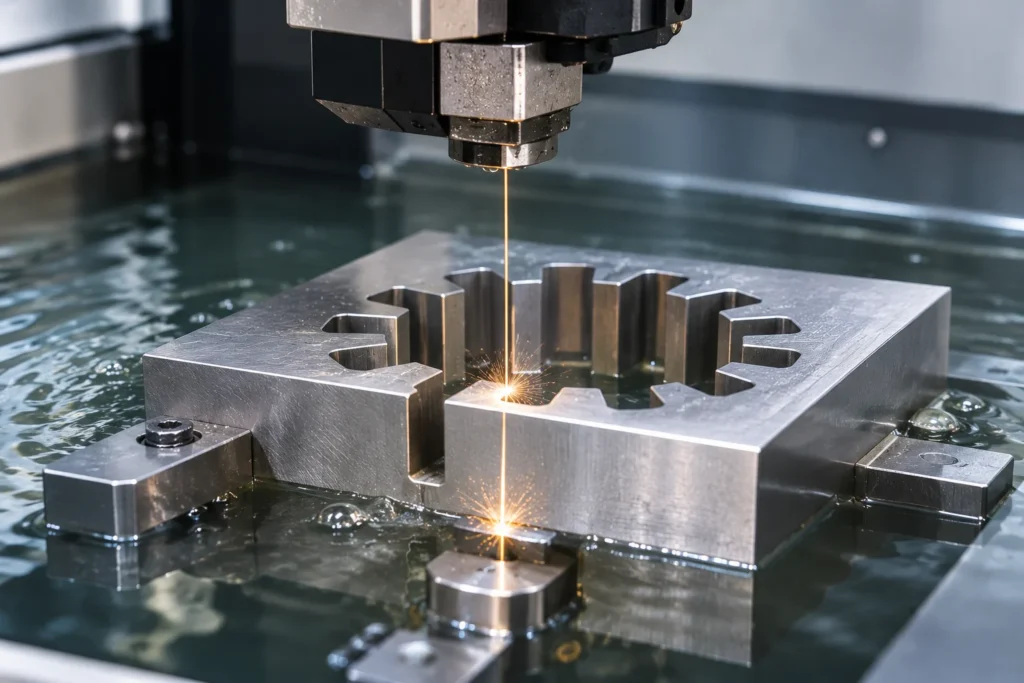
Wire EDM, also known as Wire Electrical Discharge Machining, uses a continuously moving thin metal wire as the electrode. The wire travels along a programmed path while electrical discharges remove material from the workpiece.
The wire does not physically cut through the material like a conventional saw or cutting tool. Instead, sparks generated between the wire and workpiece gradually erode the material along the programmed cutting path.
Wire EDM is particularly suitable for:
- Cutting intricate external profiles.
- Producing narrow slots and complex contours.
- Manufacturing precision punches and dies.
- Cutting hardened tool steels and conductive alloys.
- Producing components with detailed internal and external geometries.
Because the wire follows a programmed path, the process can produce complex two-dimensional profiles with high dimensional consistency.
2. Die-Sinking EDM
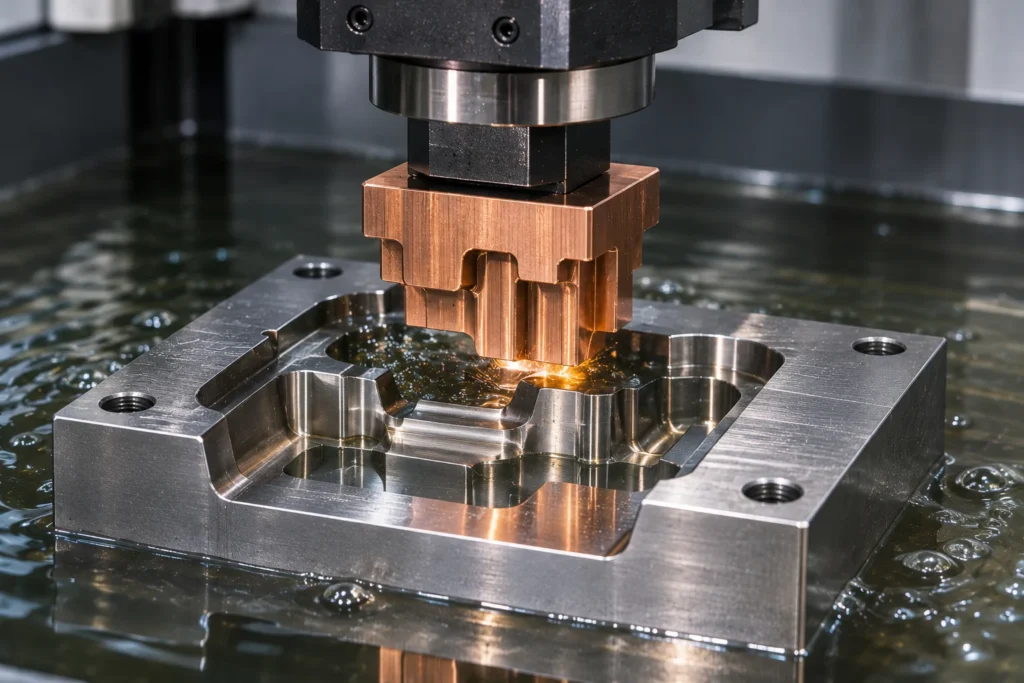
Die-sinking EDM, also called sinker EDM or ram EDM, uses a specially shaped electrode to create cavities in a conductive workpiece.
The electrode is manufactured according to the required cavity geometry and positioned above the workpiece. As electrical discharges occur, material is gradually removed from the workpiece, allowing the electrode’s shape to be reproduced as a cavity.
Unlike wire EDM, which cuts along a path, die-sinking EDM is primarily used to produce internal cavities and three-dimensional features.
Common applications include:
- Injection mould cavities.
- Die and mould manufacturing.
- Complex internal profiles.
- Deep cavities and intricate recesses.
- Features that are difficult to reach with conventional cutting tools.
Die-sinking EDM is especially useful when a component requires a detailed cavity in hardened material.
3. Hole-Drilling EDM
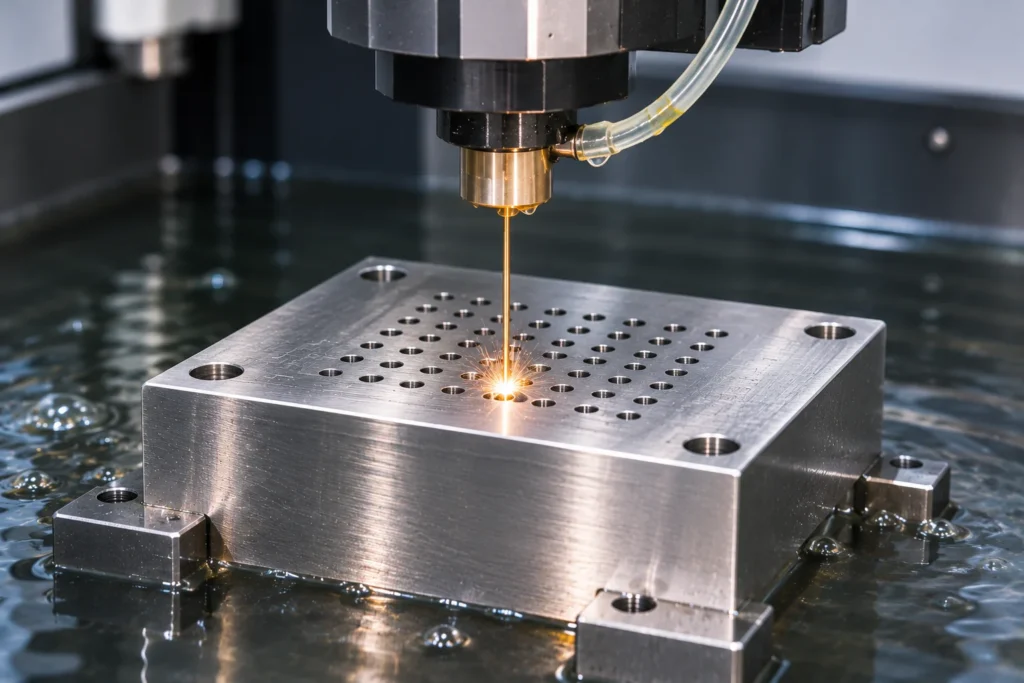
Hole-drilling EDM, also known as small-hole EDM, uses a rotating or non-rotating tubular electrode to produce small-diameter holes in electrically conductive materials.
The electrode directs dielectric fluid through its internal passage while electrical discharges remove material from the workpiece. This helps flush eroded particles out of the hole during machining.
The process is particularly useful for producing deep, narrow holes that may be difficult to manufacture using conventional drilling methods.
Typical applications include:
- Cooling holes in turbine components.
- Small holes in hardened materials.
- Deep and narrow holes.
- Precision openings in specialised industrial components.
- Starting holes for wire EDM operations.
Each EDM type serves a different manufacturing purpose. Selecting the right process depends on the required geometry, material, dimensions and production requirements.
Which Materials Can Be Machined Using EDM?
One of the main advantages of electrical discharge machining is its ability to process hard materials that can be difficult to machine using conventional cutting methods. However, EDM has one essential material requirement: the workpiece must be electrically conductive. Material hardness is not the deciding factor in the same way it is for conventional cutting processes.
Common materials suitable for EDM machining include:
| Material | Why It Is Used in EDM |
|---|---|
| Hardened tool steel | Suitable for machining dies, moulds and precision tooling after hardening. |
| Stainless steel | Used for components requiring corrosion resistance and specific mechanical properties. |
| Titanium alloys | Used in aerospace and other applications where strength-to-weight requirements are important. |
| Carbides | Suitable for specialised tooling and wear-resistant components. |
| Nickel-based alloys | Used in demanding industrial and aerospace applications. |
| Copper and conductive alloys | Used in electrical, tooling and specialised engineering applications. |
The suitability of a material also depends on its electrical conductivity, thermal properties, component geometry and the required machining results.
For example, EDM can be useful for machining hardened steel components after heat treatment. This can reduce the need for additional conventional machining operations on difficult-to-cut features. Electrically insulating materials such as ceramics generally cannot be machined using conventional EDM unless a specialised process or conductive treatment is involved.
Where Is EDM Machining Used in Manufacturing?
EDM is used across industries where component geometry, material hardness and precision requirements create machining challenges. Its ability to produce complex features in conductive materials makes it useful for several specialised manufacturing applications.
1. Tool and Die Manufacturing
Tool and die manufacturers use EDM to produce intricate cavities, profiles and narrow features in punches, dies and moulds. Die-sinking EDM is commonly used for mould cavities, while wire EDM helps create precise profiles and cutting geometries. These processes are particularly useful when the tooling material has already been hardened.
2. Aerospace Manufacturing
Aerospace components often involve specialised materials and complex geometries. EDM can be used for selected features in turbine components, engine parts and other precision-engineered components. Hole-drilling EDM, for example, is used to produce small cooling holes in certain turbine components where the hole geometry and location are critical.
3. Automotive Manufacturing
In the automotive sector, EDM is used in the production of precision tooling, dies, moulds and specialised components. It can support the manufacturing of complex profiles and features in hardened materials used in production equipment and precision tooling.
4. Medical Device Manufacturing
Certain medical manufacturing applications require intricate geometries and small features in conductive materials. EDM can be used to machine selected precision components, particularly where conventional machining access is limited. Material selection, surface requirements and applicable medical-device specifications must still be considered.
5. Precision Engineering and Mould Manufacturing
EDM is widely used in precision engineering for components that require detailed cavities, narrow slots, fine profiles and other complex features. It is especially useful in mould manufacturing, where the required geometry may be difficult to achieve using conventional milling or drilling alone.
What Are the Advantages of EDM Machining?
EDM offers several manufacturing advantages, particularly when working with hard conductive materials and complex component geometries.
- Machining Hard Materials: EDM can machine electrically conductive materials regardless of whether they are difficult to cut because of their hardness. This makes it useful for hardened tool steels, carbides and selected high-performance alloys.
- Producing Complex Geometries: The process can create intricate cavities, narrow slots, fine profiles and detailed features that may be challenging to produce using conventional cutting tools.
- Minimal Mechanical Cutting Forces: Since material removal takes place through electrical discharges rather than direct cutting contact, EDM does not apply the same mechanical cutting forces as conventional machining. This is beneficial when machining delicate or thin-walled features that may be affected by cutting pressure.
- Machining Hardened Components: EDM can be used after heat treatment to produce features in hardened components. This can reduce the need for certain secondary machining operations and help manufacturers achieve the required geometry in difficult materials.
- Precision in Detailed Features: With suitable machine settings, electrode selection and process control, EDM can produce detailed features with controlled dimensions. Wire EDM is particularly useful for intricate profiles, while die-sinking EDM supports complex cavity production.
- No Conventional Cutting Tool Wear: EDM does not use a conventional cutting edge to remove material. However, the electrode can still wear during the process, and wire EDM consumes wire continuously. Therefore, EDM eliminates conventional cutting-tool engagement but does not eliminate all tool or consumable wear.
What Are the Limitations of EDM Machining?
Despite its advantages, EDM is not suitable for every manufacturing requirement. Understanding its limitations helps manufacturers select the right process for each component.
- Limited to Electrically Conductive Materials: Conventional EDM requires the workpiece to conduct electricity. Non-conductive materials such as most ceramics, glass and plastics cannot be directly machined using standard EDM methods.
- Slower Material Removal in Certain Applications: EDM removes material through repeated electrical discharges. Depending on the material, geometry and required surface finish, the process can be slower than conventional machining, particularly when large volumes of material need to be removed.
- Electrode Wear: In die-sinking EDM, the electrode gradually wears during machining. Electrode wear can influence the final cavity geometry and must be considered during electrode design and process planning. Wire EDM also requires continuous wire consumption.
- Thermal Effects on the Surface: The intense localised heat generated during EDM can affect the machined surface. Depending on the material and process parameters, a recast layer or heat-affected region may form. For applications with strict surface-integrity requirements, additional finishing or inspection may be necessary.
- Operating and Maintenance Requirements: EDM machines require specialised power supplies, dielectric fluid systems, filtration and process controls. These requirements can increase operating costs and make process setup more specialised than conventional machining. For this reason, EDM is generally selected based on specific component requirements rather than used as a replacement for every machining operation.
EDM vs CNC Machining: What Is the Difference?
EDM and conventional CNC machining are both used in precision manufacturing, but they remove material through different mechanisms.
CNC machining commonly uses rotating cutting tools or other mechanically driven tools to remove material from a workpiece. EDM uses electrical discharges to erode electrically conductive material.
| Comparison Factor | EDM Machining | Conventional CNC Machining |
|---|---|---|
| Material removal method | Electrical discharge and thermal erosion | Mechanical cutting |
| Tool-workpiece contact | No direct cutting contact | Cutting tool physically engages the workpiece |
| Material suitability | Electrically conductive materials | Depends on the cutting tool, workpiece and machining conditions |
| Hard materials | Can machine hardened conductive materials | Machining difficulty generally increases with material hardness |
| Complex features | Suitable for intricate cavities, narrow slots and detailed profiles | Suitable for a wide range of profiles, pockets, holes and surfaces |
| Cutting forces | Minimal mechanical cutting forces | Cutting forces are generated during material removal |
| Material removal rate | Can be slower for bulk material removal | Often more suitable for efficient material removal |
| Common applications | Dies, mould cavities, fine profiles and specialised holes | Milling, turning, drilling and general component manufacturing |
Neither process is universally better. The appropriate choice depends on the component’s material, geometry, dimensional requirements, production volume and surface-finish expectations.
In many manufacturing environments, EDM and CNC machining are complementary processes. CNC machining may be used to remove bulk material and produce general features, while EDM handles specific details that are difficult to achieve through conventional cutting.
When Should Manufacturers Choose EDM Machining?
Selecting EDM should begin with an assessment of the component rather than the machining technology alone.
Manufacturers should consider EDM when:
- The workpiece is difficult to machine conventionally: Hardened tool steels, carbides and selected conductive alloys may benefit from electrical discharge machining.
- The component requires intricate features: Narrow slots, complex cavities and detailed profiles may be more practical to produce using EDM.
- Mechanical cutting forces need to be minimised: EDM can be suitable for delicate features where direct cutting forces could cause deformation.
- Machining is required after heat treatment: EDM can produce selected features in hardened components without relying on conventional cutting edges.
- Deep or small-diameter holes are required: Hole-drilling EDM can be useful for specialised applications where conventional drilling is challenging.
However, if the component requires high-volume bulk material removal, conventional CNC machining may be more efficient. Manufacturers should evaluate the complete machining requirement, including material, tolerances, surface finish, production quantity and cost.
How Schilthorn Precision Supports Your EDM Machining Requirements
At Schilthorn Precision, we bring over 15 years of experience in precision manufacturing, with capabilities in advanced CNC machining, VMC machining and fabrication. We manufacture custom industrial components based on customer drawings and technical specifications, with a focus on dimensional accuracy and manufacturing consistency.
For projects involving EDM-machined features that require further CNC machining or custom component manufacturing, Schilthorn Precision can support your additional manufacturing requirements.
Discuss your precision component requirements with Schilthorn Precision.
Frequently Asked Questions
1. What does EDM stand for in machining?
EDM stands for Electrical Discharge Machining. It is a non-traditional machining process that removes material from electrically conductive workpieces through controlled electrical sparks.
2. How does electrical discharge machining remove material?
EDM generates electrical sparks between an electrode and the workpiece. The heat produced by these sparks melts and vaporises small amounts of material. Dielectric fluid then helps remove the eroded particles from the machining gap.
3. Can EDM machine hardened steel?
Yes. EDM can machine hardened steel because material removal depends on electrical conductivity rather than the ability of a conventional cutting tool to penetrate the material. It is commonly used for dies, moulds and other hardened precision components.
4. Does EDM require physical contact with the workpiece?
No. EDM is a non-contact machining process. Electrical discharges occur across a small gap between the electrode and the workpiece, removing material without direct mechanical cutting contact.
5. What is the difference between wire EDM and sinker EDM?
Wire EDM uses a continuously moving thin wire electrode to cut profiles and intricate contours through a workpiece. Sinker EDM uses a shaped electrode to produce cavities, recesses and three-dimensional features.
6. Is EDM more accurate than CNC machining?
Neither process is automatically more accurate in every application. Accuracy depends on the machine, process parameters, tooling, material, setup and inspection methods. EDM is particularly useful for detailed features and hard conductive materials, while CNC machining is suitable for a much broader range of manufacturing operations.
7. What are the common applications of EDM machining?
EDM is commonly used in tool and die manufacturing, mould production, aerospace components, automotive tooling, precision engineering and specialised hole-making applications. It is especially useful for complex geometries and features in electrically conductive materials.