
Welding Qualifications for Heat Exchanger Fabrication: ASME Section IX Basics
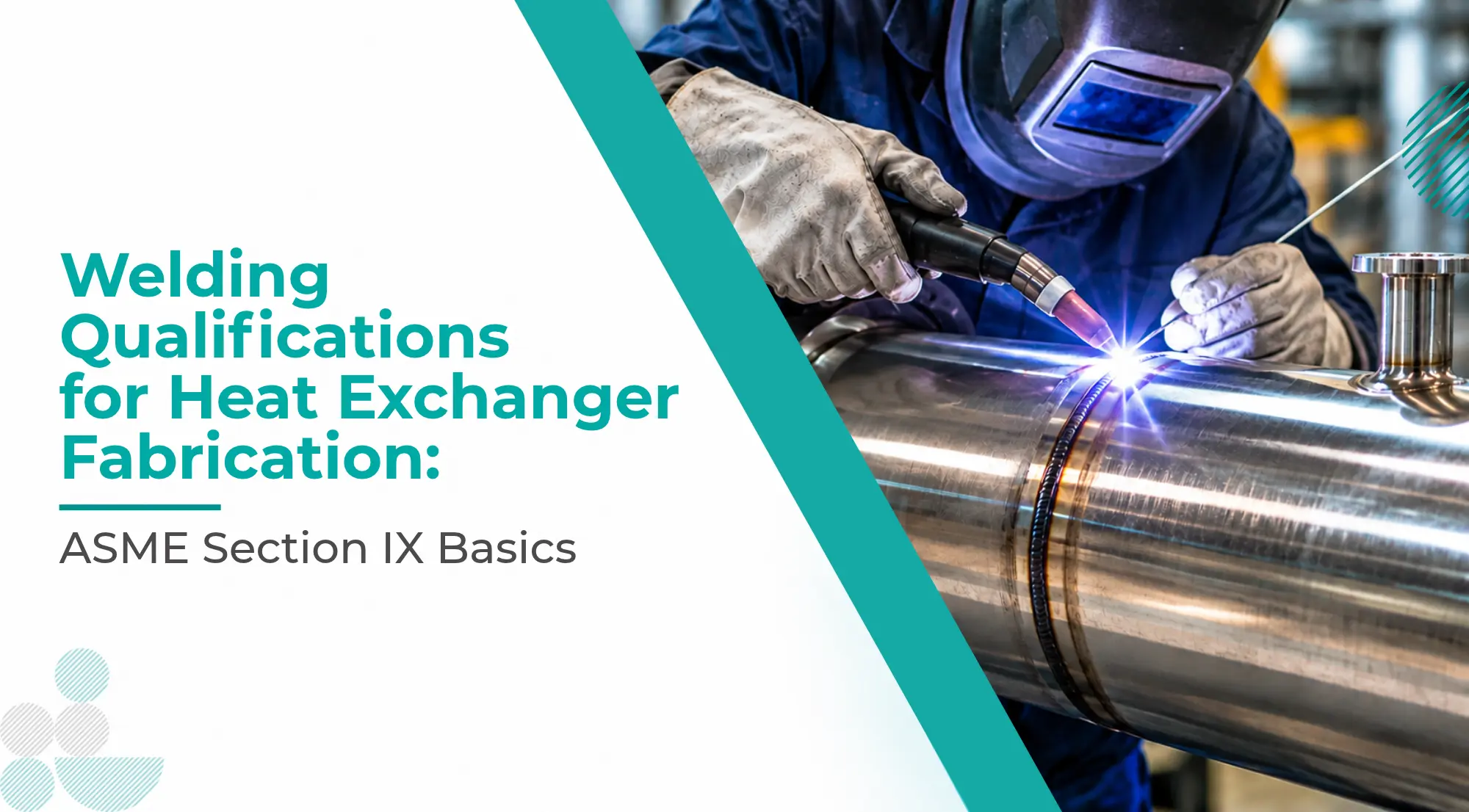


In heat exchanger fabrication, a weld must do more than join two metal components. It must meet the requirements established for the equipment, materials, joint design and intended operating conditions. A welding procedure that works for one material combination or joint configuration cannot automatically be applied to every other joint in the same exchanger.
This is where ASME Section IX becomes important. It establishes requirements for qualifying welding procedures and personnel, helping fabricators demonstrate that the proposed welding method and the people performing the work meet the applicable qualification criteria.
For heat exchanger manufacturers, understanding the relationship between a Welding Procedure Specification (WPS), a Procedure Qualification Record (PQR) and welder performance qualification is essential before production welding begins. Tube-to-tubesheet joints require particular attention because their geometry and functional requirements can introduce additional qualification considerations.
This guide explains how ASME Section IX welding qualification works, what the key documents establish and which points fabrication and quality teams should review before starting a heat exchanger project.
What Does ASME Section IX Cover in Heat Exchanger Fabrication?
ASME Boiler and Pressure Vessel Code (BPVC) Section IX covers qualification requirements for welding, brazing and fusing procedures, as well as the qualification of the personnel and operators who perform these processes. It is used alongside other applicable construction codes that establish requirements for the equipment being manufactured.
For a heat exchanger project, this distinction matters. Section IX addresses whether a welding procedure and the relevant personnel are qualified. The governing construction code, project specifications and approved drawings establish the broader requirements for design, fabrication, inspection and acceptance.
In practical terms, a fabricator needs to establish three things:
- The proposed welding procedure is qualified for the applicable variables and permitted ranges.
- The welder or welding operator is qualified for the work they will perform.
- The supporting qualification records are available and consistent with the production requirements.
Meeting these requirements is part of a controlled fabrication process; it does not replace the other inspection, testing or quality requirements applicable to the exchanger.
WPS, PQR and Welder Qualification: What Is the Difference?
WPS, PQR and welder performance qualification records are closely related, but each serves a different purpose. Treating them as interchangeable can create documentation gaps and confusion during fabrication review.
| Document | What it establishes | Why it matters |
|---|---|---|
| Welding Procedure Specification (WPS) | The welding instructions and qualified ranges to be followed during production | Guides the welder or operator on how the weld is to be made |
| Procedure Qualification Record (PQR) | The actual variables recorded during the qualification test and the results of the required tests | Provides evidence supporting procedure qualification |
| Welder Performance Qualification (WPQ) | Evidence that a welder has demonstrated the required skill within the applicable qualification range | Helps establish whether the individual is qualified for the assigned welding work |
The terminology used for welder qualification records can vary between organisations and project documentation. The applicable Section IX edition and the project’s quality procedures should determine the records maintained.
How the Documents Work Together
Consider a heat exchanger component that requires welding between specified base materials using a defined welding process. The fabricator first establishes an appropriate welding procedure and qualifies it when required. The resulting PQR records the qualification test variables and results, while the WPS sets out the production instructions within the qualified limits.
Separately, the person performing the weld must have the appropriate performance qualification. A qualified WPS does not, by itself, establish that every welder is qualified to use it. This distinction is particularly important when a project involves multiple welding processes, material combinations, joint configurations or production locations.
How Welding Procedure Qualification Works Before Production
Welding procedure qualification should be planned before production welding begins. The exact sequence depends on the applicable code, welding process, materials, joint configuration and project requirements, but the general workflow follows several stages.
Step 1: Review the Drawings and Applicable Requirements
The fabrication team reviews the approved drawings, material specifications, joint details, governing construction code and project requirements. This review establishes the intended weld configuration and identifies the applicable qualification requirements. For heat exchanger work, it is important to distinguish between different joint types rather than assuming that one procedure automatically covers every weld.
Step 2: Establish the Preliminary Welding Procedure
The welding engineer or responsible technical team identifies the proposed welding process, base materials, filler metal where applicable, joint preparation and other relevant parameters. The preliminary procedure must account for the variables that apply to the selected process. These may include material grouping, thickness, welding position, preheat, post weld heat treatment and electrical characteristics, depending on the process and applicable rules. The selected values must be evaluated against the qualification requirements rather than copied from an unrelated welding job.
Step 3: Weld the Qualification Test Coupon
A test coupon is welded using the proposed procedure, with the applicable variables recorded. The purpose is to establish whether the procedure can produce a weld that satisfies the required qualification tests. The coupon and test arrangement must follow the relevant rules; a production weld or an informal demonstration is not automatically a substitute for the required qualification test.
Step 4: Conduct the Required Tests
The qualification coupon is subjected to the examinations and tests specified by the applicable requirements. Depending on the qualification, these may include tensile testing, bend testing, impact testing when required or other prescribed examinations. The required test methods and acceptance criteria must be taken from the applicable code edition and project requirements. Not every welding procedure follows an identical test package.
Step 5: Record the Results and Establish the Qualified WPS
The actual test variables and results are documented in the PQR. The WPS is then established or finalised within the permitted qualification limits. Before production, verify that the WPS covers the intended welding conditions and that its supporting qualification records are available. If any proposed condition falls outside the qualified range, review the applicable code requirements before approving the change.
Example: Reviewing a Change Before Production
Suppose a heat exchanger project introduces a different base-metal combination from the one covered by the initially selected welding procedure. Before production begins, the fabrication team should compare the revised material requirements with the existing WPS and supporting PQR, then check the applicable ASME Section IX rules. This review determines whether the existing qualification covers the proposed work or whether further qualification is needed. The decision should be documented before the revised welding conditions are approved.
Tube-to-Tubesheet Welding: A Heat Exchanger-Specific Qualification Consideration
Tube-to-tubesheet welding deserves particular attention in shell-and-tube heat exchanger fabrication. These joints connect individual tubes to the tube sheet and their performance affects the separation of the fluids passing through the tube side and shell side.
Unlike a simple plate joint, tube-to-tube sheet welding involves a specific joint geometry and closely related dimensions, including tube diameter, tube wall thickness, tube sheet thickness and the spacing between adjacent holes. The intended function of the joint also influences its design.
Strength Welds and Seal Welds
A strength weld is intended to contribute to the mechanical strength of the tube-to-tube sheet connection. A seal weld is primarily intended to provide sealing, although the joint design and applicable construction requirements determine its role.
Some designs combine welding with mechanical tube expansion. These arrangements must be evaluated against the applicable design and construction requirements; a seal weld should not automatically be assumed to provide the same structural function as a strength weld.
Why Qualification Needs Specific Attention
Tube-to-tubesheet welding can require a qualification approach that addresses the actual joint configuration rather than relying only on a conventional groove-weld qualification. ASME Section IX includes provisions for tube-to-tube sheet qualification. Research published in the Journal of Engineering and Applied Science describes qualification trials using representative tube-to-tube sheet mock-ups, with examinations such as visual inspection, liquid penetrant testing and macro examination as applicable to the study.
The exact requirements for a project depend on the applicable construction code, Section IX edition, welding process, joint design and required qualification route. A mock-up test or specific examination should not be described as mandatory for every tube-to-tube sheet weld without checking the governing requirements. For the fabrication team, the practical priority is to establish the required qualification route before production and ensure that the test arrangement represents the relevant joint conditions.
Which Welding Variables Can Require Requalification?
A qualified welding procedure is not unrestricted. ASME Section IX defines variables that determine the limits within which a procedure remains qualified. Understanding these variables helps prevent production changes from being introduced without the necessary technical review.
The variables are generally classified as essential, nonessential and supplementary essential variables.
- Essential variables: Changes beyond the permitted limits can affect procedure qualification and require requalification under the applicable rules.
- Nonessential variables: Changes can generally be addressed through revision of the WPS without requalification, provided the revised procedure remains compliant with the applicable requirements.
- Supplementary essential variables: These become relevant when specified toughness requirements apply and can affect the qualification requirements for the procedure.
The classification of a variable depends on the welding process and the applicable Section IX provisions. A variable should not be classified solely from a general list without checking the relevant rules.
Examples of Variables to Review
| Variable or consideration | Why it matters |
|---|---|
| Welding process | Different processes have different qualification requirements |
| Base-metal grouping | Material changes can affect the applicable qualification range |
| Filler metal | Filler-metal classification and other applicable variables must remain within permitted limits |
| Weld thickness | Qualification tests establish permitted thickness ranges under the applicable rules |
| Welding position | Position requirements differ between procedure and personnel qualification |
| Preheat and post weld heat treatment | Changes may affect qualification depending on the applicable variables |
| Electrical characteristics and technique | Relevant limits depend on the process and the variables specified by Section IX |
These examples are intended as a review guide, not a substitute for the code’s variable tables. Before changing a production parameter, the responsible welding engineer should check the applicable provision and determine whether the change is permitted within the existing qualification.
Welder Qualification and Production Readiness
A qualified welding procedure does not automatically qualify every person who uses it. The welder or welding operator must meet the relevant performance qualification requirements for the assigned work.
Before production starts, the fabrication and quality teams should verify that:
- The welder’s qualification covers the relevant welding process.
- The applicable material, position, thickness, diameter or other performance variables fall within the permitted range.
- Any process-specific requirements for tube-to-tube sheet welding have been addressed.
- The qualification records are current under the applicable rules and organisational procedures.
- The work assignment matches the person’s qualified range.
Continuity requirements should also be checked under the applicable Section IX provisions. The team should not assume that a qualification remains valid indefinitely without verifying the relevant continuity and other applicable conditions. For projects with multiple welders or welding processes, maintaining clear qualification records makes it easier to confirm that the correct personnel are assigned to each operation.
Common Welding Qualification Gaps in Heat Exchanger Projects
Qualification problems often arise when documentation and actual production conditions are not reviewed together. The following issues are worth checking before fabrication begins.
- Releasing Production Work Without Resolving Qualification Gaps: If the required material, thickness or welding conditions do not match the available qualification records, the discrepancy should be resolved before the work is released. Otherwise, fabrication may be delayed while the procedure’s suitability is reviewed.
- Assuming a qualified WPS is sufficient for every welder: Procedure qualification and welder performance qualification address different requirements. Both must be checked where applicable.
- Applying a general weld qualification to a specialised joint without review: Tube-to-tubesheet joints have specific qualification considerations. The applicable rules should be reviewed before deciding which qualification route is appropriate.
- Changing production variables without checking their classification: A change in a welding parameter does not always require requalification, but it should not be accepted without reviewing the applicable variable and permitted limits.
- Maintaining incomplete or inconsistent records: Missing test results, unclear revisions or mismatches between the WPS and production documentation can complicate technical review and inspection. Records should be controlled so the approved procedure and its supporting qualification evidence can be traced.
- Treating Section IX as the complete fabrication code: Section IX covers qualification. It should be applied alongside the relevant construction code, drawings, inspection requirements and project specifications.
These checks help the fabrication team identify qualification issues before they become production delays or nonconformances.
A Pre-Fabrication Welding Qualification Checklist
Before production welding begins, the responsible engineering and quality teams can use the following checklist to confirm that the required qualification documentation has been reviewed.
- Confirm the governing construction code, applicable edition and project specifications.
- Review the approved drawings, materials and joint configurations.
- Verify that the WPS covers the intended production welding conditions.
- Confirm that the supporting PQR and required test records are available.
- Check welder or welding operator qualification for the assigned work.
- Review any specific qualification requirements for tube-to-tube sheet joints.
- Confirm that proposed changes to welding variables have been assessed.
- Ensure the applicable inspection, testing and documentation requirements are defined.
This checklist is a starting point for project review, not a replacement for the governing code or the fabricator’s approved quality procedures.
Precision Heat Exchanger Components at Schilthorn Precision
Schilthorn Precision manufactures precision-machined components, including heat exchanger tube sheets. Accurate hole patterns, dimensions and tolerances help ensure that tube sheets meet the specified assembly requirements.
For projects involving both machining and welding, Schilthorn Precision also offers welding and fabrication services. Reviewing drawings, material specifications and fabrication requirements early helps define the manufacturing scope.
Looking for a manufacturing partner for precision heat exchanger components?
Contact Schilthorn Precision to discuss your project requirements.
FAQ’s
1. What is a P-Number in ASME Section IX?
A P-Number is a material grouping used by ASME Section IX to simplify welding procedure qualification. Instead of treating every listed base metal as completely unrelated, the code groups certain materials based on relevant characteristics. This helps determine whether an existing qualification can cover a proposed material combination, subject to the applicable code requirements.
2. What is the difference between P-Number and F-Number in welding?
A P-Number relates to the base metal being welded, whereas a F-Number relates to the filler metal used for welding. These groupings serve different purposes when establishing qualification requirements. Neither number should be treated as blanket permission to substitute one material for another; the applicable qualification rules and permitted ranges must still be checked.
3. How long does a welder qualification remain valid under ASME Section IX?
A welder’s qualification is linked to continued use of the qualified welding process. Under the applicable ASME Section IX continuity rules, a qualification may become invalid for that process if the required continuity is not maintained. Fabricators should check the governing code edition, document the welder’s process usage and confirm the applicable requirements rather than relying only on the date printed on a certificate.
4. What tests are performed during welding procedure qualification?
The tests depend on the welding process, joint configuration, materials and qualification requirements applicable to the project. They may include tensile or bend testing, while impact testing or other examinations may be required in particular circumstances. The qualification plan should therefore be established before preparing the test coupon, with the required tests and acceptance criteria confirmed against the governing code and construction requirements.
5. Does ASME Section IX cover heat exchanger design and construction?
No. ASME Section IX establishes qualification requirements for welding, brazing and fusing procedures and personnel. It does not provide the complete design and construction requirements for heat exchangers. Those requirements depend on the applicable construction code, such as ASME Section VIII for relevant pressure vessels.