When a component needs to be manufactured in large quantities, selecting the right moulding process can influence everything from tooling investment and production speed to material performance and dimensional consistency. Two widely used methods are injection moulding and compression moulding.
Although both processes use heat, pressure and mould tooling to form a component, they work in fundamentally different ways. Injection moulding generally involves forcing a heated, flowable material into a closed mould cavity, while compression moulding places a measured material charge into a mould and forms it using heat and pressure.
The difference is not simply about which process is faster or cheaper. Material behaviour, component geometry, production volume, tooling requirements, dimensional expectations and the intended application all influence the better choice.
So, injection moulding vs compression moulding: which process is right for your component?
The answer depends on what you are manufacturing and what the component needs to achieve in service.
What Is Injection Moulding?
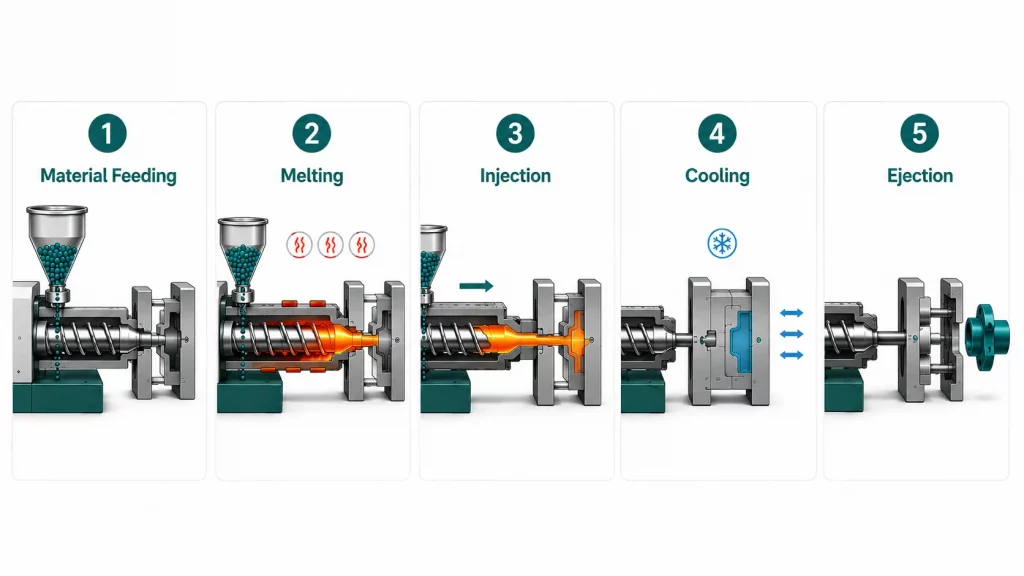
Injection moulding is a manufacturing process in which a material is heated until it reaches a suitable flow state and then injected under pressure into a closed mould cavity. Once the material fills the cavity, it is cooled or cured, depending on the material and process, before the finished component is ejected.
The process is widely associated with thermoplastics because these materials can be heated, melted and solidified again. However, specialised injection processes are also used for certain thermosets and elastomers.
A typical injection moulding process involves:
- Material preparation and feeding
- Heating and plasticisation
- Injection into a closed mould
- Packing or holding pressure
- Cooling or curing
- Mould opening and part ejection
One of the major strengths of injection moulding is its ability to produce highly repeatable components at scale. Properly designed tooling can also accommodate features such as ribs, bosses, thin sections and other relatively complex geometries.
Because the material is delivered through an injection system, the process can be highly automated and is particularly attractive when production quantities justify the tooling investment.
What Is Compression Moulding?
Compression moulding forms a component by placing a measured quantity of material, often called a material charge, directly into a mould cavity. The mould then closes and applies heat and pressure to shape and cure the material.
The process is commonly associated with rubber, thermosetting polymers and composite materials, although the exact material range depends on the specific process and equipment.
A typical compression moulding process involves:
- Preparing a measured material charge
- Positioning the material in the mould
- Closing the heated mould
- Applying pressure
- Allowing the material to flow and cure
- Opening the mould and removing the component
- Carrying out trimming or finishing where required
Unlike injection moulding, the material is not normally pushed through a runner system to fill the cavity. Instead, the material is positioned directly in the mould and formed as the tool closes. This makes compression moulding particularly useful for materials and component designs where direct application of heat and pressure provides the required manufacturing conditions.
Injection Moulding vs Compression Moulding: Key Differences
The fundamental difference is how the material reaches and fills the mould cavity. In injection moulding, the material is prepared and then injected into a closed cavity. In compression moulding, a measured charge is placed into the mould before the tool closes and compresses it.
However, several other differences affect process selection.
| Factor | Injection Moulding | Compression Moulding |
|---|---|---|
| Material delivery | Material is injected into a closed cavity | Material charge is placed directly into the mould |
| Typical material focus | Thermoplastics and selected elastomers/thermosets | Rubber, thermosets and composites |
| Tooling | Generally, more complex | Often simpler |
| Production speed | Generally, faster for suitable high-volume applications | Generally slower because curing/forming takes longer |
| Part complexity | Well suited to complex features | Better suited to simpler or larger/thicker geometries in many applications |
| Production volume | Medium to very high volumes | Low to medium volumes, depending on part and process |
| Automation | Highly suitable | Can be automated depending on application |
| Material waste | Runners and sprues may contribute to waste | Direct charging can reduce runner-related waste |
| Tooling investment | Usually, higher | Often lower for comparable applications |
| Process control | Highly repeatable when properly designed and controlled | Strong repeatability is possible but depends heavily on material, charge and mould conditions |
These are general tendencies rather than absolute rules. A specialised material or component design can change the most suitable process.
How to choose Material for mouldings
Material selection is one of the most important factors when comparing the two processes. It is not accurate to think of the decision simply as “plastic means injection moulding and rubber means compression moulding.” Material chemistry, flow behaviour, curing characteristics and the final performance requirements all need to be considered.
1. Thermoplastics: Thermoplastics soften when heated and solidify when cooled. This behaviour makes them particularly suitable for injection moulding because the material can be plasticised and pushed into the mould cavity.
Common examples include:
- ABS
- Polypropylene (PP)
- Polyamide (PA/Nylon)
- Polycarbonate (PC)
- POM
- PEEK
- Other engineering thermoplastics
Injection moulding is often preferred when these materials need to be produced in repeatable, high-volume applications.
2. Thermosets: Thermosetting materials undergo an irreversible curing reaction. Once fully cured, they cannot simply be reheated and returned to their original flow state. Phenolic, epoxy and other thermosetting compounds are commonly associated with compression moulding because the material can be placed directly into the heated cavity and cured under controlled heat and pressure.
3. Rubber and Elastomers: Rubber compounds introduce another important consideration. Materials such as natural rubber, EPDM and nitrile can be processed using moulding techniques selected according to the compound, component geometry, production volume and required performance.
For rubber components, the decision may involve more than the moulding method itself. Cure behaviour, temperature resistance, flexibility, compression set, chemical exposure and service conditions can all affect the manufacturing route.
4. Composites: Compression moulding is also widely used for certain fibre-reinforced and composite materials. Direct placement of the material charge can be advantageous for component designs where maintaining the intended material structure is important.
Therefore, material selection should happen alongside process selection rather than after it.
Tooling Costs and Investment
Tooling is often one of the first considerations when comparing the two manufacturing methods. Injection moulds generally require a more complex tool design because the mould has to work with the material delivery system. Depending on the component, tooling may incorporate runners, gates, cooling channels, slides, cores and multiple cavities.
This can result in a higher initial tooling investment. Compression moulds can be simpler because the material charge is placed directly into the cavity. For suitable applications, this can reduce tooling complexity and make the process attractive when production volumes do not justify highly complex injection tooling.
However, lower tooling cost does not automatically mean lower overall manufacturing cost.
The total economics depend on:
- Tooling investment
- Expected production quantity
- Cycle time
- Material cost
- Labour requirements
- Scrap and material waste
- Post-processing
- Part complexity
- Quality requirements
For a small production run, a simpler compression tool may provide a better economic starting point. For large production quantities, the higher initial investment in injection tooling may be offset by faster cycles and greater automation.
Cycle Time and Production Volume
Production volume can significantly influence the process decision. Injection moulding is generally well suited to medium- and high-volume production because the material filling, cooling and ejection stages can be highly automated. Multi-cavity tooling can also produce several components during each machine cycle.
Compression moulding can have longer cycles because the material needs sufficient time under heat and pressure to form and, where applicable, cure. This does not make compression moulding unsuitable for production. It simply means that the economics of the process need to be evaluated differently.
For example:
Injection moulding may be preferable when:
- Production quantities are high
- Shorter cycles are important
- Automated production is required
- Consistent part-to-part output is a priority
- Complex tooling can be justified
Compression moulding may be preferable when:
- The material is better suited to direct compression
- Production volumes can range from low to high depending on the application
- Tooling simplicity is important
- The component is relatively large or thick
- The material requires controlled curing
Which Process Is Better for Complex Components?
Part geometry is another major consideration.
Injection moulding is generally capable of producing components with more intricate features because material is injected into a carefully engineered cavity under controlled pressure.
For components that require embedded metal features, moulding inserts can be incorporated into the mould before the material is formed around them. The insert design, positioning and retention features need to be considered alongside the component geometry and selected moulding process.
It can accommodate features such as:
- Ribs
- Bosses
- Thin walls
- Detailed surfaces
- Multiple cavities
- Integrated features
Compression moulding can also produce precision components but the geometry needs to be considered in relation to material flow, mould closing and removal of the finished part.
It is often advantageous for relatively large, thick or less intricate components, particularly when rubber, thermoset or composite materials are involved. The practical limit depends on the material, mould design, component geometry and equipment.
The better question is therefore not “Which process makes more complex parts?” but:
Does the required geometry work efficiently with the selected material and moulding method?
That question should be answered during design and manufacturing review rather than after tooling has already been developed.
Dimensional Accuracy:
Dimensional requirements can also influence process selection.
Injection moulding can provide highly repeatable dimensions when the material, mould design and process parameters are properly controlled. This makes it useful for components that contain tight dimensional relationships or need to be produced consistently over large production quantities.
Compression moulding can also produce repeatable and accurate parts but factors such as material charge size, placement, curing behaviour, mould temperature, pressure and flash formation need to be carefully controlled. For either method, dimensional performance depends on more than the machine itself.
Material shrinkage, mould design, temperature control, tooling condition and part geometry all influence the final dimensions. For a critical component, manufacturers should therefore review the drawing tolerances and material specifications before selecting the process.
Advantages and Limitations of Injection Moulding & Compression Moulding
Advantages of Injection Moulding
- High production efficiency
- Excellent repeatability for suitable applications
- Suitable for complex component geometries
- Strong automation potential
- Well suited to medium and high production volumes
- Multi-cavity production can increase output
- Consistent material delivery into the mould
Limitations of Injection Moulding
- Higher initial tooling investment in many applications
- More complex mould design
- Runner and gate design must be considered
- Tool modifications can become expensive
- Material and processing conditions require careful control
Advantages of Compression Moulding
- Suitable for many rubber and thermoset applications
- Simpler tooling can be possible
- Direct material placement reduces the need for runner systems
- Suitable for larger or thicker components in many applications
- Can be economically attractive for lower production volumes
- Useful for selected composite materials
Limitations of Compression Moulding
- Longer cycles can reduce production throughput
- Material charge preparation and placement require attention
- Flash may require additional finishing
- Geometry can be more restricted for certain applications
- Process economics can become less attractive as very high volumes demand faster cycles
Neither method is universally better; the right choice depends on the material, component design and production requirements.
Which Moulding Process Is More Cost-Effective?
For lower-volume production, compression moulding can be attractive because tooling may be simpler and the initial investment can be lower.
For high-volume production, injection moulding can become more economical because faster cycles, automation and multi-cavity tooling can reduce the cost per component.
Material cost also matters. A process that minimises waste can be especially valuable when the compound itself is expensive.
Therefore, a proper cost comparison should consider:
Tooling + material + cycle time + labour + post-processing + scrap + production volume + quality requirements
Looking at tooling cost alone can lead to the wrong manufacturing decision.
When Should You Choose Injection Moulding?
Injection moulding is generally worth considering when your component requires:
- Medium to very high production volumes
- Complex or detailed geometry
- Consistent repeatability
- Efficient automated production
- Shorter production cycles
- Thermoplastic materials
- Multiple cavities or high output per cycle
It becomes particularly attractive when the initial tooling investment can be distributed across a large number of components. However, the material must first be confirmed as suitable for the selected injection process.
When Should You Choose Compression Moulding?
Compression moulding can be a strong option when:
- The component uses rubber, a thermoset or a suitable composite
- Production volume does not justify highly complex injection tooling
- The component is relatively large or thick
- Tooling simplicity is important
- Direct material charging is suitable for the component
- The material requires curing under heat and pressure
For rubber components, compression moulding may be especially useful where the compound and component design favour direct forming and controlled curing.
How Schilthorn Supports Moulded Component Manufacturing
With 15+ years of precision engineering experience, Schilthorn Precision manufactures injection moulded and rubber-metal moulded components for automobile, engineering and HVAC applications. Backed by ISO 9001 and AS9100-certified quality systems, the company combines precision machining, moulding and in-house tooling capabilities to support consistent component production.
Its rubber-metal moulding capabilities include precision metal insert fabrication, surface preparation and treatments such as surface roughening, degreasing, sand blasting, solvent cleaning and zinc coating, depending on the application. Schilthorn also supports rubber moulded inserts and vibration-damping components for applications such as split air-conditioning systems.
With an in-house CAD/CAM and CNC workshop, Schilthorn can support tooling development, cost-effective prototyping and longer production runs.
Have a moulded component requirement? Share your drawing or component details with our team for a technical discussion.
Frequently Asked Questions
1. What is the main difference between injection moulding and compression moulding?
Injection moulding delivers heated, flowable material into a closed mould cavity, while compression moulding places a measured material charge into the mould and forms it using heat and pressure.
2. Which is better for high-volume production: injection moulding or compression moulding?
Injection moulding is generally better suited to high-volume production because faster cycles, automation and multi-cavity tooling can increase output. However, the material and component design must also be suitable for the process.
3. Is compression moulding suitable for rubber components?
Yes. Compression moulding is widely used for rubber and elastomeric components where the material and component design are suitable for heat-and-pressure curing.
4. Which process has lower tooling costs?
Compression moulding often allows simpler tooling and can have a lower initial tooling investment. However, the total manufacturing cost depends on production volume, material, cycle time, labour, waste and component requirements.
5. Which process is faster?
Injection moulding is generally faster for suitable applications, particularly where high-volume automated production is required. Compression moulding can have longer cycles because the material may require additional forming and curing time.
6. Can injection moulding and compression moulding use the same materials?
There can be some overlap but material suitability depends on the specific polymer or compound and the required processing conditions. Thermoplastics are commonly associated with injection moulding, while rubber, thermosets and composites are frequently processed through compression moulding.
7. Which process is better for complex components?
Injection moulding generally provides greater flexibility for intricate geometries, thin sections and integrated features. However, compression moulding can also produce technically demanding components when the material and mould design are appropriate.
8. How do I choose between injection moulding and compression moulding?
Start by reviewing the material, component geometry, tolerances, production volume, tooling budget and performance requirements. A manufacturing review of the drawing and material specification can then determine which process is more appropriate.