
Forging vs CNC Machining: How to Choose the Right Manufacturing Route
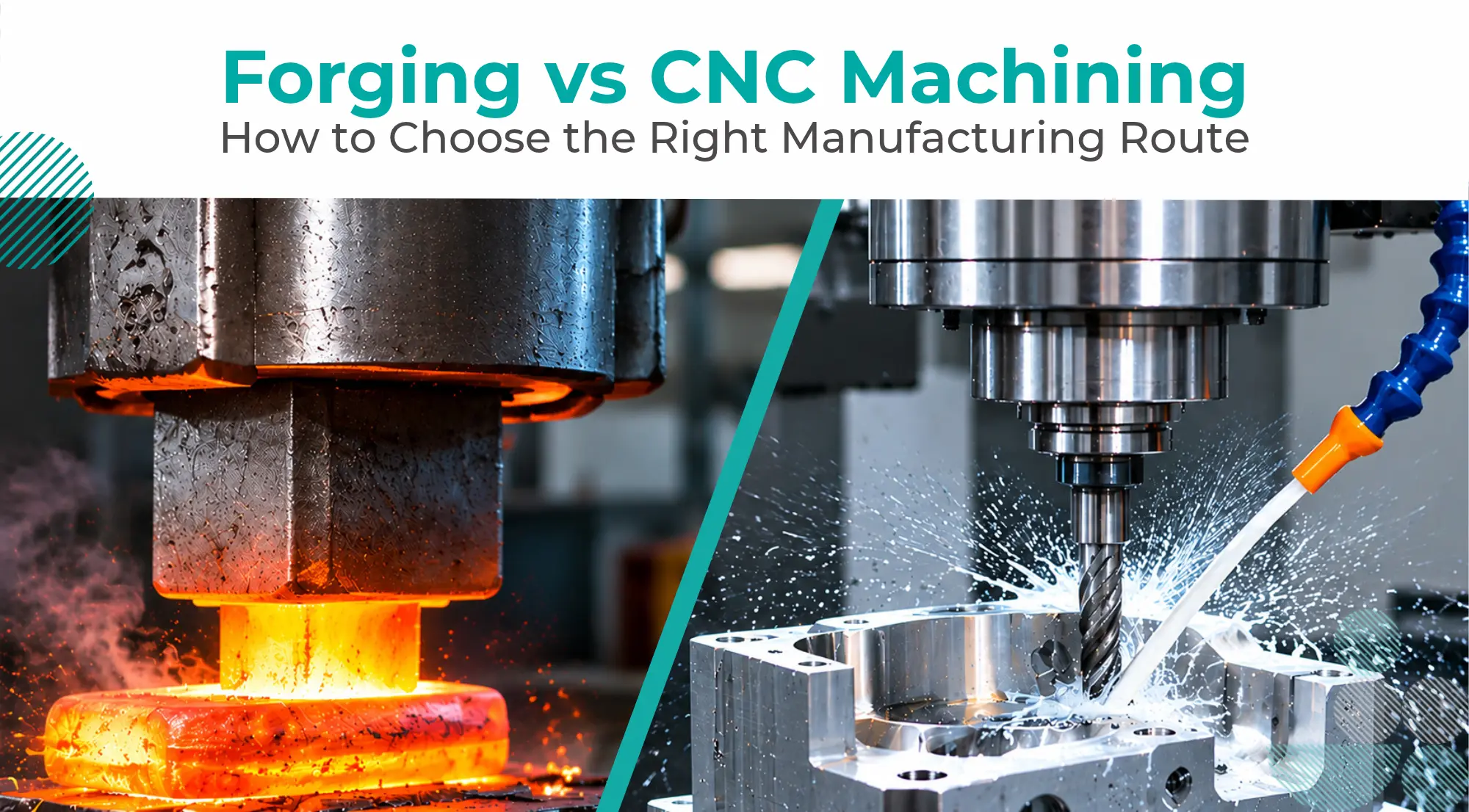


Selecting the right manufacturing process affects material utilisation, mechanical properties, dimensional accuracy and production cost. While some components can be produced directly through machining, others are first forged and then precision-machined to achieve the required specifications.
Two widely used processes are forging and CNC machining. Forging shapes metal through compressive forces, whereas CNC machining removes material using computer-controlled cutting tools. Each process offers different advantages depending on component design, material properties and production requirements.
However, these processes are not always alternatives. Many industrial components are forged to achieve their basic shape and then CNC-machined to produce accurate dimensions, holes, threads and functional surfaces. Understanding their differences and how they can work together helps manufacturers choose the right manufacturing route.
What Is Forging?
Forging is a metal-forming process in which compressive forces are applied to a metal workpiece to change its shape. The material is deformed using equipment such as mechanical presses, hydraulic presses or forging hammers, depending on the forging method and component requirements.
Unlike machining, which removes material from a workpiece, forging reshapes the existing material through controlled plastic deformation. The process can be performed at different temperatures, influencing material flow, forming force, dimensional accuracy and the resulting mechanical properties.
What Are the Different Types of Forging?
The three main types of forging are hot forging, warm forging and cold forging. They differ primarily in forming temperature, which influences material behaviour, deformation and the characteristics of the finished component.
1. Hot Forging
Hot forging involves heating the metal above its recrystallisation temperature before applying compressive force. The increased temperature makes the material more ductile, allowing it to undergo significant deformation with lower forming resistance.
Hot forging is commonly used for:
- Large and complex metal components
- Components requiring substantial deformation
- Industrial shafts and connecting elements
- Heavy-duty automotive and machinery parts
The process supports the production of complex shapes, although oxidation, scale formation and dimensional variations may require additional finishing operations.
2. Warm Forging
Warm forging is performed at temperatures below the material’s recrystallisation temperature but above room temperature. It offers a balance between the lower forming resistance associated with hot forging and the improved dimensional control possible compared with some hot-forging operations. Warm forging is used where manufacturers need controlled material deformation and improved surface and dimensional characteristics compared with conventional hot forging.
3. Cold Forging
Cold forging is performed at or near room temperature. The material is shaped through high compressive forces without the heating used in hot forging. The process can provide good dimensional consistency and surface finish, depending on the material and component geometry. Cold forging can also increase material strength through work hardening.
It is commonly used for:
- Fasteners
- Small precision metal components
- Automotive parts
- High-volume formed components
The appropriate forging method depends on the material, required geometry, deformation level and production requirements.
What Is CNC Machining?
CNC machining is a subtractive manufacturing process in which computer-controlled machines remove material from a workpiece to produce the required dimensions and geometry. The machining operation is guided by programmed instructions that control tool movement, cutting speed, feed rate and other operating parameters.
Unlike forging, which shapes material through deformation, CNC machining creates component features by removing unwanted material using cutting tools.
Common CNC machining operations include:
- CNC Milling: Uses rotating cutting tools to remove material and create flat surfaces, pockets, slots and complex profiles.
- CNC Turning: Rotates the workpiece against a cutting tool to produce cylindrical shapes, diameters, grooves and threads.
- CNC Drilling: Produces holes at specified locations and dimensions.
- CNC Boring: Enlarges and refines existing holes to achieve the required diameter and geometry.
- CNC Grinding: Uses abrasive tools to achieve specified dimensional accuracy and surface finish in suitable applications.
Where Is CNC Machining Used?
CNC machining is widely used in precision manufacturing because it supports the production of components with complex geometries, controlled dimensions and detailed features.
Typical applications include:
- Precision-machined flanges
- Industrial shafts and connectors
- Aerospace components
- Automotive parts
- Heat exchanger components
- Custom machine components
- Housings, brackets and mounting assemblies
The process is particularly useful when components require accurately positioned holes, threads, bores, mounting surfaces or other features that must meet specific engineering drawing requirements.
Forging vs CNC Machining: What Are the Key Differences?
Although both processes are used to manufacture metal components, their working principles and production capabilities are different. Forging changes the shape of a workpiece through compressive forces, whereas CNC machining removes material to achieve the required geometry.
The main differences can be understood through the following factors.
| Comparison Factor | Forging | CNC Machining |
|---|---|---|
| Manufacturing principle | Shapes metal through compressive deformation | Removes material using cutting tools |
| Material structure | Can develop favourable grain flow depending on forging design and process | Does not create forged grain flow; machining exposes and shapes the existing material |
| Mechanical properties | Can improve directional mechanical properties and structural integrity when properly controlled | Depends primarily on the starting material and its condition |
| Geometry | Suitable for producing formed and near-net-shape components | Suitable for detailed profiles, holes, slots, pockets and complex features |
| Dimensional accuracy | May require machining to achieve final tolerances | Can achieve controlled dimensions through suitable machining and inspection |
| Surface finish | Depends on forging temperature, dies and process conditions | Depends on cutting tools, parameters, machine condition and finishing operations |
| Material utilisation | Can reduce material removal compared with machining from solid stock | Material is removed to create the required shape |
| Tooling requirements | Often requires specialised dies and forming equipment | Requires suitable cutting tools, fixtures and CNC programming |
| Production volume | Often economical for medium-to-high production volumes after tooling investment | Offers flexibility for prototypes, low-volume production and varied components |
| Typical applications | Heavy-duty formed components, automotive parts and industrial forgings | Precision components, machined features and complex geometries |
The comparison shows that forging and CNC machining serve different manufacturing purposes. The better option depends on what the component needs to achieve rather than simply which process offers more advantages.
How Does Forging Affect Component Strength and Performance?
One of the main reasons manufacturers select forging is its influence on the material’s internal structure and mechanical behaviour.
During forging, compressive forces cause the metal to deform. Depending on the material, temperature and deformation process, the grain structure can flow along the contours of the component. This directional grain flow can contribute to mechanical properties suited to the component’s loading conditions.
1. Grain Flow and Material Deformation
During forging, the metal undergoes plastic deformation under compressive loads. The internal grain flow changes as the material takes the shape of the die or forming arrangement. When the forging process is properly designed, the grain flow can follow the component’s general geometry. This can be beneficial for components subjected to specific mechanical loading conditions.
2. Strength and Toughness
Forging can improve mechanical performance through controlled material deformation and suitable process conditions. Depending on the alloy and manufacturing route, forged components may offer favourable strength, toughness and structural characteristics.
However, these properties are not guaranteed by the forging process alone. Material selection, forging temperature, deformation ratio, heat treatment and inspection all influence the final result.
3. Fatigue Performance
Components exposed to repeated loading need to withstand cyclic stresses during service. A properly designed forging process can produce favourable grain flow and material integrity, which may support fatigue performance in suitable applications. The final fatigue behaviour still depends on component geometry, surface condition, material quality, heat treatment and service conditions.
4. Suitability for Heavy-Duty Applications
Forging is frequently selected for components that must withstand substantial mechanical loads.
Examples include:
- Industrial shafts.
- Crankshafts
- Connecting rods.
- Heavy machinery components.
- High-load automotive parts.
In these applications, the mechanical properties and structural requirements of the component influence whether forging is a suitable manufacturing route.
How Does CNC Machining Affect Component Accuracy and Geometry?
While forging is useful for shaping metal and developing favourable material characteristics, it may not produce every feature to the final dimensional requirements. This is where CNC machining becomes important.
CNC machining allows manufacturers to remove material in a controlled manner and produce the specific dimensions, profiles and functional features required by the engineering drawing.
- Dimensional Accuracy: CNC machining can produce components with controlled dimensions through accurately programmed tool movements and suitable machining operations. Features such as diameters, thicknesses, hole sizes and mounting surfaces can be machined according to specified tolerances. The achievable accuracy depends on machine capability, tooling, workholding, material behaviour and inspection methods.
- Complex Profiles and Features: CNC milling supports the production of pockets, slots, curved profiles and other detailed geometries. Turning operations can produce cylindrical surfaces, grooves, steps and threads. This flexibility makes CNC machining suitable for components that require several different features within the same part.
- Accurate Hole and Bore Machining: Many industrial components require accurately positioned holes and bores for fastening, assembly, fluid flow or mechanical connections. CNC drilling, boring and related operations allow manufacturers to produce these features according to drawing specifications.
- Surface Finish: CNC machining can produce specified surface finishes through suitable tool selection, cutting parameters and finishing operations. This is important for mating surfaces, sealing faces, bearing areas and other functional features.
- Flexibility in Component Design: Unlike forging, which may require specialised dies for a particular component geometry, CNC machining can accommodate different component designs through programming and tooling changes. This makes it particularly useful for custom components, prototypes and low-volume manufacturing.
Forging vs CNC Machining: Which Is More Cost-Effective?
Manufacturing cost is an important factor when selecting a production route. However, comparing only the initial process cost can lead to an incorrect decision. The overall cost depends on tooling investment, raw material requirements, material removal, machining time, production volume and secondary operations.
1. Initial Tooling Investment: Forging commonly requires specialised dies designed around the component’s geometry. Developing these dies can involve significant initial investment, making forging more attractive when the production volume is sufficient to justify the tooling cost.
CNC machining generally requires cutting tools, workholding arrangements and programming. For many component designs, this can provide a more flexible starting point without the same dedicated die investment.
2. Material Utilisation: Forging can produce near-net-shape components, reducing the amount of material that needs to be removed during subsequent machining. CNC machining removes material from a larger starting workpiece to achieve the final shape. Depending on component geometry, this can generate more material waste.
However, the actual material utilisation depends on the starting stock, component design and manufacturing sequence.
3. Machining Time and Secondary Operations: Forged components may require additional machining to achieve final dimensions, hole locations, threads and functional surfaces. This means the total production cost may include both forging and subsequent machining operations. CNC-machined components may require more material removal but can avoid the need for forging dies and separate forming operations.
4. Production Volume: Production volume strongly influences process economics.
| Production Requirement | Potentially Suitable Route | Reason |
|---|---|---|
| Prototype or one-off component | CNC machining | Avoids dedicated forging die investment |
| Low-volume custom parts | CNC machining | Offers design and production flexibility |
| High-volume formed components | Forging | Die investment can be distributed across production |
| Components requiring both strength and precision features | Forging + CNC machining | Combines forming and precision finishing |
| Complex components with substantial material removal | CNC machining | May be more practical than developing dedicated forging tooling |
These are general guidelines rather than fixed rules. A detailed cost comparison should consider the complete manufacturing sequence, production quantity and required component performance.
Why Do Manufacturers Combine Forging and CNC Machining?
Forging and CNC machining do not always have to be competing manufacturing processes. In many applications, they are used together to produce components that require both suitable mechanical properties and accurate final geometry. This combined approach is commonly known as a forging-and-machining route. The basic idea is to use forging to create the component’s initial shape and CNC machining to produce the final features and dimensions.
Step 1: Producing the Forged Blank
The manufacturing process begins by shaping the selected metal through forging. The forging operation produces a blank that is closer to the required component geometry than the original raw material. This can help reduce the amount of material that needs to be removed during subsequent machining.
Step 2: Preparing the Forged Component
After forging, the component may undergo additional operations depending on the material and application.
These can include:
- Trimming excess material.
- Heat treatment.
- Surface cleaning or descaling.
- Initial dimensional checks.
- Preparation for machining.
The exact sequence depends on the forging process, material specification and component requirements.
Step 3: CNC Machining Critical Features
The forged blank is then positioned on a CNC machine for precision machining. Machining operations may include milling, turning, drilling, boring and threading. These operations are used to achieve the final dimensions and functional features required by the engineering drawing.
For example, a forged industrial component may still require accurately machined mounting faces, bolt holes, bores and threaded connections before it can be assembled.
Step 4: Dimensional Inspection
After machining, the component is inspected to verify that the specified dimensional and geometric requirements have been achieved.
Inspection may include checking:
- Overall dimensions.
- Hole diameters and positions.
- Bore dimensions.
- Surface finish.
- Geometric tolerances.
- Other critical drawing requirements.
What Are the Benefits of Combining Both Processes?
The combined manufacturing route offers several potential benefits:
- Better material utilisation: Forging can create a near-net shape, reducing unnecessary material removal during machining.
- Mechanical performance: The forged blank can provide suitable material characteristics for components exposed to demanding mechanical loads.
- Precision finishing: CNC machining produces accurate dimensions, holes, bores, threads and functional surfaces.
- Manufacturing flexibility: Different machining operations can be selected to meet the final component requirements.
- Balanced production economics: Combining the processes can be more practical than manufacturing the entire component through extensive machining or expecting the forged blank to meet all final tolerances.
The effectiveness of this route depends on proper coordination between forging allowances, material condition, machining sequence and final inspection requirements.
How to Choose the Right Manufacturing Route for Your Component
Selecting between forging, CNC machining and a combined approach requires an understanding of the component’s actual design and performance requirements.
The following factors can help manufacturers evaluate the available options.
1. Material and Mechanical Requirements
Start by evaluating the material specification and the mechanical properties required during service. If the component must withstand significant mechanical loads and benefits from controlled material deformation, forging may be appropriate. If the component’s performance requirements can be met using suitable bar, plate or billet material, CNC machining may be a practical option.
2. Component Geometry
The shape of the component influences which manufacturing route is suitable. Forging is generally useful for components with geometries that can be produced through controlled material flow and die design. CNC machining offers greater flexibility for producing detailed profiles, pockets, holes, bores and complex machined features.
3. Dimensional and Geometric Tolerances
Review the engineering drawing to identify critical dimensions and geometric requirements. If the component requires accurate hole positions, mounting surfaces, bores or threads, additional CNC machining may be necessary even when the basic component shape is produced through forging.
4. Production Volume
The expected production quantity influences tooling investment and manufacturing cost. Forging may become more economical when dedicated tooling costs can be distributed across a sufficiently large production quantity. CNC machining is often more flexible for prototypes, custom parts and lower-volume requirements.
5. Material Utilisation
Consider the amount of raw material required for each manufacturing route. For components with substantial material removal, forging may provide a near-net-shape starting point that reduces machining allowance. However, this benefit must be evaluated against forging tooling, material handling and secondary operations.
6. Heat Treatment and Finishing Requirements
Some components require heat treatment to achieve specified mechanical properties. The manufacturing sequence should consider when heat treatment will take place and how it may influence subsequent machining operations. For example, certain critical features may need to be machined after heat treatment to achieve their final dimensions.
7. Total Manufacturing Cost
The final decision should consider the entire production route rather than one individual operation.
Include:
- Raw material cost.
- Forging die and tooling investment.
- Machining time.
- Material removal and waste.
- Heat treatment.
- Surface finishing.
- Inspection and quality requirements.
- Production quantity.
Evaluating these factors together helps manufacturers select a route that balances component performance, dimensional requirements and production economics.
Common Mistakes to Avoid When Selecting a Manufacturing Process
Even when manufacturers understand the differences between forging and CNC machining, certain assumptions can lead to an unsuitable process selection.
- Choosing Only on Initial Component Price: A lower initial manufacturing quote does not necessarily represent the lowest overall production cost. Tooling, machining, finishing, inspection and production volume should all be considered.
- Ignoring Production Volume: A process that is economical for high-volume production may not be suitable for a prototype or small batch. Dedicated forging dies, for example, require an initial investment that needs to be justified by the expected production quantity.
- Overlooking Machining Allowances: Forged components may require additional material to accommodate subsequent machining. If machining allowances are not considered during forging design, there may be insufficient material in critical areas or unnecessary material removal elsewhere.
- Assuming Forged Components Meet Final Tolerances: Forging produces the basic component shape, but it does not automatically achieve every final dimensional and geometric requirement. Critical surfaces, holes, bores and other functional features may still require CNC machining.
- Ignoring Heat Treatment and Finishing Requirements: Material properties and dimensions can be influenced by heat treatment and other secondary operations. The complete manufacturing sequence should account for these requirements before the production route is finalised.
- Selecting a Process Without Considering Component Function: A manufacturing route should be selected according to how the component will perform during service. Material strength, loading conditions, fit, alignment, dimensional accuracy and surface requirements should all influence the decision.
How Schilthorn Precision Supports CNC Machining Requirements for Forged Components
Schilthorn Precision brings over 15 years of experience in precision manufacturing, with advanced CNC machining, HAAS VMC machining centres and custom component manufacturing capabilities. We work according to customer drawings and technical specifications, focusing on dimensional accuracy, machining consistency and component quality.
Our machining capabilities support manufacturers requiring precision-machined industrial components with specific geometric and dimensional requirements. By understanding the component design and its machining needs, we work to deliver parts aligned with customer specifications.
Looking for a precision machining partner for your forged components?
Frequently Asked Questions About Forging vs CNC Machining
1. What is the main difference between forging and CNC machining?
Forging shapes metal through compressive forces, while CNC machining removes material using computer-controlled cutting tools. Forging is commonly used to produce formed component blanks, whereas CNC machining is used to create accurate dimensions and detailed features.
2. Are forged components stronger than CNC-machined components?
Forged components can offer favourable mechanical properties because controlled deformation may produce beneficial grain flow. However, strength depends on material composition, processing conditions, heat treatment and component design. CNC machining does not automatically make a component weaker; the starting material and its condition are important factors.
3. Is forging cheaper than CNC machining?
The cost depends on component geometry, production volume, tooling investment, material utilisation and secondary operations. Forging can be economical for suitable medium-to-high-volume production, while CNC machining may be more practical for prototypes, custom components and lower production quantities.
4. Can forged components be CNC-machined?
Yes. Forged components are frequently CNC-machined to achieve final dimensions, accurate hole positions, bores, threads and functional surfaces. Combining both processes allows manufacturers to benefit from forging and precision machining.
5. Which process is better for complex components?
CNC machining offers flexibility for producing detailed profiles, pockets, holes and complex features. Forging is suitable for components whose basic geometry can be formed through controlled material deformation. Some complex components benefit from a combination of both processes.
6. Does forging reduce material waste?
Forging can reduce material waste by producing near-net-shape components that require less material removal during finishing. However, actual material utilisation depends on the component design, forging allowances, trimming requirements and subsequent machining operations.
7. When should manufacturers choose forging over machining?
Manufacturers should consider forging when the component benefits from controlled material deformation, suitable grain flow, near-net-shape production and the expected production volume justifies tooling investment. The decision should also account for mechanical requirements, component geometry and final machining needs.