
Brass HVAC Connectors Manufacturer in India: Tolerances, Certifications & MOQ
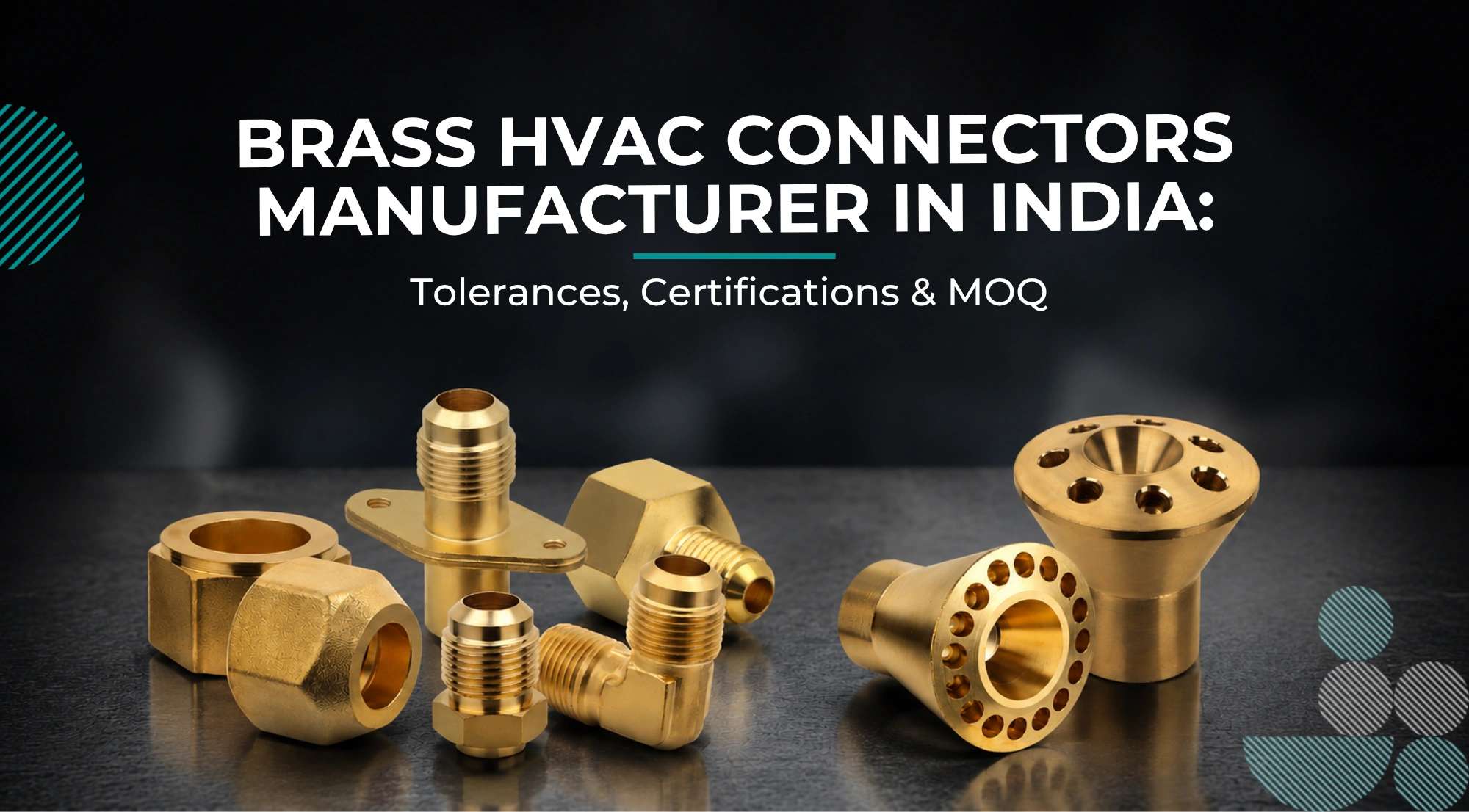


India recorded around 536 heatwave days during summer 2024 and the HVAC industry felt every one of them. The Indian HVAC market stood at USD 11.8 billion in 2024 and is projected to reach USD 29.4 billion by 2030 , growing at a CAGR of 16.3%. As demand for high-performance HVAC systems continues to rise, the quality of every component matters.
A single poorly machined connector can cause refrigerant leaks, pressure loss and system failure. In compact, high-efficiency HVAC equipment where tolerances are measured in microns, there is no margin for a component that is almost right.
India has become a serious sourcing destination for brass HVAC connectors with advanced CNC machining capabilities, engineering depth and competitive production costs making it an attractive alternative to European and East Asian supply chains. But not every manufacturer delivers the same level of precision, consistency or compliance.
This guide covers what to look for before you place an order: tolerances, material grades, certifications, inspection standards and MOQ so you can evaluate a brass HVAC connectors manufacturer in India on what actually matters.
What Are Brass HVAC Connectors?
Brass HVAC Connectors are precision-machined components used to connect, seal and control the flow of refrigerants, water or gases within heating, ventilation, air conditioning and refrigeration systems. They ensure secure mechanical connections while maintaining system pressure and preventing leakage throughout the equipment’s operating life.
These connectors are used in residential, commercial and industrial HVAC equipment, including air conditioners, chillers, heat exchangers, refrigeration systems and heat pumps. Their dimensional accuracy is essential because even slight variations in threads or sealing surfaces can compromise system performance.
Depending on the application, an HVAC connector may be manufactured in different shapes, thread standards and sizes to match specific piping systems and equipment designs.
Why Brass Is the Preferred Material for HVAC Components
Material selection has a significant impact on the reliability and service life of HVAC equipment. While materials such as stainless steel, aluminium and engineering plastics are used in certain applications, brass continues to be the preferred choice for many connectors and fittings because it offers an excellent balance of strength, corrosion resistance and machinability.
1. Excellent Corrosion Resistance
HVAC systems are often exposed to moisture, changing temperatures and refrigerants that can accelerate corrosion. Brass naturally resists oxidation and corrosion, helping maintain reliable performance over extended operating periods. This resistance reduces the likelihood of component degradation, leakage and premature replacement.
2. Outstanding Machinability
Brass is one of the easiest engineering materials to machine with high precision. Its excellent machinability enables manufacturers to produce intricate geometries, fine threads and tight dimensional tolerances using advanced CNC turning and milling processes. This makes it an ideal material for high-volume production of precision Brass HVAC Components.
3. Leak-Proof Threaded Connections
Properly machined brass threads create secure and reliable joints that minimise the risk of refrigerant or fluid leakage. Accurate thread profiles also simplify installation and improve compatibility with mating components. For HVAC systems operating under pressure, this level of precision is essential for maintaining safety and efficiency.
4. Good Thermal Conductivity
Brass provides good thermal conductivity, allowing it to perform effectively in heating and cooling applications where efficient heat transfer contributes to overall system performance. Although copper offers higher conductivity, brass combines thermal performance with greater mechanical strength, making it suitable for many HVAC fittings.
5. High Strength and Durability
Brass components can withstand vibration, pressure fluctuations and repeated thermal cycling without significant deformation. Their mechanical strength supports long service life in demanding operating environments while reducing maintenance requirements.
6. Compatibility with Various Refrigerants
Modern HVAC systems use a variety of refrigerants depending on application and regulatory requirements. Brass offers excellent compatibility with many commonly used refrigerants, making it a versatile material for connectors, valves and other fluid-handling components.
Types of Brass HVAC Components Manufacturers Commonly Produce
A reliable brass HVAC components manufacturer typically produces a wide range of precision-machined parts to meet the requirements of OEMs, HVAC equipment manufacturers and refrigeration system suppliers.
Although individual designs vary by application, the following components are among the most commonly manufactured.
| Component | Primary Function | Typical HVAC Application |
|---|---|---|
| Brass Connector | Connects pipes or tubing securely | Air conditioners, chillers, refrigeration systems |
| Flare Fitting | Creates leak-proof tube connections | Refrigerant lines |
| Brass Distributor | Evenly distributes refrigerant to multiple evaporator circuits | Evaporators, heat exchangers, refrigeration and air conditioning systems |
| Coupling | Joins two sections of pipe or tubing | HVAC piping systems |
| Reducer | Connects pipes of different diameters | Fluid distribution systems |
| Adaptor | Connects different thread or pipe standards | HVAC assemblies |
| Hose Connector | Connects flexible hoses to equipment | Cooling and refrigeration units |
| Valve Body | Controls refrigerant or fluid flow | Expansion and control valves |
| Threaded Insert | Provides durable threaded connections | Plastic moulded HVAC components |
| Custom CNC-Machined Components | Manufactured according to customer drawings | OEM HVAC equipment |
These Brass HVAC Components are available in various thread types, dimensions and material grades depending on the equipment manufacturer’s specifications.
Many brass HVAC components suppliers also provide custom manufacturing services, allowing OEMs to source specialised connectors that meet unique design and performance requirements.
Why Tight Tolerances Matter in Brass HVAC Connectors
HVAC systems operate under pressure and rely on precision-engineered connections to prevent refrigerant leakage, maintain system efficiency and ensure long-term reliability. Even minor dimensional deviations can affect thread engagement, sealing performance and component compatibility, leading to assembly issues or premature failure.
For this reason, machining tolerances are among the most important factors buyers should evaluate when selecting a Brass HVAC Connectors Manufacturer.
Although the exact tolerance requirements vary depending on the component design, application and customer specifications, precision CNC machining enables manufacturers to achieve highly consistent dimensional accuracy across production batches.
Typical Manufacturing Tolerances for Brass HVAC Connectors
| Feature | Typical Tolerance* |
|---|---|
| Outside Diameter | ±0.02–0.05 mm |
| Bore Diameter | ±0.01–0.03 mm |
| Overall Length | ±0.05 mm |
| Thread Pitch | As per BSP, BSPT, NPT or customer specifications |
| Concentricity | As specified in engineering drawings |
| Surface Finish | Typically, Ra 0.8–3.2 μm, depending on the application |
Actual tolerances may vary based on component geometry, thread standards, manufacturing processes and customer requirements.
Maintaining these tolerances helps manufacturers achieve:
- Reliable leak-proof sealing
- Accurate thread engagement
- Consistent assembly across production batches
- Improved compatibility with mating components
- Reduced rework and warranty claims
- Enhanced overall HVAC system performance
Common Brass Grades Used for HVAC Components
The choice of brass grade influences the machinability, corrosion resistance, mechanical strength and overall performance of HVAC connectors. Reputable manufacturers select material grades based on application requirements, customer specifications and relevant industry standards.
Some of the most commonly used brass grades include:
| Brass Grade | Typical Application |
|---|---|
| CW614N | Precision CNC-machined HVAC fittings and connectors |
| CW617N | Forged brass valves, fittings and pressure-bearing components |
| C36000 | High-speed CNC machining of precision brass components |
| IS 319 Grade I | General-purpose brass connectors and engineering components |
| Customer-Specified Grades | Manufactured to meet OEM drawings and technical specifications |
The appropriate brass grade depends on factors such as operating pressure, corrosion resistance, machining requirements and compatibility with the intended HVAC application. When sourcing components, buyers should confirm that the manufacturer uses certified raw materials with complete material traceability to ensure consistent quality and long-term reliability.
Looking for a Reliable Brass HVAC Components Manufacturer?
Manufacturing Process for Brass HVAC Connectors
The quality and performance of Brass HVAC connectors depend not only on the material used but also on the precision of the manufacturing process. Every machining step must be carefully controlled to achieve the dimensional accuracy, surface finish and thread quality required for leak-free HVAC systems.
A reliable brass HVAC components manufacturer follows a structured production process supported by advanced CNC machining, quality inspections and strict process controls.
1. Raw Material Selection
The process begins with selecting the appropriate brass grade based on the application’s strength, machinability, corrosion resistance and customer specifications. Using certified raw materials ensures consistent machining performance and long-term component reliability.
2. CNC Turning
Brass rods are machined on CNC turning centres to produce the primary geometry of the component, including outside diameters, internal bores, grooves, shoulders and seating surfaces. This stage establishes the foundation for dimensional accuracy and ensures consistency across production batches.
3. Milling and Drilling
When additional machining features are required, CNC milling and drilling operations are performed to create hexagonal profiles, cross holes, mounting features and other complex geometries. Multi-axis machining enables manufacturers to produce precision brass HVAC fittings with excellent repeatability.
4. Thread Cutting
Thread machining is one of the most critical stages in manufacturing HVAC connectors, as it directly affects sealing performance and installation reliability. Depending on customer requirements, manufacturers produce threads such as:
- BSP
- BSPT
- NPT
- Metric
- UNF/UNC
Precision thread machining helps ensure leak-free connections and compatibility with global HVAC systems.
5. Deburring and Surface Finishing
After machining, burrs and sharp edges are removed to improve assembly and handling. Depending on the application, components may also undergo polishing, ultrasonic cleaning or surface treatments such as nickel or chrome plating to enhance corrosion resistance and product appearance.
6. Dimensional Inspection
Before dispatch, every production batch undergoes quality inspection to verify compliance with customer drawings and technical specifications. Critical checks typically include:
- Thread accuracy
- Dimensional verification
- Surface finish inspection
- Visual and functional checks
For high-precision OEM applications, manufacturers may also perform 100% inspection of critical dimensions to ensure consistent product quality.
Certifications and Quality Standards Buyers Should Look For
Choosing a supplier based solely on price can lead to quality issues, inconsistent production and delayed deliveries. Instead, buyers should evaluate whether the manufacturer follows recognised quality management practices and inspection procedures.
Here are some of the key certifications and quality systems to consider.
ISO 9001 Quality Management System
ISO 9001 certification demonstrates that a manufacturer follows documented quality management processes, monitors production consistency and continually improves operational performance.
For OEMs, this provides greater confidence in product quality and process control.
Material Traceability
Reliable manufacturers maintain complete traceability of raw materials throughout the manufacturing process.
Material traceability allows buyers to verify:
- Material grade
- Supplier information
- Production batch
- Inspection records
This is particularly important for export projects and regulated industries.
RoHS and REACH Compliance (When required)
Some international customers require components that comply with environmental regulations such as RoHS or REACH. Manufacturers supplying export markets should be able to provide compliance documentation when applicable.
Calibration of Measuring Equipment
Precision machining depends on accurate measurement. Manufacturers should regularly calibrate inspection equipment, including:
- Vernier callipers
- Micrometres
- Height gauges
- Thread gauges
- Coordinate Measuring Machines (CMMs)
Proper calibration improves inspection accuracy and production consistency.
Inspection Reports
Professional manufacturers often provide inspection documentation along with production orders. Depending on customer requirements, this may include:
- First Article Inspection (FAI)
- Dimensional inspection reports
- Material certificates
- Batch inspection records
These documents help buyers verify that components meet drawing specifications before shipment.
What Is the Typical MOQ for Brass HVAC Connectors?
The Minimum Order Quantity (MOQ) for brass HVAC connectors varies depending on the component design and manufacturing requirements. Standard components generally have lower MOQs, while custom parts may require higher quantities due to tooling and setup requirements. Factors such as material, component complexity, machining process and production volume also influence the MOQ. It’s always best to discuss your specific requirements with the manufacturer to determine the most suitable order quantity.
Why Schilthorn Is a Trusted Brass HVAC Connectors Manufacturer
With 15+ years of experience, Schilthorn Precision Engineering has built a reputation as a trusted manufacturer of high-quality Brass HVAC Connectors for HVAC OEMs, heat exchanger manufacturers and industrial equipment companies. We combine advanced CNC machining, engineering expertise and rigorous quality control to deliver components that meet exact customer specifications and perform reliably in demanding applications.
Our Manufacturing Capabilities Include:
- Advanced CNC turning and milling
- Precision machining with tight dimensional tolerances
- Custom manufacturing based on customer drawings and specifications
- Complex brass HVAC fittings and connector machining
- In-process and final quality inspections
- Scalable production from prototypes to high-volume manufacturing
- Reliable domestic and global supply capabilities
By combining modern manufacturing technology with rigorous quality control, we help customers reduce production challenges, improve assembly efficiency and achieve consistent product performance.
Looking for a Reliable Brass HVAC Connectors Manufacturer?
Contact our engineering team today to discuss your drawings, technical specifications or custom manufacturing requirements and discover how Schilthorn can support your next HVAC project.
Frequently Asked Questions
1. Why is brass used in HVAC fittings?
Brass offers excellent corrosion resistance, good machinability, high strength and reliable sealing performance. These properties make it well suited for connectors, fittings and other fluid-handling components used in HVAC systems.
2. What tolerances are recommended for brass HVAC components?
The required tolerances depend on the application and customer specifications. Precision machining with tight dimensional control is recommended to ensure proper thread engagement, leak prevention and assembly consistency.
3. What is the typical MOQ for brass HVAC connectors?
There is no fixed MOQ across the industry. Minimum order quantities vary depending on factors such as component complexity, tooling requirements, production volume and whether the part is standard or custom-designed.
4. Can brass HVAC fittings be custom manufactured?
Yes. Many manufacturers offer custom machining services based on customer drawings, CAD models or technical specifications, allowing OEMs to source components tailored to their equipment designs.
5. Does Schilthorn manufacture custom brass HVAC components?
Yes. Schilthorn manufactures precision brass HVAC connectors, fittings and other custom-machined components according to customer specifications, supporting both prototype development and large-scale production.
6. What Inspection Processes Do Schilthorn Follow?
Quality is verified at every stage of the manufacturing process to ensure each component meets customer specifications. Depending on the product requirements, Schilthorn conducts dimensional inspections, thread verification, visual inspections, surface finish evaluation and functional checks using precision measuring instruments. For critical OEM applications, 100% inspection of key dimensions can also be performed to ensure consistent quality and reliable performance.