
Injection Moulding vs. 3D Printing: Key Differences Explained
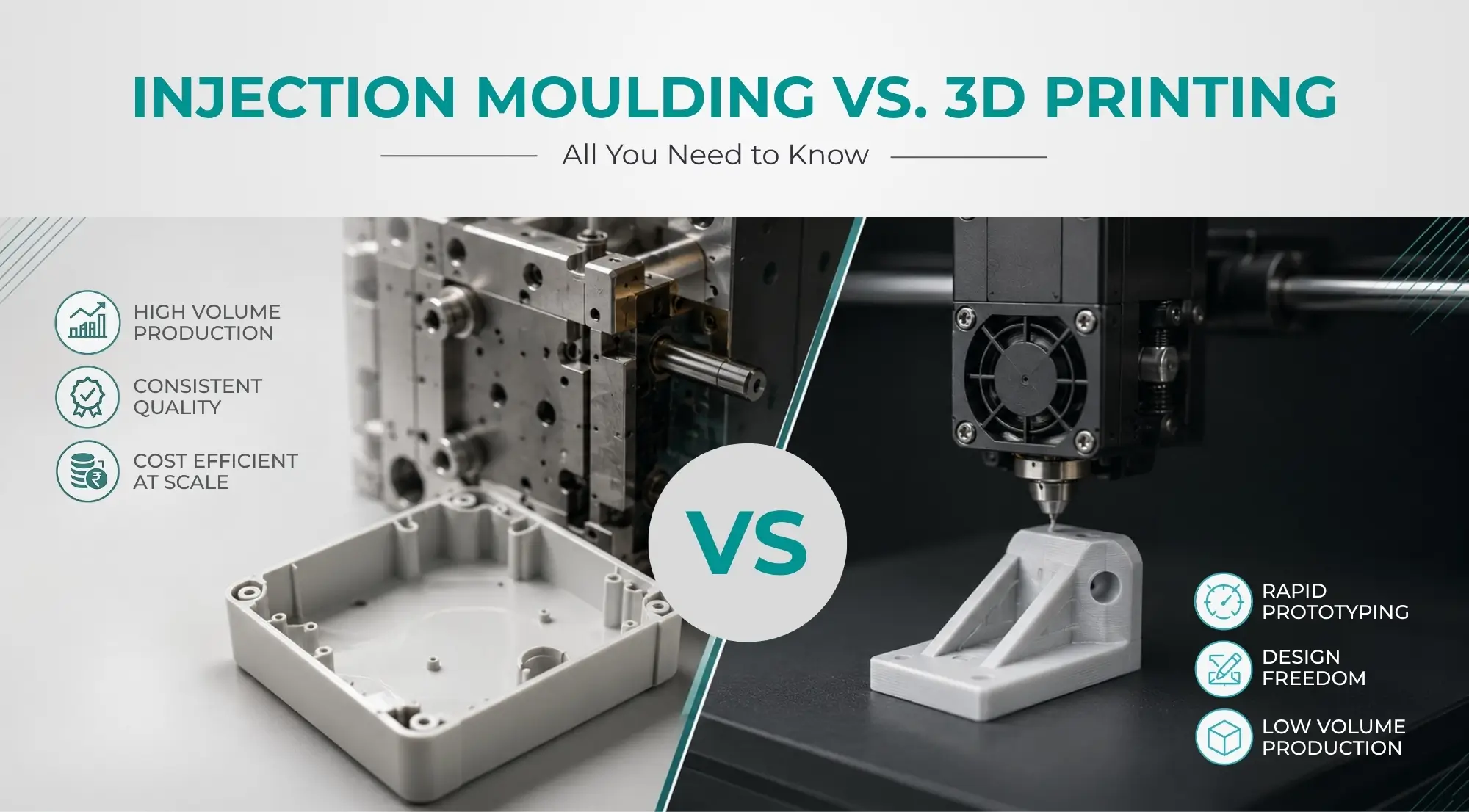


Modern manufacturing is evolving rapidly. Businesses are under constant pressure to deliver products faster, reduce production costs, improve precision and maintain consistent quality. As industries continue to innovate, two manufacturing technologies have emerged as major solutions for product development and production: Injection Moulding and 3D Printing.
Both methods are widely used across industries such as automotive, aerospace, medical, electronics, industrial manufacturing and consumer products. However, despite serving similar manufacturing goals, these technologies operate very differently and are suitable for different production requirements.
Choosing between Injection Moulding and 3D Printing is not simply about selecting a manufacturing process. It is about understanding production volume, material requirements, cost efficiency, product complexity, scalability and long-term manufacturing goals.
What is Injection Moulding?
Injection Moulding is a highly efficient manufacturing process used to produce plastic and polymer components in large volumes with excellent consistency and precision.
This Moulding process involves melting raw material usually plastic pellets and injecting the molten material into a custom-designed mould cavity under high pressure. Once cooled and solidified, the finished component is ejected from the mould.
This process is widely preferred for mass production because it enables manufacturers to create thousands or even millions of identical parts with minimal variation.
How the Injection Moulding Process Works
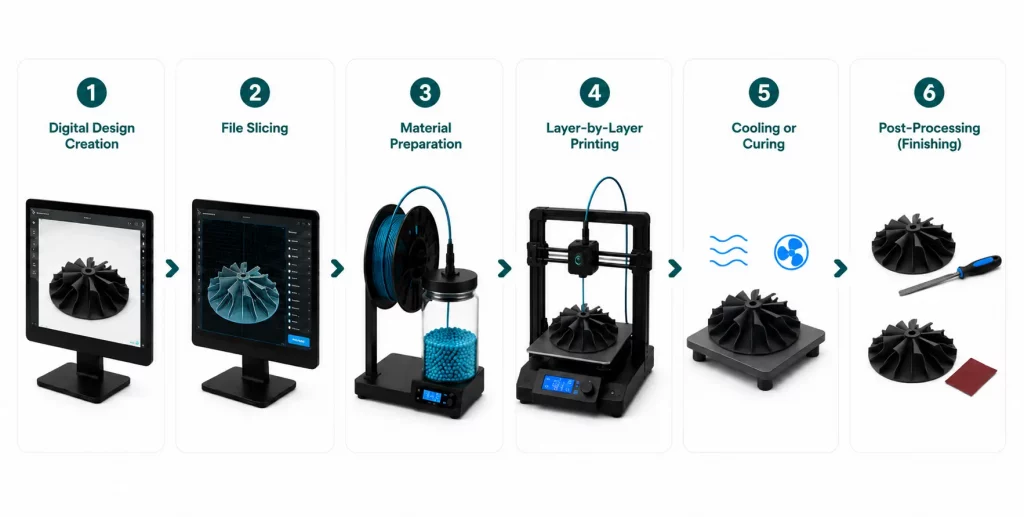
The Injection Moulding process is a highly efficient manufacturing method used to produce precision plastic components in large volumes. The process generally includes the following stages:
-
Material Feeding
The process begins with feeding plastic granules or pellets into a hopper connected to the Injection Moulding machine. These raw materials are selected based on the product’s strength, flexibility, heat resistance and durability requirements.
-
Melting
Inside the heated barrel, the plastic material is exposed to high temperatures and melted into a molten state. A rotating screw helps move and evenly melt the material for consistent processing.
-
Injection
Once the material is fully molten, it is injected into a precision-engineered mould cavity under high pressure. This allows the material to completely fill the mould and accurately form the desired component shape.
-
Cooling
After injection, the molten plastic inside the mould begins to cool and solidify. Proper cooling is important for maintaining dimensional accuracy, strength and surface finish quality.
-
Ejection
Once the component has fully cooled, the mould opens and the finished part is ejected from the mould cavity. The component may then go through additional finishing or quality inspection processes if required.
The cycle then repeats continuously, making Injection Moulding highly suitable for fast and high-volume manufacturing.
Common Materials Used in Injection Moulding
Injection Moulding supports a wide range of industrial-grade materials, including:
- ABS
- Polypropylene (PP)
- Polycarbonate (PC)
- Nylon
- Polyethylene (PE)
- Thermoplastic Elastomers (TPE)
- PEEK
- Acrylic
These materials offer high durability, impact resistance, heat resistance, and dimensional stability.
Industries Using Injection Moulding
- Automotive: Used for manufacturing high-precision vehicle components such as dashboards, bumpers, interior trims, housings, and electrical connectors.
- Consumer Products: Used for producing large volumes of household items, packaging products, plastic containers, toys, and personal care product components.
- Medical Devices: Used for manufacturing sterile and accurate medical components such as syringes, diagnostic equipment parts, surgical instrument handles, and IV components.
- Electronics: Used for producing durable and lightweight electronic components including device enclosures, switches, connector housings, and cable management parts.
Advantages of Injection Moulding
- High Production Efficiency: Enables fast and continuous manufacturing of large volumes of components with minimal production time.
- Excellent Repeatability: Produces identical parts with consistent quality, precision, and dimensional accuracy.
- Lower Cost Per Part: Reduces the cost per component significantly during high-volume production runs.
- Superior Surface Finish: Delivers smooth, clean, and high-quality component surfaces with minimal post-processing.
- Wide Material Selection: Supports a broad range of plastic and engineering-grade materials for different application needs.
- Strong Mechanical Properties: Produces durable and high-strength components suitable for demanding industrial applications.
Limitations of Injection Moulding
- High Initial Tooling Cost: Requires expensive mould design and tooling investment before production begins.
- Longer Setup Time: Mould manufacturing and machine setup can increase overall project lead time.
- Limited Design Flexibility: Design modifications after mould creation can be difficult and costly.
- Not Cost-Effective for Low Volumes: Small production runs may not justify the high tooling expenses.
- Material Change Complexity: Switching materials or colours during production can require additional machine cleaning and setup.
- Large Machine Requirement: Manufacturing large or complex components may require heavy and expensive machinery.
What is 3D Printing?
3D Printing, also known as additive manufacturing, is a manufacturing process that creates components layer by layer directly from a digital design file.
Unlike Injection Moulding, which removes or shapes material using moulds, 3D Printing builds products by adding material progressively until the final shape is achieved.
This technology has transformed rapid prototyping, custom manufacturing, and low-volume production by allowing manufacturers to quickly produce complex geometries without tooling.
How 3D Printing Process Works
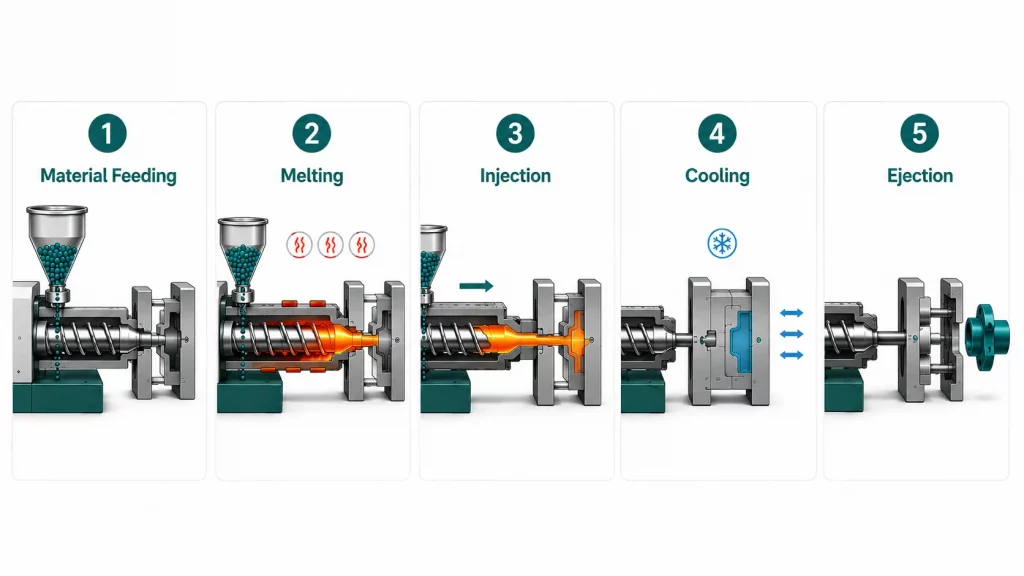
This process generally includes the following stages:
-
Digital Design Creation
The process begins with creating a 3D model using CAD (Computer-Aided Design) software. This digital model defines the shape, dimensions, and structure of the final component.
-
File Slicing
The 3D model is then converted into thin horizontal layers using slicing software. The software generates instructions that guide the 3D printer during the printing process.
-
Material Preparation
Depending on the printing technology, materials such as plastic filament, resin, powder, or metal are prepared inside the printer before production begins.
-
Layer-by-Layer Printing
The printer starts building the object layer by layer based on the digital instructions. Each layer bonds to the previous one until the complete component is formed.
-
Cooling or Curing
After printing, the material is cooled, hardened, or cured depending on the technology and material used to ensure structural stability.
-
Post-Processing
The finished component may undergo additional processes such as sanding, polishing, painting, or support removal to improve surface finish and functionality.
3D Printing is widely used for rapid prototyping, product testing, customised manufacturing, and complex design applications across industries such as aerospace, healthcare, automotive, and consumer electronics.
Materials Used in 3D Printing
Common materials include:
- PLA
- ABS
- Nylon
- Resin
- TPU
- Metal powders
- Carbon-fibre composites
Industries Using 3D Printing
- Aerospace: Used for manufacturing lightweight prototype components, complex aircraft parts, and customised engineering designs.
- Automotive Prototyping: Used for rapid prototyping, product testing, and design validation of vehicle components.
- Healthcare: Used for producing medical models, prosthetics, dental components, and customised healthcare devices.
- Product Design: Used for quickly developing and testing new product concepts before mass production.
- Architecture: Used for creating detailed architectural models and design visualisations.
- Education: Used for practical learning, research projects, and engineering design training.
- Consumer Electronics: Used for prototyping electronic device components, casings, and customised product designs.
Advantages of 3D Printing
- Rapid Prototyping: Enables faster product development and prototype creation directly from digital designs.
- Design Flexibility: Allows the production of highly complex and customised geometries that are difficult to manufacture traditionally.
- No Tooling Required: Eliminates the need for expensive moulds or tooling setups, reducing initial production costs.
- Faster Design Modifications: CAD designs can be updated and printed quickly without changing physical tooling.
- Cost-Effective for Low Volumes: Ideal for custom products, prototyping, and small-batch manufacturing.
Limitations of 3D Printing
- Slower Production Speed: Not suitable for large-scale or high-volume manufacturing due to longer printing times.
- Limited Material Options: Offers fewer industrial-grade material choices compared to Injection Moulding.
- Surface Finish Limitations: Printed parts often require additional post-processing for smoother finishes.
- Higher Per-Part Cost at Scale: Production costs increase significantly when manufacturing large quantities.
Injection Moulding vs. 3D Printing: Understanding the Core Difference
Manufacturers often compare Injection Moulding vs. 3D Printing because both technologies can produce plastic and functional components. However, the right choice depends heavily on production goals, volume requirements, budget, lead time, and product complexity.
Understanding the difference between Injection Moulding and 3D Printing is essential for selecting the most efficient manufacturing solution.
| Factor | Injection Moulding | 3D Printing |
|---|---|---|
| Production Volume | Best suited for high-volume manufacturing with consistent output and faster production cycles. | Ideal for low-volume production, prototyping, and customised components. |
| Initial Cost | Requires high initial investment for mould design and tooling setup. | Has lower setup costs since no moulds or tooling are required. |
| Production Speed | Faster and more efficient for large-scale mass production. | Slower when producing large quantities due to layer-by-layer printing. |
| Design Flexibility | Design changes are limited once the mould is created. | Allows highly flexible and complex design modifications directly from CAD files. |
| Material Options | Supports a wide range of industrial-grade plastics and engineering materials. | Material options are comparatively more limited depending on printer technology. |
| Surface Finish | Produces smooth and consistent surface finishes with minimal post-processing. | Often requires sanding, polishing, or finishing after printing. |
| Customisation | Less suitable for customised or frequently changing designs. | Highly suitable for customised, personalised, and unique product designs. |
| Waste Generation | Generates moderate material waste during manufacturing. | Produces lower material waste because material is added only where needed. |
| Lead Time | Requires longer setup time due to mould manufacturing and machine preparation. | Enables faster prototyping and quicker product development cycles. |
| Scalability | Highly scalable for continuous industrial production and large manufacturing volumes. | More suitable for small-scale production and rapid development projects. |
When Should You Choose Injection Moulding?
Injection Moulding is the ideal manufacturing solution when businesses require large-scale production, high precision, and long-term manufacturing efficiency. It is widely preferred for industries that demand consistent quality, durability, and cost-effective mass production.
-
Large Production Runs
Injection Moulding is highly suitable for manufacturing thousands or millions of identical components efficiently and consistently.
-
Long-Term Manufacturing Projects
The process is ideal for long-term production because the initial tooling investment becomes cost-effective over large production volumes.
-
Products Requiring Tight Tolerances
Injection Moulding delivers excellent dimensional accuracy and repeatability, making it suitable for precision-engineered components.
-
Industries Demanding Durability and Consistency
Industries such as automotive, medical, electronics, and industrial manufacturing prefer Injection Moulding for producing durable and high-quality parts with consistent performance.
When Should You Choose 3D Printing?
3D Printing is best suited for projects that require flexibility, rapid development, customisation, and low-volume production. It allows manufacturers to quickly create and modify designs without expensive tooling.
-
Prototype Development
It enables rapid prototyping, allowing businesses to quickly transform digital designs into physical models.
-
Product Testing and Validation
Manufacturers use 3D Printing to test product functionality, fit, and design performance before moving to mass production.
-
Custom or Personalised Products
The technology is highly effective for producing customised or personalised components with unique designs.
-
Small-Batch Production
3D Printing is cost-effective for low-volume manufacturing where tooling costs for Injection Moulding may not be practical.
Cost Comparison: Injection Moulding vs. 3D Printing
Cost plays an important role when choosing between Injection Moulding and 3D Printing. Both manufacturing methods have different cost structures depending on production volume, tooling requirements, and project goals.
-
Tooling and Setup Costs
Injection Moulding requires custom moulds and tooling, which increases the initial setup cost. However, this investment becomes cost-effective for large production runs.
3D Printing does not require moulds or tooling, making it more affordable for prototypes and small-batch production.
- Injection Moulding: High initial tooling cost
- 3D Printing: Low setup cost with no tooling required
-
Production Cost Per Unit
Injection Moulding offers a lower cost per part when manufacturing in large quantities because production becomes faster and more efficient.
3D Printing has a higher per-part cost since components are printed individually layer by layer.
- Injection Moulding: Cost-effective for mass production
- 3D Printing: Better for low-volume production
-
Material Costs
Injection Moulding materials are generally more economical for large-scale production.
3D Printing materials such as specialised filaments and resins can be comparatively expensive depending on the application.
- Injection Moulding: Lower material cost at scale
- 3D Printing: Material costs may be higher
-
Long-Term Scalability
Injection Moulding is highly scalable and suitable for continuous high-volume manufacturing.
3D Printing is more suitable for prototyping, custom products, and smaller production runs.
- Injection Moulding: Best for long-term large-scale production
- 3D Printing: Best for flexible low-volume manufacturing
Which Process is More Economical?
- Choose Injection Moulding for high-volume production, long-term projects, and lower cost per unit.
- Choose 3D Printing for rapid prototyping, customisation, and small-batch manufacturing.
How Schilthorn Supports Precision Manufacturing
At Schilthorn Precision Engineering, we help businesses choose the right manufacturing approach for precision, scalability, and production efficiency. With 18+ years of engineering expertise, we support industries with high-quality manufacturing solutions for both prototyping and large-scale production requirements.
Backed by ISO 9001 & AS9100 certified manufacturing standards, our team delivers precision-engineered components for automotive, aerospace, HVAC, industrial, and engineering applications.
Why Businesses Choose Schilthorn
- 18+ Years of Precision Manufacturing Experience
- Expertise in High-Volume & Custom Manufacturing Solutions
- ISO 9001 & AS9100 Certified Quality Standards
- Advanced CNC & Precision Engineering Capabilities
- High Accuracy, Consistency & Quality Assurance
- Scalable Manufacturing Support for Industrial Applications
Ready to accelerate your product development and manufacturing process? Partner with Schilthorn Precision Engineering for precision-driven solutions ranging from rapid prototyping to reliable large-scale manufacturing tailored to your production goals.
FAQs
-
Is Injection Moulding suitable for customised products?
Injection Moulding is less suitable for highly customised products because mould modifications can be expensive and time-consuming.
-
Which process provides a better surface finish?
Injection Moulding generally provides smoother and more consistent surface finishes compared to 3D Printing.
-
Does 3D Printing require moulds or tooling?
No, 3D Printing does not require moulds or tooling, which makes it highly suitable for rapid prototyping and custom production.
-
Can 3D Printing replace Injection Moulding?
3D Printing is excellent for prototyping and customisation, but Injection Moulding remains the preferred solution for large-scale industrial manufacturing.
-
Which process is faster?
3D Printing is faster for prototyping, while Injection Moulding is much faster for mass production.
-
Is Injection Moulding cheaper than 3D Printing?
For large-scale production, Injection Moulding becomes significantly cheaper per unit. However, for small batches and prototypes, 3D Printing is often more cost-effective.