
Why Rubber to Metal Bonding Fails, Common Challenges with Expert Solutions
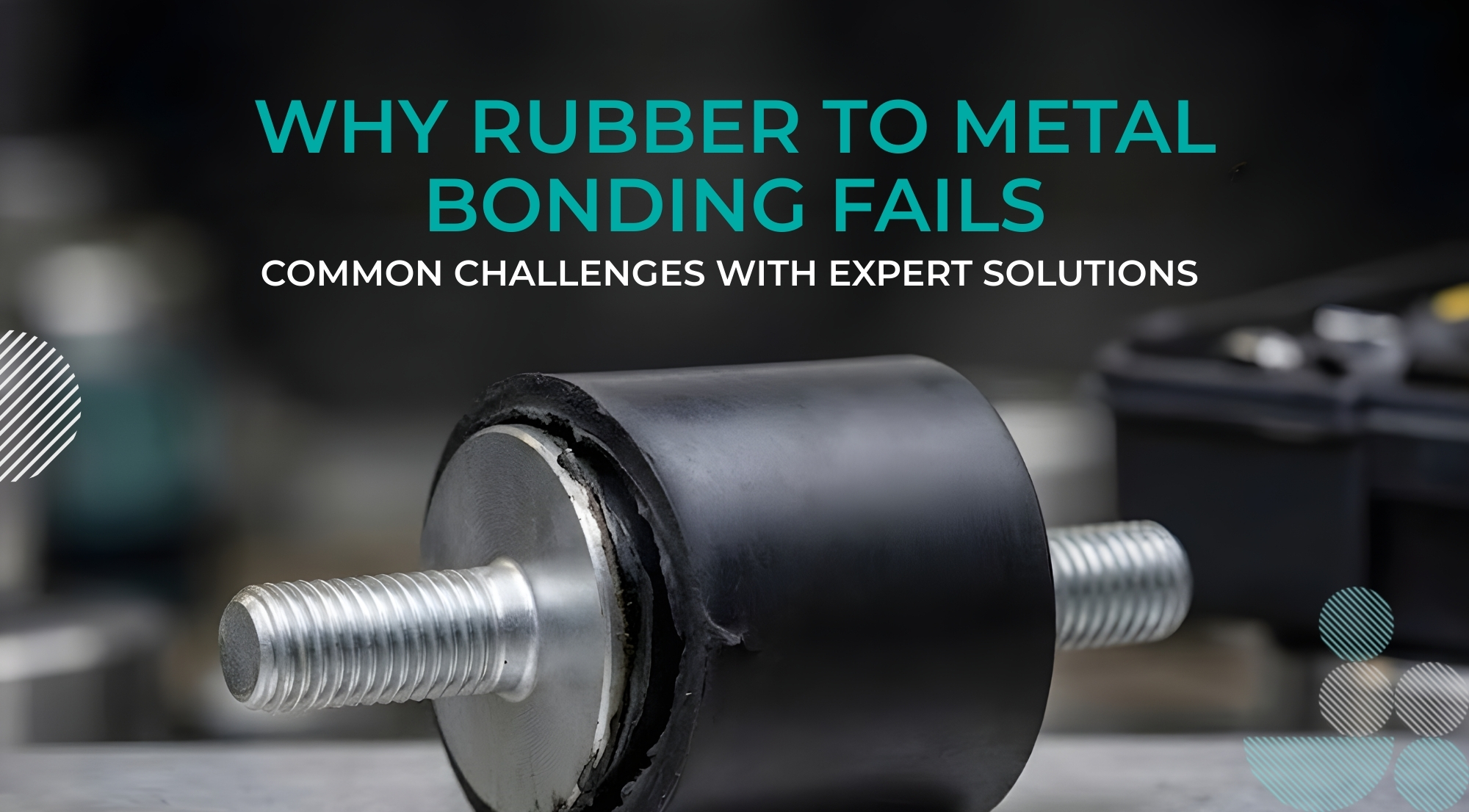


Rubber to metal bonding is a controlled thermo-chemical joining method in which an elastomer is permanently attached to a metallic insert during vulcanization. Because the bonded interface cannot be inspected after curing, its performance depends entirely on disciplined surface preparation, adhesive control and process stability.
Metal-to-rubber bonding is technically challenging because it involves joining materials with fundamentally different mechanical and thermal characteristics. Elastomers deform elastically and exhibit high strain capability, while metals maintain rigid structural behaviour. Differences in modulus, surface energy and coefficient of thermal expansion create interfacial stress during curing and under service conditions. Maintaining a stable bond therefore requires strict control of surface condition, adhesive activation and curing parameters.
In precision-engineered components, interfacial separation reduces fatigue life and structural reliability. Bond failure is rarely caused by a single defect; it is typically the result of cumulative process imbalance. The following sections explain the common causes of rubber to metal bonding failure and the expert solutions required to prevent them.
Rubber to Metal Bonding Fails and Common Challenges with Expert Solutions
1. Metal Surface Contamination and Low Surface Energy:
The bonded interface begins at the metal surface. Adhesive primers require intimate molecular contact with a chemically active surface to develop stable adhesion. Residual oils, corrosion inhibitors, moisture films or handling contamination reduce surface energy and impair wetting. When wetting is incomplete, adhesive cannot penetrate micro-asperities effectively, resulting in localized weak zones at the primer metal interface. The common indicators and contributing factors are:
- Visible oil smearing or uneven primer spread.
- Water break test failure.
- Delayed adhesive application after blasting.
- Silicone contamination from compressed air systems.
- Fingerprint contamination during handling.
- Oxidation of inserts stored in humid conditions.
Engineering Solution:
Surface preparation must be treated as a controlled parameter within the rubber to metal bonding process. Degreasing should be validated through surface cleanliness testing. A defined blast-to-prime time window must be enforced to minimize oxide formation. Controlled storage and handling procedures reduce variability before adhesive application.
2. Inadequate or Excessive Surface Roughness
Mechanical anchoring between adhesive and metal depends on controlled surface roughness generated during abrasive blasting. A surface that is too smooth limits mechanical interlocking, while an excessively rough surface creates stress concentration points that weaken adhesion under cyclic load. Inconsistent roughness leads to variation in bond strength across rubber to metal bonded parts which includes factors such as:
- Low bond strength despite proper adhesive use.
- Smooth metal finish after blasting.
- Integrated abrasive particles.
- Variation in blasting pressure.
- Reused or contaminated blasting media.
- Inconsistent Ra measurements.
Engineering Solution:
Define and validate an optimal roughness range using profilometer measurement. Standardize blasting parameters and replace media regularly. Surface profile verification should be integrated into insert inspection before priming.
3. Adhesive Film Thickness Variation
Rubber to metal bonding relies on precise primer and cover coat thickness to transfer load effectively. A thin adhesive layer results in incomplete coverage, while excessive thickness may introduce internal stress and cohesive weakness. Thickness variation directly compromises the uniformity of rubber to metal bonded components.
- Adhesive pooling or sagging.
- Uneven spray patterns.
- Improper viscosity due to dilution errors.
- Inconsistent mixing ratios.
- Clogged spray equipment.
- No thickness validation checks.
Engineering Solution:
Monitor adhesive viscosity and solids content. Calibrate spray equipment to maintain uniform deposition. Perform periodic destructive thickness verification. Adhesive application must be treated as a measurable variable within the rubber to metal bonding process.
4. Incomplete Solvent Flash-Off
During rubber to metal molding, residual solvent trapped within the adhesive layer expands under heat, generating micro-voids or blistering. These voids reduce effective bonding area and act as crack initiation points. Environmental conditions strongly influence solvent evaporation behaviour.
- Blistering after demoulding.
- Bubbles at the interface during failure analysis.
- Shortened flash-off time to increase output.
- High humidity in coating area.
- Thick adhesive layers.
- Poor airflow during drying.
Engineering Solution:
Establish and validate defined flash-off times under controlled temperature and humidity. Ensure complete solvent evaporation before molding begins. Use forced-air drying where necessary to stabilize evaporation rates.
5. Adhesive Rubber Material Compatibility Mismatch
Chemical compatibility between adhesive and elastomer is essential for stable interfacial bonding. Mismatch in polarity, cure system or formulation chemistry weakens crosslink development at the interface. Blooming additives or plasticizer migration can form a barrier that prevents effective adhesion in rubber to metal bonded parts:
- Clean adhesive surface after rubber separation (RC-type failure).
- Visible blooming on rubber surface.
- Change in rubber compound supplier.
- Peroxide-cured elastomer paired with incompatible adhesive.
- Excessive softener content.
- Bond strength variation across rubber grades.
Engineering Solution:
Match adhesive chemistry with the rubber compound and cure system. Conduct compatibility trials before production. Limit blooming-prone ingredients. Validate bonding through peel or shear testing during development.
6. Cure Imbalance and Density Variation
Bond development depends on synchronized adhesive activation and rubber crosslinking. Under-curing reduces crosslink density and weakens cohesive strength, while over-curing may degrade elastomer properties. Thermal gradients within moulds can produce inconsistent cure across rubber to metal bonded components due to factors such as:
- Hardness variation between cavities.
- Reduced tensile strength.
- Premature failure after aging.
- Uneven platen temperature.
- Cycle time reduction without validation.
- Inconsistent rheometer results.
Engineering Solution:
Determine optimal cure parameters through rheometer testing. Conduct thermal mapping to ensure uniform heating. Avoid cycle time reduction without confirming full crosslink development. Validate bond performance after accelerated aging.
7. Molding Pressure and Flow Imbalance
Uniform pressure during rubber to metal molding ensures intimate contact between rubber and adhesive-coated inserts. Insufficient clamp force, poor venting or uneven flow can prevent full wetting of the bonding surface, creating localized weak regions, Common indicators and contributing factors:
- Localized failure near gate areas.
- Flash indicating poor sealing.
- Trapped air pockets.
- Inconsistent cavity pressure.
- Poor venting design.
- Flow shadow regions around inserts.
Engineering Solution:
Calibrate clamp force regularly. Optimize venting to prevent gas entrapment. Use flow simulation during mold design. Monitor cavity pressure during production to improve consistency.
8. Thermal Expansion Mismatch
Rubber expands and contracts at a rate significantly different from metal. During temperature cycling, differential expansion generates shear stress at the interface. Under cyclic mechanical loading, stress concentration at geometric transitions may initiate micro-separation in rubber to metal bonded components:
- Failure after thermal cycling tests.
- Delamination at sharp insert corners.
- Cracks at geometric transitions.
- Thin bonding areas.
- High operating temperature fluctuations.
- Repeated cyclic shear loading.
Engineering Solution:
Select elastomer grades suitable for operating temperature range. Incorporate adequate radii and bonding area in design. Conduct accelerated fatigue and thermal cycling tests during validation.
9. Environmental and Chemical Degradation
Service environments involving oil, humidity, ozone and elevated temperatures can degrade elastomer properties. Oil swelling alters stress distribution; heat aging increases stiffness and chemical attack weakens polymer chains. These changes shift load toward the interface and promote separation.
- Increased hardness after aging.
- Volume expansion after oil immersion.
- Surface cracking from ozone exposure.
- Reduced bond strength after thermal aging.
- Exposure to aggressive chemicals.
- Lack of environmental validation.
Engineering Solution:
Select rubber compounds compatible with service conditions. Conduct oil immersion, heat aging and humidity cycling tests during validation. Evaluate bond strength after environmental exposure to confirm long-term durability.
Rubber to metal bonding fails when surface stability, adhesive control, cure synchronization, molding balance or environmental compatibility are compromised. Reliable performance in rubber to metal bonded components depends on treating each stage of the rubber to metal bonding process as a measurable and controlled parameter. When surface preparation, material compatibility and thermal stability are disciplined and validated, bond strength becomes repeatable, durable and resistant to service-induced degradation.
10. Insert Dimensional Tolerance
Rubber to metal bonding is not only a chemical process; it is also a dimensional interface system. Variations in insert geometry, concentricity, flatness or surface parallelism directly influence adhesive distribution and stress transfer. If metallic inserts fall outside machining tolerance limits, rubber flow during rubber to metal molding may become uneven, resulting in localized thin bond areas or incomplete wetting.
Even small deviations in insert thickness or misalignment within the cavity can create non-uniform compression and pressure gradients during vulcanization. These variations alter adhesive film behaviour and crosslink development. In precision assemblies’ machining tolerance may shift stress concentration to specific regions of rubber to metal bonded parts, increasing the likelihood of delamination under cyclic loading. Common Indicators and Contributing Factors:
In precision assemblies’ machining tolerance:
- Localized bond failure at one edge of insert.
- Variation in bond strength across identical batches.
- Uneven rubber flash distribution.
- Insert wobble or misalignment during molding.
- Out-of-spec flatness or concentricity.
- Inconsistent insert positioning in multi-cavity tools.
Engineering Solution:
Metal inserts used in rubber to metal bonded components must comply with defined dimensional tolerances and geometric controls. Flatness, concentricity and thickness should be verified prior to molding. Insert positioning fixtures must ensure repeatable alignment inside the mold cavity. Precision control of insert geometry is as critical as adhesive chemistry in achieving stable bond performance.
Why Choose Schilthorn Precision Engineering to Controls These Bonding Failures
At Schilthorn Precision Engineering, rubber to metal bonding is treated as an integrated engineering system rather than an isolated adhesive operation. Surface preparation, insert geometry, adhesive application, controlled moulding and cure synchronization are managed as measurable process parameters to prevent the failure mechanisms discussed above. From validated surface conditioning and primer systems to stable compression and transfer moulding under defined cure cycles, each stage of the rubber to metal bonding process is controlled to ensure consistent adhesion strength and structural reliability. Supported by CMM-verified inspection and ISO 9001 & AS9100 certified quality systems, rubber to metal bonded components is produced under disciplined process control to minimize variability and enhance long-term fatigue performance.