
WHAT IS A CHILLER? TYPES, WORKING AND KEY COMPONENTS


WHAT IS A CHILLER?
A chiller is a mechanical refrigeration system that removes heat from a circulating fluid and maintains that fluid at a controlled temperature. The system operates by using refrigerant as the working medium to absorb heat at low temperature and pressure and to reject heat at higher temperature and pressure.
The circulating fluid passes through the evaporator, where the refrigerant absorbs heat and undergoes a phase change from liquid to vapor. This heat removal process lowers the temperature of the circulating fluid, which then returns to the load for continued heat absorption.
The overall cooling performance and operational stability of a chiller depend on controlled pressure levels, refrigerant thermodynamic properties, heat-exchange effectiveness, and flow consistency. Any deviation in these parameters directly influences cooling capacity, energy consumption, energy efficiency and operating reliability.
Chillers are designed for continuous-duty operation and are engineered to maintain temperature stability under varying thermal loads. Proper design, selection, and operation ensure predictable performance and extended service life.
WORKING PRINCIPLE OF A CHILLER
A chiller operates on the vapor compression refrigeration cycle, which consists of four continuous stages: evaporation, compression, condensation, and expansion.
Low-pressure refrigerant absorbs heat from the process fluid in the evaporator and evaporates into vapor. The compressor then compresses this vapor, increasing its pressure and temperature. The high-pressure vapor releases heat in the condenser and condenses into liquid refrigerant. The expansion valve subsequently reduces the pressure and temperature of the liquid refrigerant before it re-enters the evaporator.
This closed cycle repeats continuously, allowing the chiller to remove heat from the process fluid and maintain controlled temperature conditions.
WHAT ARE THE KEY COMPONENTS OF A CHILLER?
A chiller consists of four primary components that operate together to remove heat from a process fluid using a vapor compression refrigeration cycle. Each component performs a specific thermodynamic function that enables continuous heat absorption and rejection.
- Evaporator: The evaporator is a heat exchanger component [Add Word] that transfers heat from the process fluid to the refrigerant, causing the refrigerant to undergo a phase change. Refrigerant enters the evaporator as a low-pressure liquid–vapor mixture and absorbs heat from the process fluid. As heat is absorbed, the refrigerant evaporates from liquid to vapor at approximately constant temperature. By the time the refrigerant exits the evaporator, it exists as low-pressure vapor, typically in a superheated state. Superheat occurs when all liquid refrigerant has evaporated and the vapor temperature rises above its saturation temperature, ensuring that no liquid refrigerant enters the compressor. The process fluid enters the evaporator at a higher temperature and exits at a lower temperature after transferring heat to the refrigerant.
- Compressor: The compressor draws low-pressure refrigerant vapor from the evaporator and compresses it to a higher pressure. This compression process increases both the pressure and temperature of the refrigerant. The result is a high-pressure, high-temperature refrigerant vapor that is discharged to the condenser. The compressor provides the energy required to circulate refrigerant throughout the chiller system and establishes the pressure difference between the evaporator and condenser. Without the compressor, refrigerant circulation and heat transfer within the chiller would not occur.
- Condenser: The condenser removes heat from the high-pressure refrigerant vapor and condenses it into a liquid. Heat rejection occurs either by circulating water through the condenser in water-cooled chillers or by-passing ambient air over the condenser surface in air-cooled chillers. As the refrigerant releases heat, it undergoes a phase change from vapor to liquid at approximately constant pressure. The condenser rejects both the heat absorbed in the evaporator and the energy added by the compressor during compression.
- Expansion Valve: The expansion valve controls the flow of refrigerant from the condenser to the evaporator. It meters the refrigerant mass flow rate and creates a controlled pressure reduction. This pressure drop lowers the refrigerant temperature and prepares it for heat absorption in the evaporator. By regulating refrigerant flow in response to evaporator load, the expansion valve maintains stable system operation and prevents liquid refrigerant from returning to the compressor.
TYPES OF CHILLERS
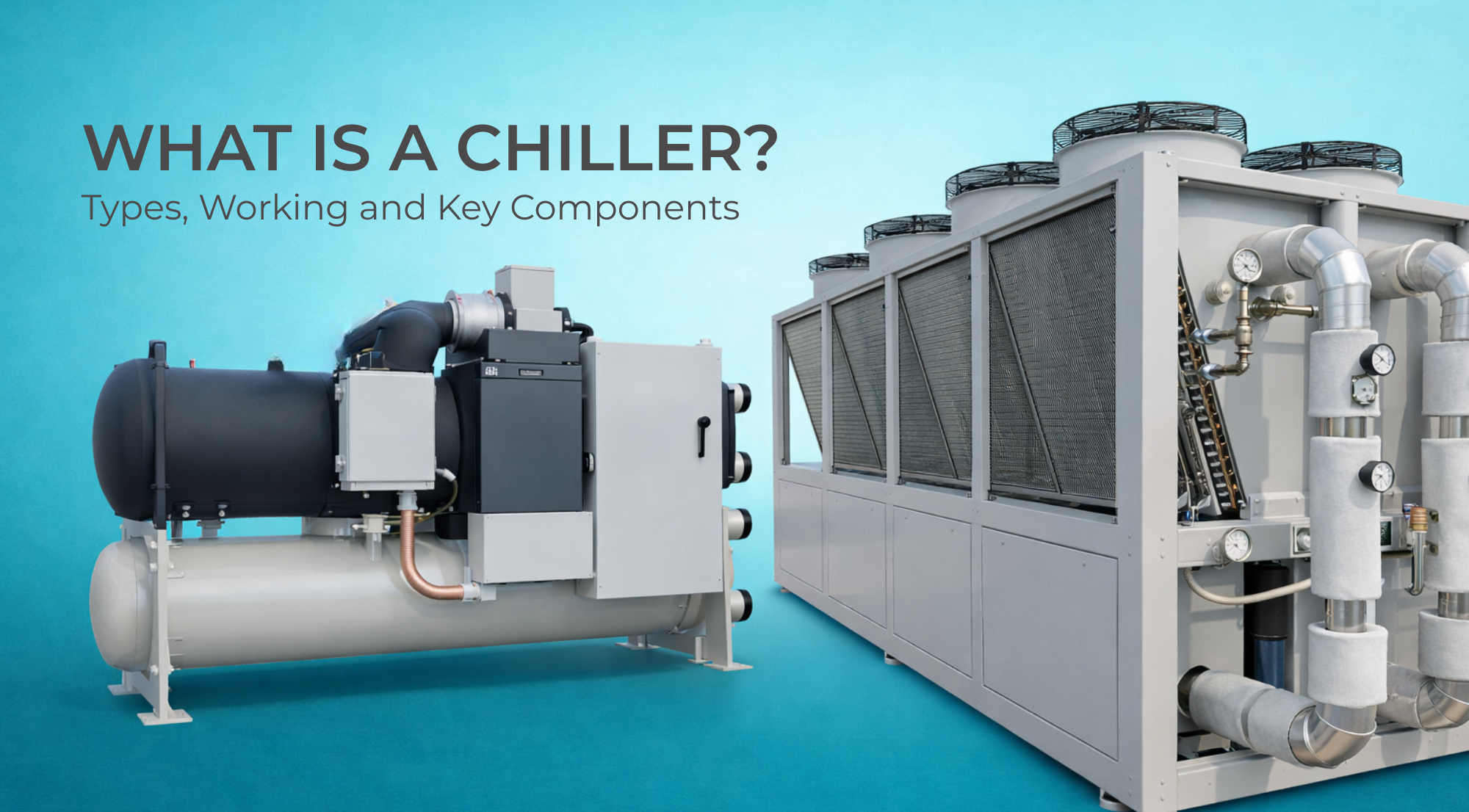
Chillers are commonly classified according to how heat is rejected from the refrigeration cycle at the condenser. Based on this heat-rejection method, chillers are broadly divided into air-cooled chillers and water-cooled chillers. In both types, the refrigeration cycle, working principle and core components remain the same. The distinction lies in the medium used to remove heat from the condenser.
- Air-Cooled Chiller: An air-cooled chiller rejects heat from the refrigerant directly to ambient air through a finned condenser and mechanically induced airflow. As high-pressure refrigerant flows through the condenser, it releases heat to the surrounding air and condenses from vapor to liquid.
Air-cooled chillers operate without auxiliary water systems. Their performance depends on ambient air temperature, airflow rate, condenser surface condition, and fin cleanliness. Higher ambient temperatures increase condensing pressure, which can reduce system efficiency.
- Water-Cooled Chiller: A water-cooled chiller rejects heat from the refrigerant to water through a condenser connected to a circulating water system. Heat transfers from the refrigerant to the water, which then carries the thermal energy away from the condenser.
Water-cooled chillers provide stable operation under continuous or high-load conditions due to the superior heat-transfer characteristics of water. Their performance depends on controlled water flow, effective heat removal, and proper water quality management to prevent fouling or scaling.
Applications of Chillers
Chillers are applied wherever controlled removal of heat is required to maintain defined temperature limits in continuous or intermittent operation. Application suitability depends on cooling capacity, operating temperature range, duty cycle, and load characteristics.
- Building HVAC Systems: Chillers are used in centralized HVAC systems for large buildings where thermal loads are high and continuous temperature control is required. These systems supply chilled fluid to air-handling or terminal units to maintain stable indoor conditions across large floor areas and multiple zones. Typical installations in HVAC Chillers include commercial buildings, healthcare facilities, institutional campuses, and large public infrastructures.
- Industrial Production Processes: In industrial environments, chillers remove process heat generated during continuous or cyclic production operations. Controlled cooling is required to maintain process stability, protect equipment, and ensure consistent operating conditions. industrial cooling system applications include chemical processing, petrochemical operations, plastics manufacturing, metal processing, automotive production, and other heat-intensive manufacturing systems.
- Food Storage and Processing: Chillers are used to control temperature during food processing, storage, and preservation. Stable cooling conditions are required to maintain product quality, inhibit microbial growth, and comply with process control requirements. These applications include cold storage systems, food processing lines, beverage production, and post-processing cooling operations.
- Data Centres and Electronic Systems: Chillers are used to remove heat generated by high-density electronic equipment operating continuously. Controlled cooling prevents thermal stress, maintains stable operating conditions, and supports uninterrupted system operation. These systems typically operate under steady thermal loads with limited tolerance for temperature variation.
- Power Generation Facilities: In power generation systems, chillers remove heat generated during energy conversion and auxiliary processes. Cooling is required to maintain thermal balance and support continuous operation under varying load conditions. Applications include cooling of auxiliary systems, control equipment, and process loops within power plants.
- Pharmaceutical and Laboratory Systems: Chillers are used in pharmaceutical production, research laboratories, and medical facilities where precise temperature control is required for equipment operation and material stability. These systems support processes involving temperature-sensitive compounds, analytical instruments, and controlled experimental environments.
Across all sectors, chillers function as controlled thermal systems designed to remove heat and maintain defined temperature conditions. Proper application depends on accurate assessment of thermal load, operating conditions, and system duty requirements.
WHY CHOOSE SCHILTHORN PRECISION FOR CHILLER REQUIREMENTS?
With over 18+ years of expertise in precision engineering, Schilthorn Precision supports chiller manufacturers and system integrators with precision-machined components and assemblies components used in industrial and HVAC chiller systems. Our capabilities span high-accuracy heat exchanger components, shells, tube sheets, pressure-retaining components supplied as per customer drawings and applicable specifications and custom assemblies manufactured to strict dimensional tolerances and international standards. Backed by ISO 9001 and AS9100 certifications, advanced machining infrastructure, and rigorous quality inspection, we deliver components that contribute to efficient heat transfer, structural integrity, and long-term reliability across chiller applications in power, process industries, marine, HVAC and heavy industrial systems. For precision-engineered chiller components built to exact specifications, connect with Schilthorn Precision Now.