
The Complete Guide To Precision Engineering: Principles, Tools And Applications


Precision engineering is an engineering discipline concerned with the accurate definition, control and verification of dimensions, geometry and surface characteristics in precision machined components and mechanical systems where functional reliability depends on extremely tight tolerances and predictable behaviour.
In applications such as heat exchangers, pressure equipment, HVAC systems, aerospace assemblies and other high-reliability mechanical systems, even small deviations in geometry, alignment or surface condition can result in leakage, misfit, accelerated wear, fatigue failure or reduced service life. Precision engineering provides a structured engineering framework to manage these risks by controlling variation, defining functional accuracy requirements and ensuring that dimensional and geometric characteristics remain stable throughout the component’s service life.
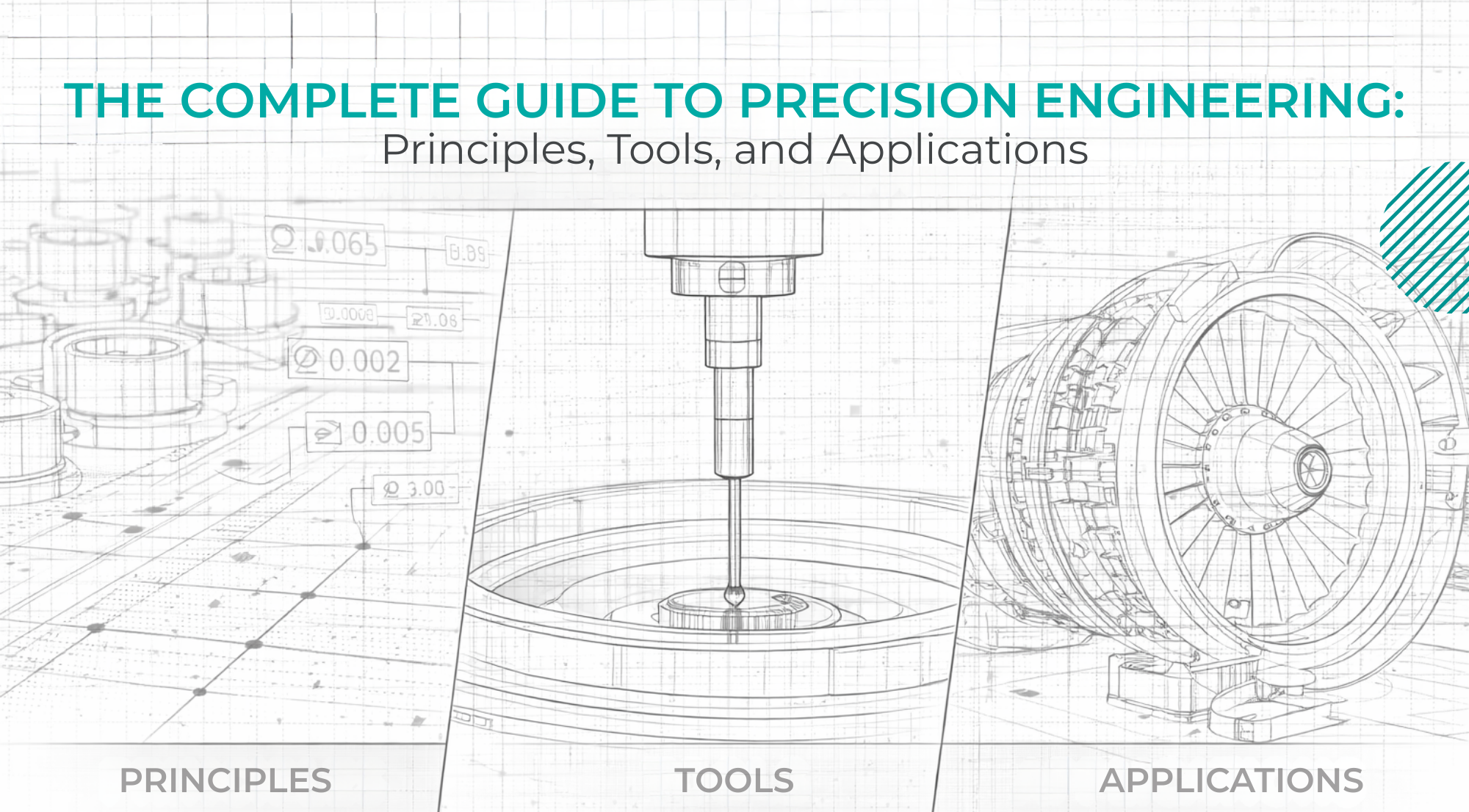
This guide explains precision engineering by systematically covering its core principles, the engineering tools and control disciplines that enable precision and the industrial applications where precision engineering is essential.
WHAT IS PRECISION ENGINEERING?
Precision engineering is an engineering discipline focused on the systematic control of dimensional, geometric and surface characteristics to ensure predictable and repeatable functional performance in mechanical components and assemblies. It addresses accuracy not as an isolated measurement, but as a system-level property governed by how features interact, align and remain stable under real operating conditions.
Rather than relying on nominal dimensions alone, precision engineering emphasises variation control. Equal importance is given to dimensional consistency, geometric relationships between features, datum reference structures and the long-term stability of these characteristics when subjected to pressure, temperature variation, vibration or cyclic loading. Precision engineering integrates several fundamental control elements, including:
- Linear and geometric tolerances.
- Feature relationships and datum reference systems.
- Surface condition at functional interfaces.
- Dimensional and geometric stability over time.
Together, these elements determine whether a component or system performs reliably once assembled and continues to do so throughout its operational life. Precision engineering therefore focuses on controlling variation rather than achieving nominal values alone, forming the foundation for predictable system behaviour, interchangeability and long-term functional integrity in advanced and high-reliability applications.
CORE PRINCIPLES OF PRECISION ENGINEERING
- Dimensional Accuracy and Tolerance Control.
Dimensional accuracy in precision engineering refers to the ability to achieve defined size limits consistently and repeatedly, often at micron or sub-micron levels. Precision is meaningful only when dimensional outcomes remain stable across multiple components and operating scenarios. Tolerance control ensures that allowable variation is logically allocated so that interacting features function together without interference, misalignment or excessive stress. When multiple dimensions contribute to an assembly, small variations can accumulate and affect overall system behaviour. Precision engineering addresses this through structured tolerance allocation and clearly defined reference relationships. - Geometric Accuracy and Feature Relationships (GD&T).
Geometric accuracy governs the shape, orientation and positional relationships between features rather than size alone. Characteristics such as flatness, parallelism, perpendicular, concentricity and positional accuracy directly influence alignment, load distribution, sealing behaviour and motion stability. A component may meet dimensional limits yet fail functionally if geometric relationships are not controlled. Precision engineering therefore prioritises geometric control to ensure that feature relationships support the intended functional behaviour of the system. - Surface Condition and Functional Performance.
Surface condition is a functional parameter, not a cosmetic one. Surface characteristics influence friction, wear, sealing effectiveness, heat transfer and contact behaviour between mating components. Precision engineering defines surface requirements based on functional interaction rather than appearance. Excessive roughness or excessive smoothness can both lead to performance issues depending on the application. Consistency of surface condition across functional interfaces is therefore as critical as achieving a specified value. - Material Behaviour and Dimensional Stability.
Material behaviour directly affects dimensional and geometric stability. Precision engineering accounts for how materials respond to thermal effects, applied loads, internal stress and time-dependent deformation. Different materials exhibit varying expansion rates, elastic behaviour and stress relaxation characteristics, all of which can influence accuracy during service. Understanding and accommodating material behaviour is essential to ensuring that defined tolerances and geometric relationships remain stable throughout a component’s operational life.
TOOLS AND SYSTEMS USED IN PRECISION ENGINEERING
Precision engineering relies on engineering control systems and validation disciplines that ensure defined accuracy requirements can be achieved and maintained. These requirements are realised through controlled precision machining capabilities supported by dimensional verification and process discipline.
- Measurement and Metrology Systems.
Measurement systems must be more accurate than the tolerances being verified. Coordinate Measuring Machines (CMMs), precision gauges and calibrated inspection instruments are used to verify dimensional and geometric requirements such as position, flatness and concentricity. Reliable measurement closes the loop between engineering intent and physical verification, enabling control of variation before it affects system performance. - Engineering Documentation and Control Frameworks.
Precision engineering depends on clearly defined drawings, GD&T frameworks, tolerance schemes and inspection criteria. These documents establish unambiguous requirements and provide a common reference for design, validation and acceptance, ensuring consistency across components and assemblies. - Process Stability and Verification Systems.
While precision engineering is distinct from manufacturing execution, it requires that execution systems behave predictably. Verification methods such as first article inspection, in-process checks and final validation ensure that defined engineering requirements are being met consistently and that variation remains within controlled limits.
APPLICATIONS OF PRECISION ENGINEERING IN INDUSTRY
- Aerospace and Defence
Precision engineering governs the dimensional and geometric control of critical components such as turbine interfaces, sensor housings, navigation assemblies and structural elements. These components must maintain alignment, stability and integrity under extreme temperature, pressure and dynamic loading conditions.
- Medical Devices and Healthcare Equipment
In medical applications, precision engineering ensures the accuracy, repeatability and safety of surgical instruments, implantable components and diagnostic systems. Tight control of tolerances and surface characteristics is essential to meet stringent regulatory, functional and biocompatibility requirements.
- Automotive Systems
Precision engineering supports high-performance engine assemblies, transmission systems, braking interfaces and safety-critical components. Accurate control of tolerances and feature relationships improves efficiency, reduces wear and ensures interchangeability across high-volume production environments.
- Electronics and Semiconductor Systems
Precision engineering enables the control of feature geometry, alignment and interface integrity in micro-scale components such as connectors, housings and structural supports. This discipline underpins the continued miniaturisation and reliability of electronic and semiconductor systems.
- Industrial Automation and Robotics
Robotic systems and automated machinery depend on precision-engineered components to achieve repeatable motion control, accurate positioning and stable high-speed operation. Precision engineering ensures predictable behaviour across cycles and extended service periods.
- Consumer and Industrial Products
In high-reliability consumer and industrial products, precision engineering ensures consistent fit, alignment and long-term durability. Controlled tolerances reduce assembly variation, improve product lifespan and support reliable mass deployment.
KEY BENEFITS OF PRECISION ENGINEERING
- Improved Quality and Consistency
Precision engineering ensures that dimensional, geometric and surface requirements are clearly defined, controlled and verified, resulting in components that meet exact specifications with minimal variation. By focusing on variation control rather than nominal values alone, it reduces the risk of dimensional mismatch, assembly issues and functional defects across batches and operating conditions. - Enhanced Performance and Durability
Accurate control of feature relationships and surface characteristics reduces unintended friction, stress concentration and uneven load distribution. As a result, components perform more predictably within assemblies and exhibit longer service life, improved wear behaviour and stable performance under sustained or cyclic loading. - Predictable and Repeatable Outcomes
Precision engineering establishes accuracy as a system property, ensuring that required tolerances and geometric relationships can be achieved consistently over time. This predictability is critical in high-reliability systems where repeatable behaviour matters more than isolated dimensional accuracy. - Reduced Lifecycle Cost and Waste
By addressing accuracy and variation at the engineering stage, precision engineering minimises downstream issues such as rework, adjustment during assembly, premature failure and unplanned maintenance. This leads to lower material loss, reduced corrective effort and improved overall lifecycle efficiency. - Enabling Complex and High-Accuracy Designs
Precision engineering allows the realisation of complex geometries, tight tolerances and compact interfaces that are not feasible without structured control of dimensions and feature relationships. This capability supports innovation in system design while maintaining functional reliability. - Safety and Reliability in Critical Applications
In safety-critical sectors such as aerospace, medical devices, power generation and process industries, precision engineering ensures that components behave exactly as intended under demanding conditions. Accurate, verified components reduce operational risk and support compliance with stringent performance and safety requirements.
Why Choose Schilthorn Precision for Precision Engineering Requirements
Schilthorn Precision Engineering brings over 18+ years of experience in supporting precision engineering requirements through a disciplined build-to-print execution approach. Backed by ISO 9001 and AS9100 certified quality systems, Schilthorn realises defined dimensional, geometric, and surface specifications through controlled CNC turning, CNC milling and multi-axis machining capabilities across a wide range of precision-engineered components. Supported by material expertise across carbon steels, stainless steels, copper-based alloys and selected high-performance materials, along with dimensional and geometric verification using calibrated inspection systems including CMMs, Schilthorn ensures that precision engineering intent tolerance integrity, geometric consistency, and predictable functional behaviour is preserved across components, batches, and applications.