
What is Plain Milling: Process, Types, Advantages and Applications


Milling is one of the most widely used machining operations in the manufacturing industry. It is a material removal process in which a rotating cutting tool removes unwanted material from a workpiece to create specific shapes, dimensions and surface finishes. Milling operations play a major role in industries that require high precision, smooth surfaces and accurate component manufacturing.
Among the various milling operations, plain milling is one of the most fundamental and commonly used techniques. The plain milling process is primarily used for machining flat horizontal surfaces with high accuracy and consistent surface finish. Due to its efficiency and versatility, plain milling is extensively used in automotive, aerospace, industrial machinery and metal fabrication industries.
Understanding what is plain milling, how it works, its different types and industrial applications is essential for manufacturers in precision machining operations.
What is Plain Milling?
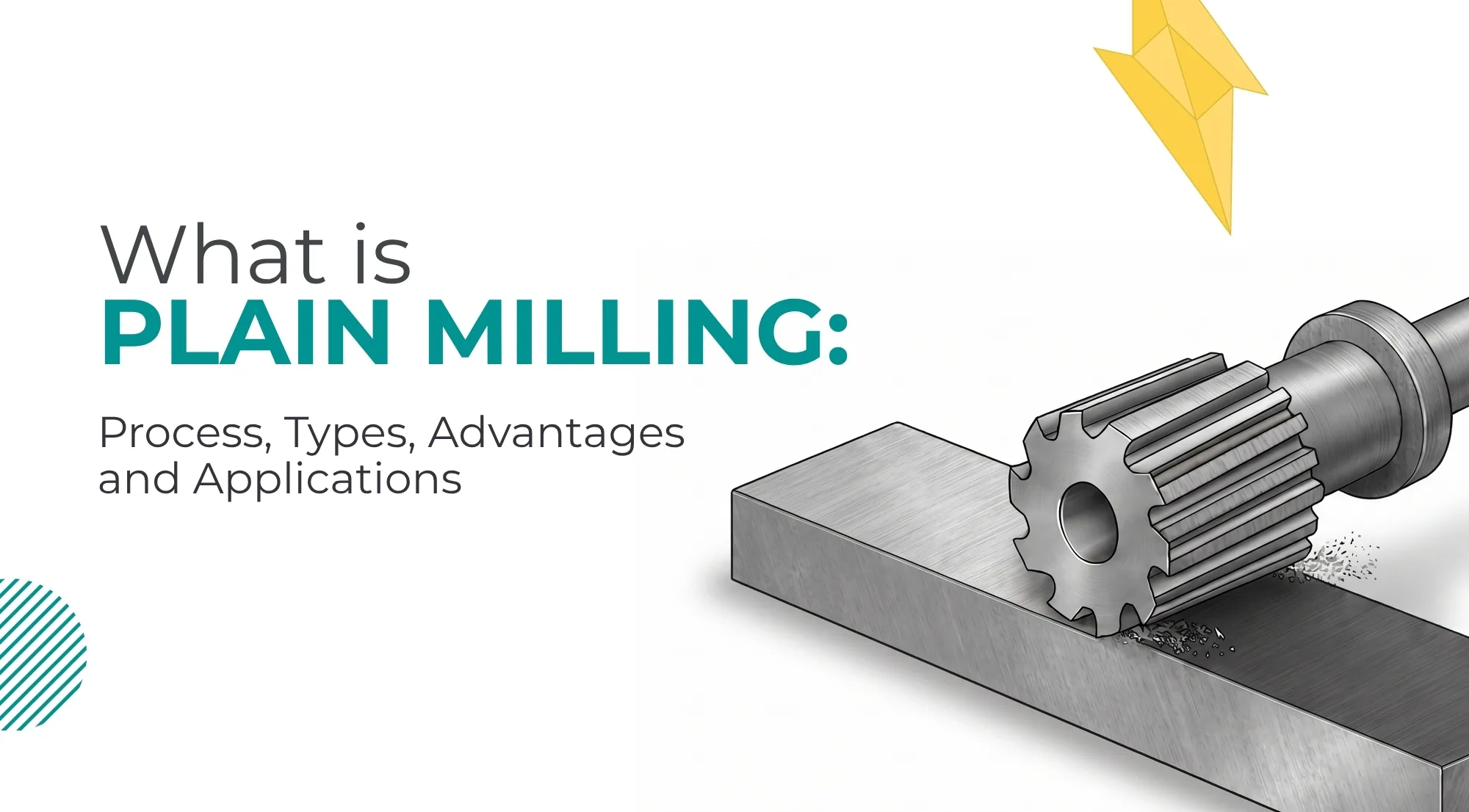
Plain milling is a machining operation used to produce flat horizontal surfaces by removing material from a workpiece using a rotating milling cutter. In this process, the cutter axis remains parallel to the machined surface.
Plain milling is also called slab milling because the cutting action is mainly performed by the peripheral teeth of the cutter. The process is commonly carried out on a plain milling machine or horizontal milling machine using a plain milling cutter mounted on an Arbor.
During the plain milling process, the cutter rotates continuously while the workpiece moves against it, gradually removing material to achieve the desired shape and surface finish. Compared to other milling operations like face milling or end milling, plain milling is mainly used for machining large flat surfaces with high accuracy and efficiency.
Key Features of Plain Milling
- Produces flat horizontal surfaces
- Uses a horizontal milling machine
- Suitable for large surface machining
- Provides good dimensional accuracy
- Offers smooth surface finish
- Commonly used in mass production
Industries such as automotive, aerospace, heavy machinery and tool manufacturing widely use plain milling for precision machining applications.
Purpose of Plain Milling
The primary objectives of plain milling include:
- Creating flat horizontal surfaces
- Improving surface finish
- Achieving dimensional accuracy
- Removing excess material efficiently
Understanding the Plain Milling Process
The plain milling process involves the controlled removal of material using a rotating cutter and a moving workpiece. The cutter rotates at high speed while the workpiece is fed slowly against the cutter teeth.
The machining process depends on factors such as cutter type, workpiece material, feed rate, cutting speed and depth of cut.
Step-by-Step Plain Milling Process
-
Workpiece Setup and Clamping
Proper workpiece setup on the plain milling machine is important to maintain machining accuracy and surface quality. Clamps, Vises or fixtures are used to hold the material firmly in place to prevent movement or vibration during machining. Proper clamping is important because even small movements can affect surface finish, dimensional accuracy and overall machining quality.
-
Selection of Milling Cutter
After securing the workpiece, a suitable plain milling cutter is selected based on factors such as workpiece material, required surface finish, cutting depth and machining speed. Different cutter materials such as high-speed steel (HSS) or carbide are chosen depending on the application. The correct cutter selection helps improve machining efficiency, surface quality and tool life.
-
Setting Spindle Speed and Feed Rate
Before starting the machining operation, important cutting parameters including spindle speed, feed rate and depth of cut are adjusted. These settings depend on the material being machined and the desired machining performance. Proper parameter settings help achieve smooth cutting, reduce tool wear and improve productivity during the milling process.
-
Cutter Rotation and Material Removal
Once the machine is set up, the milling cutter begins rotating at high speed while the workpiece moves gradually against it. The rotating cutter teeth continuously remove material layer by layer from the workpiece surface. During this process, coolant may also be used to reduce heat generation, improve cutting performance and extend tool life.
-
Surface Finishing and Inspection
After the required amount of material is removed, the machined surface is inspected for dimensional accuracy, surface finish and overall quality. Measuring tools such as callipers, micrometres or surface testers may be used for inspection. If needed, additional finishing operations are performed to achieve the desired final specifications.
Key Parameters in the Milling Process
Several machining parameters directly affect the performance, efficiency and surface quality of the plain milling process. Proper adjustment of these parameters helps achieve better machining accuracy, smoother surface finish and longer tool life.
-
Cutting Speed
Cutting speed refers to the rotational speed of the milling cutter during machining. Higher cutting speeds can improve productivity and reduce machining time, but excessive speed may generate more heat and increase tool wear. The ideal cutting speed depends on the cutter material and the type of workpiece being machined.
-
Feed Rate
Feed rate is the speed at which the workpiece moves against the rotating cutter. A proper feed rate helps maintain smooth cutting and consistent material removal. Very high feed rates may reduce surface finish quality, while extremely low feed rates can decrease machining efficiency.
-
Depth of Cut
Depth of cut indicates how much material is removed in a single pass of the cutter. A larger depth of cut increases the material removal rate but also places higher load on the machine and cutting tool. Proper depth selection helps balance productivity and machining stability.
-
Tool Material
The material of the milling cutter plays an important role in machining performance and tool durability. High-speed steel (HSS) cutters are cost-effective and suitable for general machining, while carbide cutters offer higher cutting speeds, better wear resistance and improved performance in demanding applications.
-
Machine Rigidity
Machine rigidity refers to the stability and strength of the plain milling machine setup during operation. A rigid setup minimizes vibration, improves dimensional accuracy and helps achieve better surface finish. Poor machine rigidity can lead to chatter, uneven cutting and reduced machining quality.
Types of Cutters Used in Plain Milling
-
Helical Tooth Cutters
Helical tooth cutters are designed with teeth positioned at an angle around the cutter body. This angular arrangement allows the cutter teeth to engage with the workpiece gradually rather than making sudden contact. As a result, the cutting action becomes smoother and more continuous.
These cutters help:
- Reduce vibration and chatter during machining
- Improve surface finish quality
- Lower cutting impact and noise
- Enhance machining stability at higher speeds
Helical tooth cutters are widely used in the plain milling process where smooth operation and consistent material removal are important.
-
Straight Tooth Cutters
Straight tooth cutters have teeth aligned parallel to the cutter axis. These cutters provide a simple cutting action and are commonly used for light-duty or general-purpose milling operations.
Their simple design makes them suitable for:
- Low-speed machining operations
- Basic flat surface machining
- Applications involving lower cutting loads
- Easy maintenance and lower manufacturing cost
However, straight tooth cutters may generate more vibration compared to helical cutters because the entire tooth engages the material simultaneously during cutting.
-
High-Speed Steel (HSS) Cutters
High-speed steel cutters are manufactured from alloy steel materials capable of maintaining hardness even at elevated temperatures generated during machining. HSS cutters are known for their toughness, durability and cost-effectiveness.
These cutters offer:
- Good resistance to wear and impact
- Reliable performance in general machining operations
- Easy regrinding and reshaping
- Better toughness compared to brittle cutting materials
HSS cutters are commonly used in conventional plain milling applications where moderate cutting speeds and versatility are required.
-
Carbide Milling Cutters
Carbide milling cutters are made using tungsten carbide materials that provide extremely high hardness and wear resistance. These cutters can operate at much higher cutting speeds than HSS cutters while maintaining cutting efficiency.
Key advantages of carbide milling cutters include:
- Higher cutting speed capability
- Excellent wear resistance
- Longer tool life
- Improved machining productivity
- Better performance in hard materials
Carbide cutters are preferred in high-production milling process applications where precision, efficiency and long operational life are critical.
Types of Plain Milling Operations
Different types of plain milling operations are used based on machining requirements, material type and production needs. Each type offers unique features and industrial applications.
-
Conventional Milling
In conventional plain milling, the cutter rotates opposite to the feed direction of the workpiece. The cutter teeth gradually engage with the material, making the process suitable for stable and controlled machining operations.
Features
- Better control during rough machining
- Reduced backlash problems
- Suitable for older milling machines
- Stable cutting operation
Applications
- General machining operations
- Rough surface machining
- Heavy material removal
- Basic industrial manufacturing
-
Climb Milling
In climb milling, the cutter rotates in the same direction as the feed movement of the workpiece. This operation provides smoother cutting and improved surface quality.
Features
- Better surface finish
- Lower cutting force
- Reduced tool wear
- Higher machining efficiency
Applications
- Precision surface machining
- CNC milling operations
- Finishing applications
- High-accuracy component manufacturing
-
Heavy-Duty Milling
Heavy-duty plain milling is used for machining large and heavy workpieces where high material removal rates are required.
Features
- High material removal capability
- Suitable for large workpieces
- Strong and rigid machine setup
- Efficient for heavy machining operations
Applications
- Large steel components
- Heavy machine bases
- Industrial structural parts
- Heavy fabrication industries
-
Precision Milling
Precision plain milling is performed when superior dimensional accuracy and surface finish are required for critical applications.
Features
- High dimensional accuracy
- Excellent surface finish
- Minimal machining error
- Suitable for precision engineering
Applications
- Aerospace components
- Precision engineering parts
- Tool and die manufacturing
- High-accuracy industrial components
Advantages of Plain Milling
Plain milling offers several advantages that make it one of the most widely used machining operations in manufacturing industries.
- High Machining Efficiency: Plain milling allows rapid material removal from large workpiece surfaces, making the process highly efficient for industrial production.
- Excellent Surface Finish: With proper cutter selection and optimized machining parameters, plain milling produces smooth and consistent surface finishes.
- Suitable for Large Flat Surfaces: The process is highly effective for machining wide horizontal surfaces with good accuracy and uniformity.
- Better Dimensional Accuracy: Plain milling provides precise dimensions and helps maintain tight machining tolerances during production.
- Cost-Effective for Mass Production: Due to its high productivity and faster machining capability, plain milling helps reduce overall manufacturing costs in large-scale production.
- Versatile Machining Operation: Plain milling can be used for machining different industrial components and various engineering materials efficiently.
- Compatibility with Different Materials: The process is suitable for machining materials such as steel, aluminium, cast iron, brass and other engineering metals.
Limitations of Plain Milling
Despite its advantages, plain milling also has certain limitations depending on the machining requirement.
- Limited to Flat Surfaces: Plain milling is mainly designed for machining flat horizontal surfaces and is less effective for complex shapes.
- Tool Wear at High Cutting Speeds: Excessive cutting speeds can increase heat generation and lead to faster cutter wear.
- Requires Rigid Setup: A stable and rigid machine setup is necessary to minimize vibration and maintain machining accuracy.
- Less Suitable for Complex Geometries: Complex profiles, contours and intricate designs generally require other milling operations such as end milling or CNC contour milling.
Applications of Plain Milling
Plain milling is widely used across various manufacturing industries for producing flat surfaces, improving dimensional accuracy and achieving better surface finish.
-
Automotive Industry
In the automotive sector, plain milling is used for machining precision engine and transmission components that require accurate flat surfaces and consistent dimensions.
Applications
- Engine blocks
- Transmission housings
- Gearbox components
- Mounting surfaces
-
Aerospace Industry
The aerospace industry uses plain milling for manufacturing lightweight and high-precision components with strict dimensional requirements.
Applications
- Structural aircraft components
- Precision flat surfaces
- Lightweight metal parts
- Aerospace assembly components
-
Industrial Machinery
Plain milling is commonly used in industrial machinery manufacturing for machining large and heavy machine components.
Applications
- Machine bases
- Equipment frames
- Heavy structural components
- Industrial support structures
-
Tool and Die Manufacturing
Tool and die manufacturers use plain milling to achieve smooth surfaces and precise dimensions for tooling applications.
Applications
- Surface preparation
- Precision tool machining
- Die component manufacturing
- Mold base machining
-
General Metal Fabrication
In metal fabrication industries, plain milling helps prepare and finish metal parts for further processing and assembly.
Applications
- Flat plate machining
- Surface finishing
- Metal component preparation
- Fabricated part machining
Factors Affecting Plain Milling Performance
- Machine Stability
- Cutter Material
- Workpiece Material
- Feed and Speed Settings
- Coolant Usage
- Tool Geometry
How Schilthorn Supports Precision Manufacturing
At Schilthorn Precision Engineering, we help manufacturers achieve accurate, efficient and reliable machining solutions for a wide range of industrial applications. With 18+ years of engineering expertise. Our team delivers high-quality machined components for automotive, aerospace, HVAC, industrial and engineering sectors.
Why Businesses Choose Schilthorn
- 18+ Years of Precision Engineering Experience
- Expertise in CNC Milling & Machining Solutions
- ISO 9001 & AS9100 Certified Manufacturing Standards
- High Accuracy, Surface Finish & Dimensional Consistency
- Advanced CNC Machining & Precision Engineering Capabilities
- Scalable Production Support for Industrial Applications
Ready to improve your machining efficiency and component precision? Partner with Schilthorn Precision Engineering for reliable milling and precision manufacturing solutions tailored to your production goals.
FAQ’s
-
What is plain milling used for?
Plain milling is mainly used for machining flat horizontal surfaces on metal workpieces. It is commonly used for surface finishing, material removal and achieving accurate dimensions in manufacturing operations.
-
What is the difference between plain milling and face milling?
In plain milling, the cutter axis remains parallel to the workpiece surface and cutting is mainly done by the peripheral teeth of the cutter. In face milling, the cutter axis is perpendicular to the workpiece surface and cutting is performed mainly by the face of the cutter.
-
Why is plain milling also called slab milling?
Plain milling is also known as slab milling because it uses a slab-type milling cutter to machine large flat surfaces on a horizontal milling machine.
-
Which cutter is used in plain milling?
Plain milling commonly uses helical tooth cutters, straight tooth cutters, high-speed steel (HSS) cutters and carbide cutters depending on the machining requirement.
-
Is plain milling suitable for CNC machines?
Yes, plain milling is widely used in CNC milling machines because CNC systems provide better accuracy, consistency and machining efficiency for precision manufacturing.
-
What factors affect milling surface finish?
Several factors affect milling surface finish, including cutting speed, feed rate, depth of cut, cutter material, machine rigidity, coolant usage and tool geometry.