
Baffle Plates in Heat Exchangers
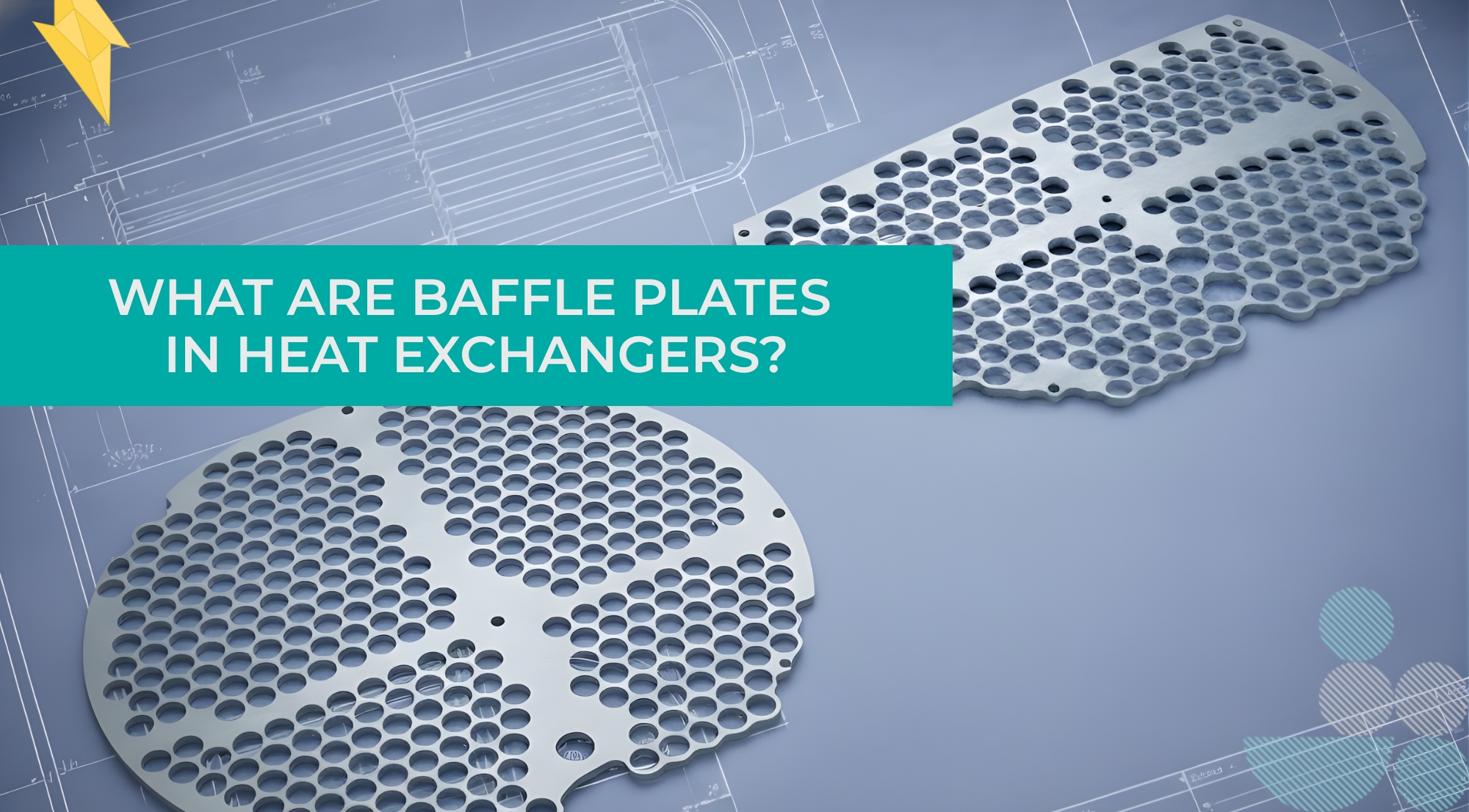


In shell-and-tube heat exchangers, overall performance is not governed by tubes alone. A significant part of heat exchanger efficiency, shell-side pressure drops and mechanical reliability depends on how the shell-side fluid is guided through the exchanger. This flow control is achieved using baffle plates.
Baffle plates for heat exchangers are rigid internal plates installed on the shell side of shell-and-tube heat exchangers to direct shell-side fluid flow and to mechanically support the tube bundle. While baffle plates are not heat-transfer surfaces themselves, they are essential heat exchanger components that strongly influence heat transfer performance, pressure loss, and tube vibration control.
In the absence of baffle plates, shell-side fluid tends to flow along the shortest and least resistant path through the shell, bypassing a large portion of the tube surface. This results in poor heat transfer, uneven temperature distribution, and increased risk of tube vibration and mechanical damage. By forcing the shell-side fluid to repeatedly flow across the tube bundle, baffle plates improve turbulence, increase effective heat transfer, and ensure stable exchanger operation.
From a functional perspective, a baffle plate performs three critical roles within a shell-and-tube heat exchanger. First, it redirects shell-side fluid across the tubes instead of allowing straight-through axial flow. Second, it provides structural support to the tubes, reducing unsupported span and limiting flow-induced vibration. Third, it controls shell-side pressure drop, ensuring that the available pressure is effectively converted into useful heat transfer rather than being lost as bypass flow.
Because baffle plates directly influence both fluid flow behaviour and mechanical loading, their geometry, layout, and dimensional accuracy are critical to the long-term performance, reliability and service life of shell-and-tube heat exchangers.
Types of Baffle Plates in Heat Exchangers
Baffle plates in shell-and-tube heat exchangers are fundamentally classified based on their orientation to the shell axis and the resulting shell-side flow pattern. From an engineering standpoint, all baffle configurations fall into three main categories: transverse baffles, longitudinal baffles, and hybrid baffle systems. Each category serves a distinct hydraulic and mechanical purpose.
1. Transverse Baffle Plates:
Transverse baffle plates are installed perpendicular to the shell axis. Their primary function is to force shell-side fluid to flow across the tube bundle, creating crossflow that enhances heat transfer while simultaneously supporting the tubes. These are the most widely used baffle plates in shell-and-tube heat exchangers.
Segmental Baffle Plates (TEMA Segmental Baffles):
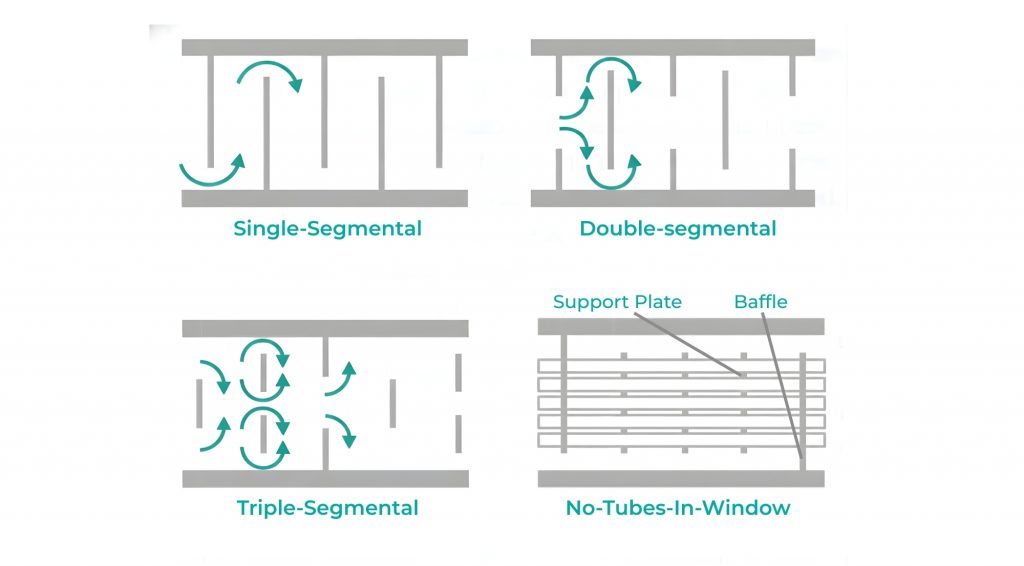
Segmental baffles are commonly referred to as TEMA segmental baffles are circular plates with a segment removed to form a flow window. This geometry forces shell-side fluid into a zig-zag path across the tube bundle. Depending on how the window is arranged, segmental baffles are further classified as:
- Single-segmental baffles: Produce strong crossflow and high heat-transfer rates, with higher shell side pressure drop.
- Double-segmental baffles: Divide shell-side flow into two parallel paths, reducing pressure drop while maintaining reasonable crossflow.
- Triple-segmental baffles: Further split flow into multiple paths, reducing pressure drop with lower heat-transfer intensity.
- No-Tubes-in-Window (NTIW) baffles: Also known as tube support plates, which exclude tubes from the window region to improve tube support and reduce vibration, especially in high-velocity or gas services.
Segmental baffles are preferred where high thermal performance and robust tube support are required.
Disc-and-Doughnut Baffle Plates:
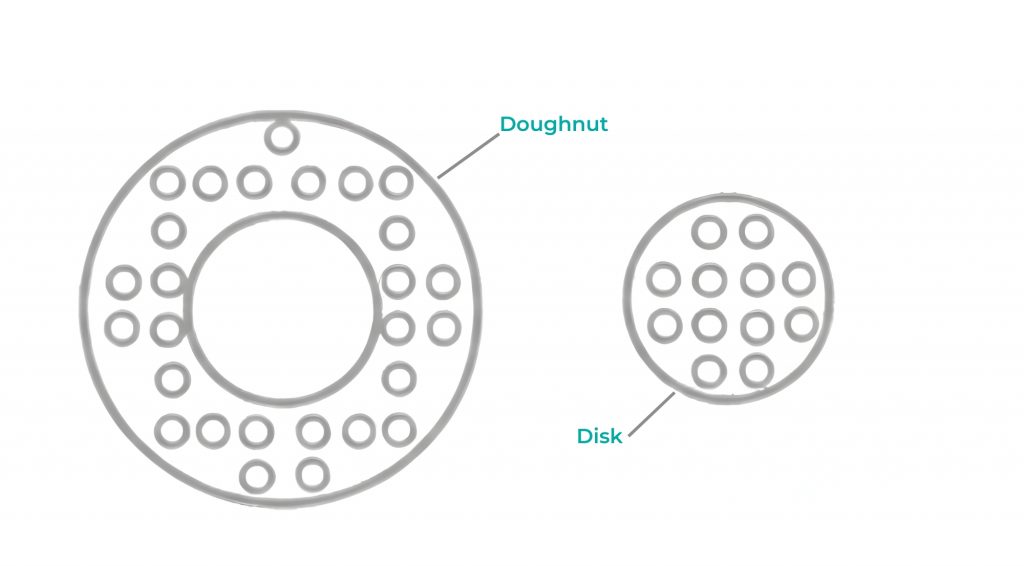
Disc-and-doughnut baffles are another form of transverse baffle system. They consist of alternating solid discs and annular rings (doughnuts) arranged along the shell length. This configuration causes shell-side fluid to expand radially around the disc and then contract through the doughnut opening, resulting in:
- More uniform radial flow distribution.
- Reduced bypass flow near the shell wall.
- Improved vibration control.
Disk-and-donut baffles are commonly used in gas and vapor heat exchangers, where uniform flow and mechanical stability are critical.
2. Longitudinal Baffle Plates:
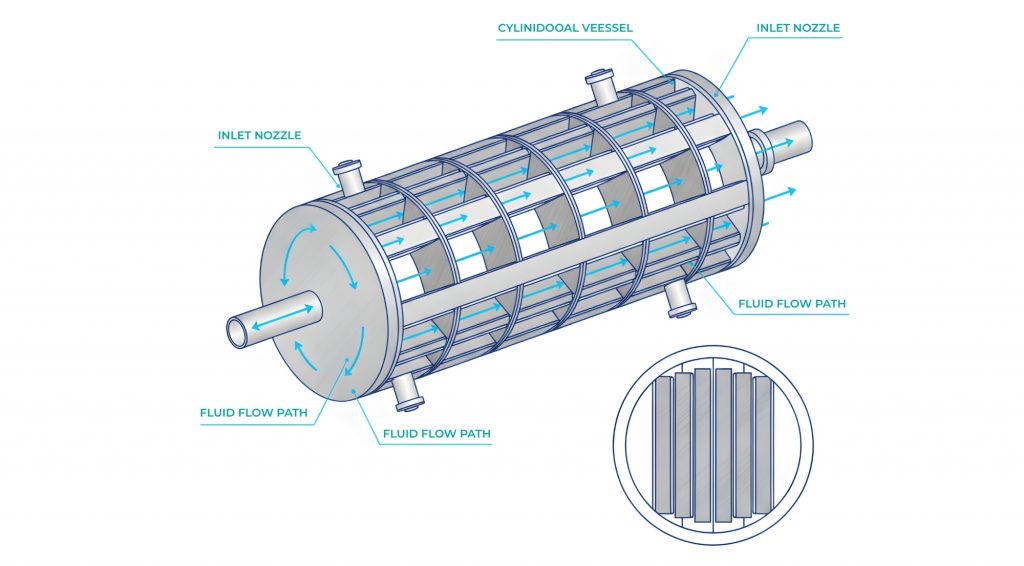
Longitudinal baffle plates are installed parallel to the shell axis. Instead of forcing repeated crossflow, they divide the shell-side fluid into separate longitudinal flow paths, creating multi-pass shell-side flow.
These baffles split the shell into two or more flow channels, forcing the shell-side fluid to make multiple passes along the length of the exchanger. This arrangement is primarily used to control shell-side pressure drop and to manage temperature profiles in specific exchanger layouts.
Longitudinal baffles are commonly used in multi-pass shell configurations, such as TEMA F, G or H shells, where shell-side flow direction and residence time must be carefully controlled. Typical characteristics of longitudinal baffle systems include:
- Lower crossflow heat-transfer intensity compared to transverse baffles.
- Reduced pressure drops per shell-side pass.
- Improved control of shell-side residence time and temperature distribution.
3. Hybrid and Combined Baffle Systems:
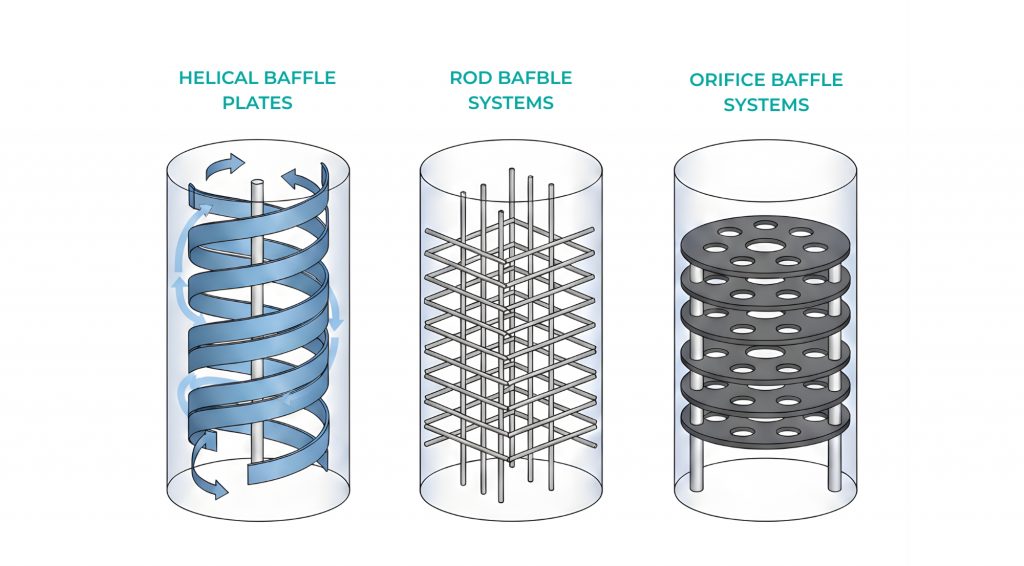
Hybrid baffle systems combine elements of both transverse and longitudinal flow control to balance heat-transfer performance, pressure drop, and tube vibration resistance. These systems are typically selected for specialized or demanding operating conditions.
Helical Baffle Plates: Helical baffles or inclined baffles are inclined plates arranged to create a continuous spiral flow path along the shell. While not purely transverse, they promote crossflow without the sharp flow direction changes associated with segmental baffles. Helical baffle systems provide:
- Continuous swirling shell-side flow.
- Lower pressure drop compared to segmental baffles.
- Reduced stagnant zones and fouling potential.
- Continuous tube support along the exchanger length.
Helical baffles are widely used in viscous, fouling, and vibration-sensitive services.
Rod Baffle Systems: Rod baffles also known as Grid Baffles replace solid plates with metal rods arranged in a grid pattern. These systems primarily promote longitudinal flow while still providing periodic tube support. Rod baffle systems are characterized by:
- Very low shell-side pressure drop.
- Excellent tube vibration suppression.
- Predominantly longitudinal flow with localized turbulence.
They are commonly used in long-tube heat exchangers and applications where vibration control is more critical than maximum heat-transfer rate.
Orifice Baffle Systems: Orifice baffles use closely controlled clearances between the tube outside diameter and the baffle hole diameter to guide shell-side fluid flow. Although often grouped separately, orifice baffles function as hybrid systems because they provide tube support while allowing mostly axial flow with limited crossflow. Orifice baffles are typically selected when:
- Shell-side pressure drop is severely limited.
- Moderate heat-transfer performance is acceptable.
Baffle Cut and Its Influence on Performance: While baffle type defines the overall flow mechanism, baffle cut determines how effectively shell-side fluid is distributed across the tube bundle. Baffle cut is defined as the percentage of shell inside diameter not covered by the baffle plate. In most shell-and-tube heat exchangers, typical baffle cuts fall in the range of 20–25% of shell inside diameter.
- Smaller baffle cuts increase crossflow velocity and heat transfer but raise pressure drop.
- Larger baffle cuts reduce pressure drop but increase bypass flow and stagnant zones.
Instead of increasing baffle cut beyond acceptable limits, pressure drop is often managed using double-segmental baffles or multi-pass shell arrangements.
Types of Materials Used for Baffle Plates
Once baffle configuration is defined, material selection becomes critical to ensure durability and dimensional stability. Common materials used for baffle plates include:
- Carbon steel for general industrial service.
- Stainless steel (304, 316, 316L) for corrosive or clean environments.
- Alloy steels for high-temperature or high-pressure conditions.
- Duplex and super duplex stainless steels for chloride-rich services.
- Non-ferrous alloys for specialized chemical or marine applications.
Applications of Baffle Plates
Heat exchanger baffle plates are used in shell-and-tube heat exchangers across a wide range of industries, including:
- Chemical and petrochemical processing.
- Oil refineries and reboilers.
- Power generation heat exchangers.
- Gas coolers and heaters.
- Oil coolers and feedwater heaters.
- Heat recovery systems.
Baffle plates are fundamental internal components of shell-and-tube heat exchangers. By regulating shell-side flow and supporting the tube bundle, they directly influence heat-transfer efficiency, pressure drop, and mechanical stability.
Why Choose Schilthorn Precision for Your Baffle Plate Requirements?
Schilthorn Precision Engineering, a baffle plate manufacturer, machines baffle plates for shell-and-tube heat exchangers as build-to-print, load-bearing internal components rather than generic plates. Machining is performed as part of controlled baffle plate sourcing, strictly to customer drawings and ASME/TEMA requirements, using CNC and VMC processes to control tube-hole size and position, window geometry, plate flatness, and tie-rod alignment, which directly affect shell-side flow distribution and tube support. Materials include carbon steel, stainless steel, copper-nickel and selected alloys, with CMM-based inspection used to verify dimensional accuracy and baffle plate quality prior to bundle assembly, supporting stable mechanical behaviour and reliable long-term exchanger performance.