
Tube Sheets for Chillers and Condensers: Materials and Specification
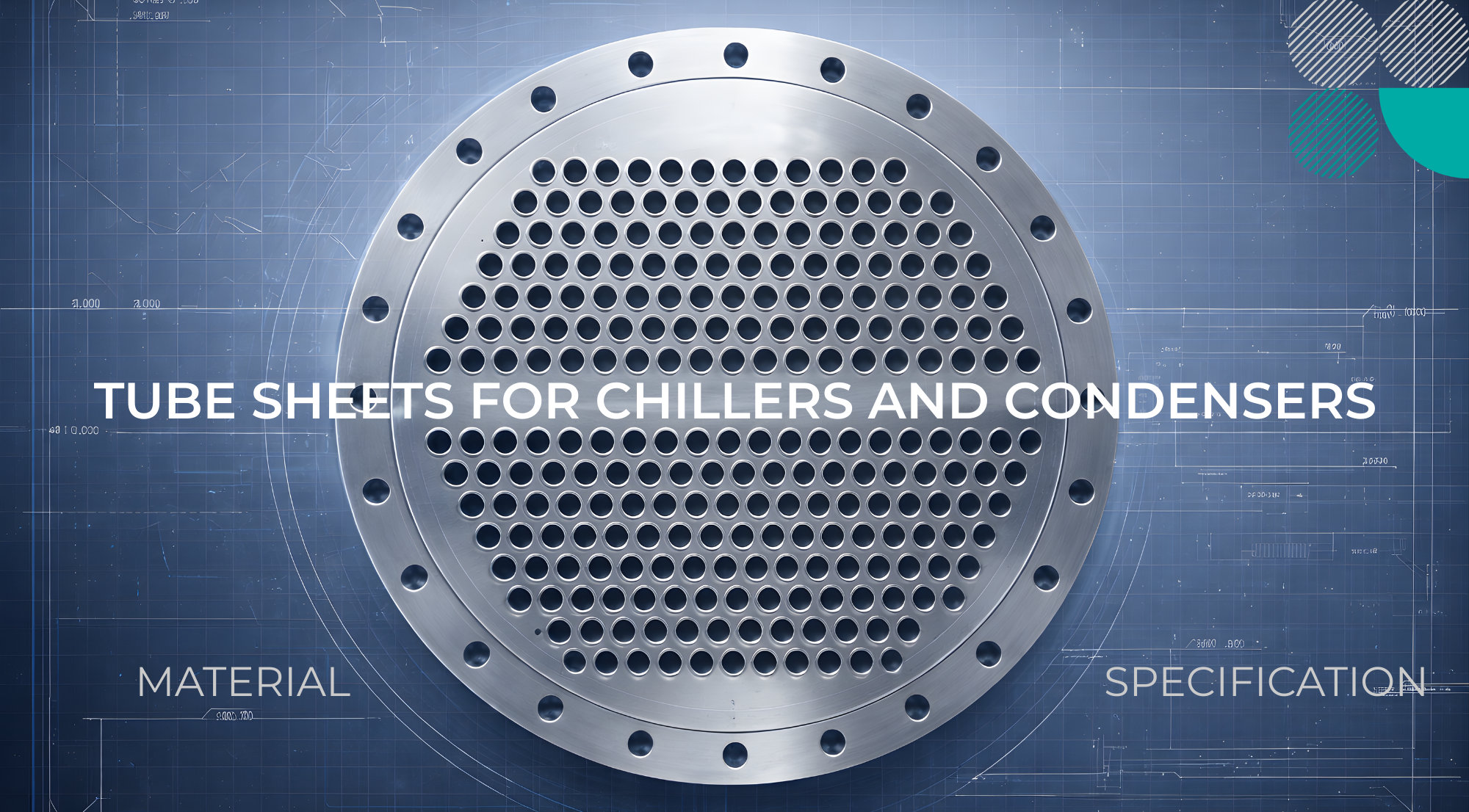


Tube sheets are machined components used in shell-and-tube chillers and condensers to position, retain and seal heat-exchange tubes. They form the interface between the tube bundle and the exchanger assembly and act as a pressure boundary between tube-side and shell-side fluids. Compared to covers or support plates, tube sheets are thick sections with high hole density and tightly controlled positional requirements.
In operation, tube sheets perform multiple functions simultaneously. They maintain tube alignment; support axial loads generated by pressure and flow and provide the surface required for tube expansion or rolling. Their geometry, material condition and machining accuracy influence joint integrity, leakage behaviour and vibration response during service. Tube sheets are typically supplied as individual machined parts, but their functional performance is realised only after tube expansion and under operating conditions. Dimensional instability, hole inaccuracies or surface inconsistencies at this stage commonly lead to leakage, tube loosening or reduced service life, even when tubes themselves meet specification.
Role of Tube Sheets in Chiller and Condenser Assemblies
In chiller and condenser assemblies, tube sheets perform multiple mechanical and sealing functions simultaneously:
- Support the tube bundle against axial loads generated by internal pressure.
- Provide the interface geometry for tube expansion or rolling.
- Maintain separation between two different process fluids.
- Resist distortion caused by thermal gradients and operating cycles.
Chillers generally operate within controlled temperature ranges but experience repeated start-stop cycles. Condensers often handle higher flow rates, fouling media, or corrosive cooling water. These service differences influence tube sheet thickness, material selection and machining approach.
Materials Used for Tube Sheets
Material selection for tube sheets is governed by service, operating pressure, temperature range, corrosion risk and tube-to-sheet joining method.
- Carbon Steel: Carbon steel tube sheets are used in non-corrosive services where cost control is critical. Proper corrosion allowance and surface protection are necessary. In condenser applications with untreated cooling water, corrosion can limit service life if not adequately addressed.
- Stainless Steel: Stainless steel tube sheets are specified where corrosion resistance and dimensional stability are required. Austenitic grades are common in chillers and clean-service condensers, while duplex and super-duplex grades are selected for higher strength and chloride resistance.
- Clad Tube Sheets: Clad tube sheets combine a carbon steel base with a corrosion-resistant overlay. This configuration balances structural strength and corrosion protection. Cladding integrity, bond quality and overlay thickness must be controlled during machining.
- Copper-Nickel and Special Alloys: Copper-nickel alloys are used in seawater or aggressive cooling water applications. Nickel-based alloys are selected for specialised chemical or high-temperature services. These materials require controlled machining parameters to maintain surface finish and dimensional accuracy.
Tube Sheet Specifications in Chiller and Condenser Applications
Although tube sheets in chillers and condensers may appear similar on drawings, their specification requirements differ in practice due to how these systems operate in service. Differences in temperature cycling, flow behaviour and cooling media directly influence how tube sheet dimensions, tolerances and surface conditions must be controlled during manufacturing.
Tube Sheet Specifications in Chillers
Tube sheets used in chillers are exposed to relatively controlled operating temperatures but frequent start and stop cycles. Over time, repeated thermal expansion and contraction place stress on the tube-to-tube sheet joint. In this service, dimensional stability and consistency across the full tube sheet surface are critical.
Typical specification focus areas include
- Thickness: Sufficient section thickness is required to minimise distortion during thermal cycling and to maintain flatness after machining and tube expansion.
- Hole diameter tolerance: Tight hole size control is necessary to achieve uniform tube expansion without excessive tube wall thinning.
- Hole positional accuracy: Consistent hole positioning ensures proper tube alignment and prevents localised stress during assembly and operation.
- Groove profile: Groove depth and profile must remain consistent across all holes to achieve repeatable tube pull-out resistance.
- Flatness: Flatness control is essential to maintain gasket sealing integrity throughout operating cycles.
- Surface finish: Uniform surface finish supports even tube seating and reduces the risk of fretting at the tube interface.
In chiller service, deviations in flatness or hole geometry typically lead to gradual leakage or loss of tube tightness rather than sudden failure.
Tube Sheet Specifications in Condensers
Condenser tube sheets operate under higher flow rates and are often exposed to fouling media or corrosive cooling water. Mechanical loading, erosion and long-term material degradation are more prominent concerns than thermal cycling alone.
Common specification focus areas include
- Thickness: Greater thickness is often required to maintain rigidity under hydraulic loads and to resist vibration induced by high flow velocities.
- Hole diameter tolerance: Hole sizing must remain consistent to ensure reliable tube expansion even as fouling or minor corrosion develops over time.
- Hole pitch and ligament width: Adequate ligament strength is required to resist vibration fatigue, erosion and long-term weakening of the tube sheet.
- Groove geometry: Deeper or multiple grooves are commonly used to improve tube retention in demanding flow conditions.
- Flatness: Flatness remains critical to ensure sealing performance under continuous pressure and flow.
- Surface finish: Controlled finishes reduce crevice formation, fouling build-up and corrosion initiation at the tube interface.
In condenser applications, inadequate thickness or weak ligament areas frequently result in tube loosening, leakage, or accelerated wear during service.
Tube sheet specifications for chillers and condensers must reflect operating behaviour, not just nominal dimensions. Tube sheets manufactured to generic tolerances without accounting for application-specific service conditions often become the limiting factor in heat exchanger reliability, even when tubes and other components are correctly specified.
How to Choose a Tube Sheet Supplier for Chillers and Condensers
Choosing a tube sheet supplier for chiller and condenser applications requires evaluation beyond drawing compliance or material grade confirmation. Tube sheets are high-risk components where supplier manufacturing discipline directly affects tube joint integrity, leakage performance and long-term service behaviour. The following factors should guide supplier selection.
- Material Control and Traceability: Select suppliers who can demonstrate full material traceability, including mill test certificates for base materials and documented cladding details where applicable. For clad tube sheets, cladding thickness verification, bond integrity checks, and overlay material grade confirmation are critical. Suppliers unable to provide controlled documentation often introduce corrosion-related failures during service.
- Capability to Machine High Hole Density Components: Tube sheets typically involve a large number of closely spaced holes with tight positional tolerances. Supplier selection should prioritise proven experience in drilling, grooving, and facing operations at this scale. Variations in hole position or groove geometry commonly surface only during tube expansion or hydrotesting, when corrective action is no longer possible.
- Control of Dimensional Stability: Dimensional stability should be a primary selection criterion. Choose suppliers with defined machining sequences, residual stress management practices, and appropriate fixturing methods. Tube sheets that meet drawing tolerances immediately after machining but distort during handling, tube expansion, or operation indicate inadequate process control.
- Inspection and Measurement Capability: Supplier selection should favour manufacturers with in-house inspection infrastructure capable of verifying hole diameter, positional accuracy, groove profile, flatness, and surface finish. Reliance on outsourced inspection often leads to inconsistent measurements, extended lead times, and accountability gaps during customer or third-party inspection.
- Documentation and Quality Records: Select suppliers who maintain consistent, revision-controlled documentation, including inspection reports and material certificates. Robust quality records support smoother assembly, audits, and maintenance activities, while poor documentation frequently results in rework, inspection delays or rejection.
Why Choose Schilthorn Precision for Your Tube Sheet Requirements?
Schilthorn Precision Engineering manufactures tube sheets for chiller and condenser applications with process controls aligned to high hole-density, tight-tolerance components rather than generic plate machining. Tube sheets are produced in accordance with ASME and TEMA requirements, using multi-axis CNC and VMC machining to maintain consistent hole diameter, positional accuracy within ±100 µm, controlled groove geometry, and surface finishes up to 0.8 Ra where required for reliable tube expansion and sealing. Material capability includes carbon steel, stainless steel, copper-nickel, and selected high-nickel alloys based on service conditions. Defined machining sequences, fixturing practices, and CMM-based inspection of hole size, position, flatness, and groove profile support dimensional stability prior to tube expansion and contribute to reduced leakage risk and stable long-term performance in operating chillers and condensers.